
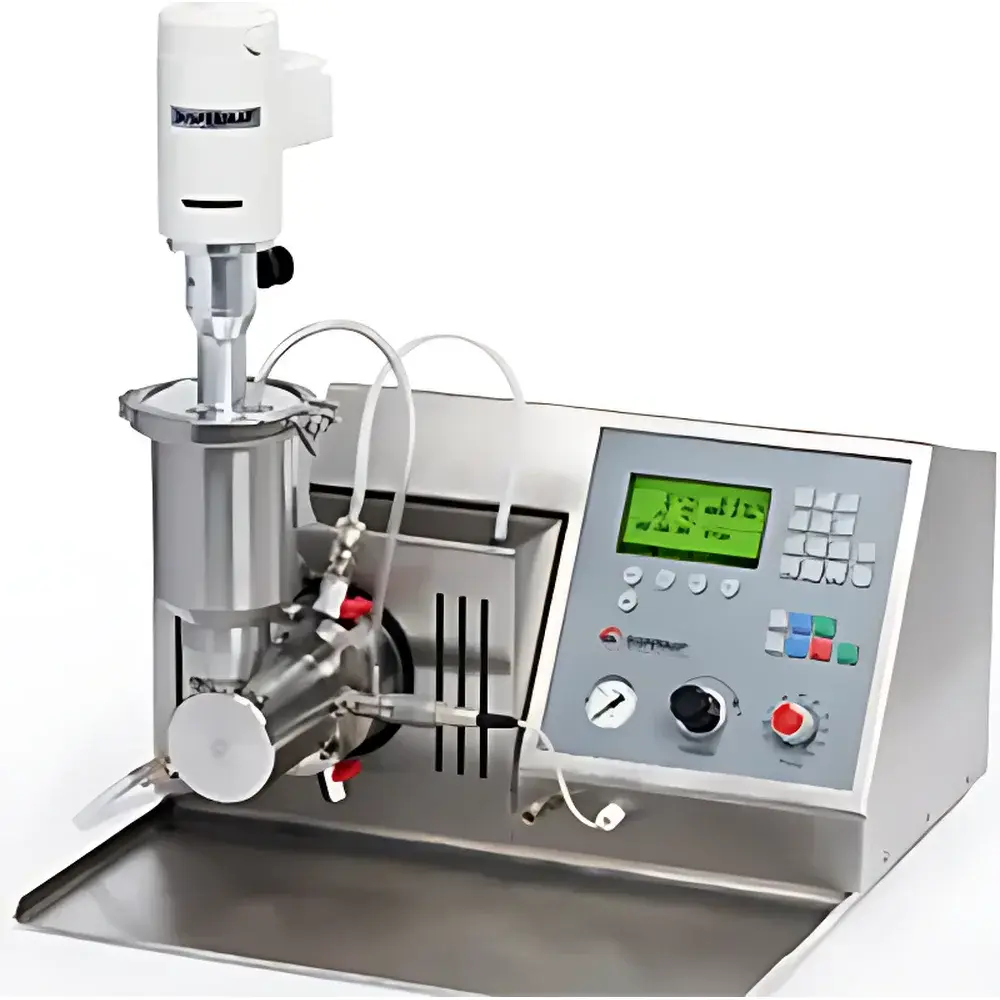
VMA DISPERMAT SL12 Laboratory Stirring and Dispersion System
| Brand | VMA |
|---|---|
| Origin | Germany |
| Model | SL12 |
| Power Rating | 1.1 kW |
| Speed Range | 0–6000 rpm |
| Grinding Chamber Volume | 0.25 L |
| Sample Volume Capacity | 0.15–0.75 L |
| Drive Technology | Stepless Electronic Speed Control with Digital RPM Display |
| Explosion Protection | ATEX-certified (C-Ex / M-Ex variants available) |
| Construction Materials | Stainless Steel, Tungsten Carbide, or Ceramic Options |
| Operating Parameters Monitored | Rotational Speed, Torque, Material Temperature, Input Power, Processing Time |
| Data Logging | Full parameter recording with timestamped export via USB/RS232 interface |
| Preset Programs | Up to 10 user-defined protocols with configurable torque, temperature, speed, and power limits |
| Lift Mechanism | Motorized vertical adjustment |
Overview
The VMA DISPERMAT SL12 is a high-performance laboratory-scale stirring and dispersion system engineered for reproducible, scalable processing of complex dispersions across R&D, quality control, and pilot production environments. Based on the proven Couette shear principle, the SL12 delivers controlled mechanical energy input through a precision-machined rotor-stator geometry, enabling efficient deagglomeration, wetting, and homogenization of both low- and high-viscosity systems—including pastes, slurries, suspensions, and highly filled formulations. Its modular design supports integration into closed-loop circulation setups, making it suitable for applications requiring continuous throughput simulation or multi-stage dispersion protocols. As part of VMA’s DISPERMAT platform—developed in Germany with over four decades of dispersion engineering heritage—the SL12 bridges the gap between benchtop development and industrial-scale manufacturing by maintaining identical shear profiles and energy density across scale-up transitions.
Key Features
- Stepless electronic speed control (0–6000 rpm) with real-time digital RPM readout and ±0.5% speed stability under load
- Motorized vertical lift mechanism enabling precise gap adjustment between rotor and stator, critical for consistent shear rate application
- ATEX-compliant variants (C-Ex and M-Ex) certified for use in Zone 1/21 hazardous areas per Directive 2014/34/EU
- Multi-parameter monitoring interface displaying rotational speed, torque (N·cm), material temperature (°C), input power (W), and elapsed time
- Configurable safety thresholds for torque overload, temperature excursion, and power deviation—automatically triggering process halt and alert logging
- Corrosion- and wear-resistant wetted parts available in stainless steel (1.4404/316L), tungsten carbide, or technical ceramics to accommodate aggressive solvents or abrasive fillers
- Integrated circulation pump option supporting closed-loop recirculation at flow rates up to 15 L/min, enhancing particle size distribution uniformity
Sample Compatibility & Compliance
The SL12 accommodates sample volumes from 150 mL to 750 mL within its 0.25 L grinding chamber, supporting Newtonian and non-Newtonian fluids with viscosities ranging from 50,000 mPa·s (measured at 25°C). It is routinely employed for pigment dispersion in coatings, carbon black stabilization in battery slurries, nanoparticle suspension in pharmaceutical nanosuspensions, and ceramic slurry homogenization. The system complies with ISO 8502-9 (surface cleanliness), ASTM D1210 (Hegman grind gauge correlation), and EU GMP Annex 15 requirements for equipment qualification. All firmware and data handling modules support audit trail functionality aligned with FDA 21 CFR Part 11 and EU Annex 11 expectations for electronic records and signatures.
Software & Data Management
The embedded control unit logs all operational parameters—including speed ramp profiles, torque transients, thermal drift, and power consumption—at user-selectable intervals (100 ms to 5 s resolution). Data exports as CSV files via USB or RS232 for post-processing in MATLAB, Python, or LIMS platforms. Ten programmable dispersion protocols can be stored locally, each defining target speed ramps, hold times, torque ceilings, and thermal abort conditions. Optional PC-based software (DISPERMATIC® Suite) enables remote operation, batch comparison analytics, and automated report generation compliant with ISO/IEC 17025 documentation standards.
Applications
- Development and optimization of pigment dispersions for automotive OEM coatings and architectural paints
- Rheological conditioning of cathode/anode slurries prior to electrode coating in lithium-ion battery manufacturing
- Stabilization of metal oxide nanoparticles (e.g., TiO₂, SiO₂) in cosmetic emulsions and sunscreen formulations
- Homogenization of ceramic and refractory suspensions for additive manufacturing feedstocks
- QC testing of dispersion stability in adhesives, sealants, and construction mortars per EN 13892-4
- Scale-down validation of industrial disperser performance using energy input equivalence modeling (kW·h/kg)
FAQ
What is the maximum viscosity the SL12 can process effectively?
The SL12 maintains stable operation up to approximately 50,000 mPa·s at reduced speeds (≤1500 rpm) when equipped with high-torque configuration and appropriate rotor-stator geometry.
Can the SL12 be integrated into an automated lab workflow?
Yes—via optional analog/digital I/O ports and Modbus RTU protocol support, enabling synchronization with PLC-controlled feeding systems, temperature jackets, or inline particle analyzers.
Is calibration traceable to national standards?
Torque and temperature sensors are factory-calibrated with NIST-traceable references; full IQ/OQ documentation packages are available upon request.
How does the SL12 ensure repeatability across operators?
Through enforced protocol execution—user access to manual speed override is disabled during active programs, and all parameter changes are logged with operator ID and timestamp.
What maintenance intervals are recommended for long-term reliability?
Bearing inspection and lubrication every 1,000 operating hours; stator/rotor wear assessment recommended after 500 cycles with abrasive media or corrosive solvents.



