
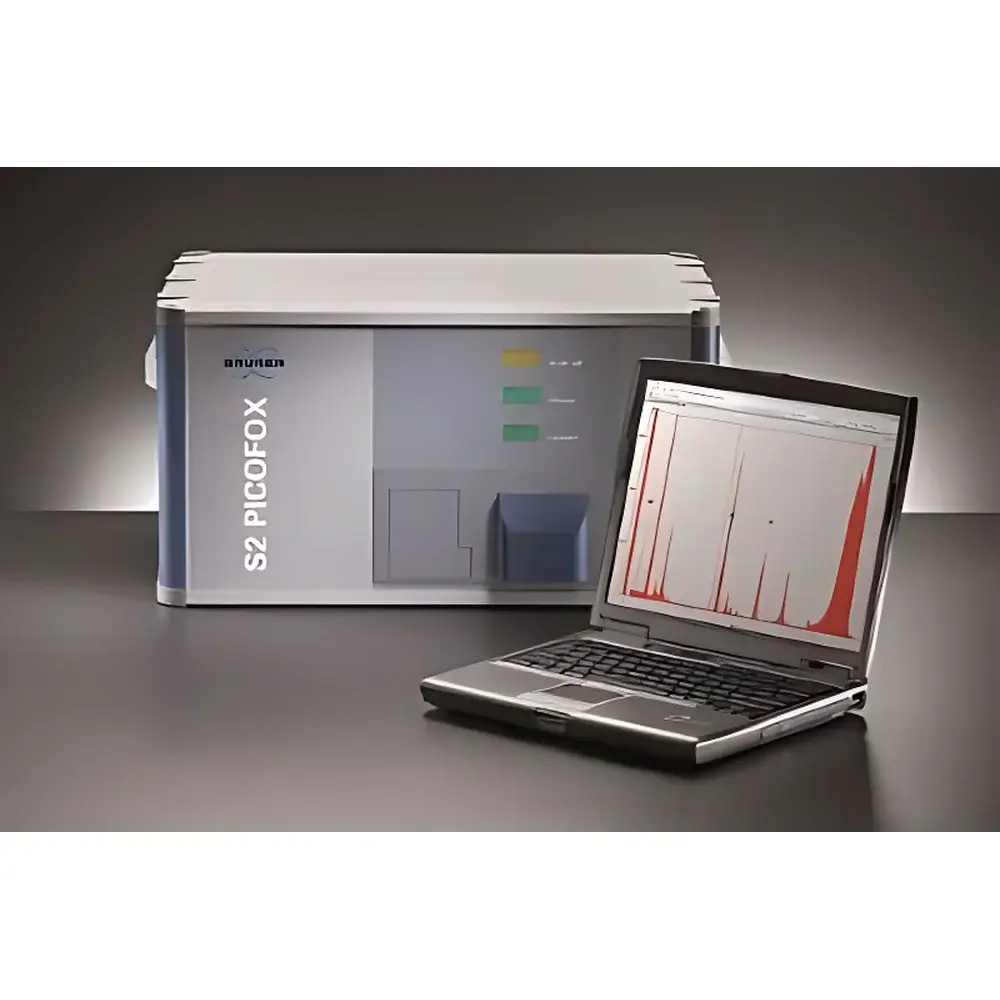
Bruker S2 PICOFOX1 Total Reflection X-Ray Fluorescence (TXRF) Spectrometer
| Brand | Bruker |
|---|---|
| Origin | Germany |
| Instrument Type | Benchtop Laboratory Analyzer |
| Detection Principle | Total Reflection X-Ray Fluorescence (TXRF) |
| Elemental Range | Al (13) to U (92) |
| Detection Limit | 2 pg |
| Sample Volume (Liquid) | 1–50 µL |
| Sample Mass (Solid/Powder) | ≤10 µg |
| Analysis Time | ≤20 min per sample |
| Accuracy | ≤±10% for aqueous matrices |
| Resolution | <160 eV at Mn Kα (100 kcps) |
| Detector | 4th-generation XFlash® Silicon Drift Detector (SDD), Peltier-cooled |
| Calibration | Factory-predefined quantitative calibration curves, matrix-independent quantification enabled by TXRF physics |
Overview
The Bruker S2 PICOFOX1 is a benchtop total reflection X-ray fluorescence (TXRF) spectrometer engineered for ultra-trace elemental analysis of environmental, clinical, and industrial samples. Unlike conventional energy-dispersive XRF (ED-XRF) or wavelength-dispersive XRF (WD-XRF), the S2 PICOFOX1 utilizes a monochromatic, grazing-incidence X-ray beam—generated by Mo or W anode excitation and focused via Ni/C multilayer optics—to induce fluorescence under total external reflection conditions (incident angle: 0.3°–0.6°). This optical configuration minimizes background scatter from both substrate and sample matrix, resulting in exceptional signal-to-noise ratios and inherently low detection limits down to 2 pg per element. The instrument operates on first-principles quantification: because TXRF eliminates absorption and matrix attenuation effects, fluorescence intensity scales linearly with elemental mass deposited on the reflector, enabling accurate, calibration-free quantification when combined with internal standardization or factory-established response functions.
Key Features
- Monochromatic TXRF excitation using Mo/W anode and Ni/C multilayer optics for minimized spectral interference and enhanced elemental specificity
- Fourth-generation XFlash® silicon drift detector (SDD) with Peltier cooling—no liquid nitrogen or consumables required; energy resolution <160 eV at Mn Kα (100 kcps)
- Benchtop form factor with integrated vacuum chamber and automated alignment—no external gas supply, cryogens, or auxiliary instrumentation needed
- Two optional autosampler configurations: 1-position manual stage for rapid single-sample screening or 25-position robotic carousel for high-throughput laboratory workflows
- Quantitative analysis without user-provided standards: factory-calibrated sensitivity factors cover the full elemental range from Al (Z=13) to U (Z=92), validated against NIST SRMs and ISO 17294-2 reference materials
- Minimal sample consumption: 1–50 µL of aqueous or suspended samples; ≤10 µg of solid powders—including soils, sediments, filters, and biological tissues
Sample Compatibility & Compliance
The S2 PICOFOX1 accepts diverse sample forms without digestion in most cases: liquids (water, wastewater, urine, serum), dried residues (air filters, evaporated extracts), powders (soils, sludges, catalysts), thin films, and suspended particulates. Sample preparation is simplified—liquid aliquots are dispensed directly onto quartz or acrylic reflectors using calibrated pipettes and dried under ambient or controlled conditions. Solid samples may be applied as-is or suspended in volatile solvents (e.g., methanol) prior to deposition. The system complies with key regulatory frameworks governing trace metal analysis, including EPA Method 200.8 (for metals in drinking water), ISO 17294-2 (water quality — inductively coupled plasma mass spectrometry), and ASTM D5673 (trace elements in water by TXRF). Its audit-ready data structure supports GLP/GMP environments through timestamped acquisition logs, user-access control, and full electronic record retention per FDA 21 CFR Part 11 requirements.
Software & Data Management
The instrument is operated via Bruker’s proprietary SPECTRA software, a Windows-based platform supporting method setup, real-time spectrum visualization, peak deconvolution, and quantitative reporting. All spectra are stored in vendor-neutral .spc format with embedded metadata (instrument parameters, sample ID, operator, date/time, calibration version). Quantitative results export to CSV, PDF, or LIMS-compatible XML. Software features include automatic background subtraction, internal standard correction (e.g., Ga or Y addition), multi-element calibration curve management, and statistical batch reporting (mean, SD, CV%, recovery %). Audit trails log all parameter changes, result modifications, and user logins—fully compliant with ISO/IEC 17025 documentation requirements for accredited testing laboratories.
Applications
The S2 PICOFOX1 delivers reliable quantification across regulatory and research domains requiring sub-ppb sensitivity in complex matrices. In environmental monitoring, it quantifies As, Cd, Cr, Cu, Hg, Ni, Pb, and Zn in surface water, groundwater, wastewater effluents, and leachates per EU Water Framework Directive and US Clean Water Act criteria. In public health labs, it supports biomonitoring of toxic metals in whole blood, urine, and tissue homogenates per CDC NHANES protocols. Industrial applications include purity verification of pharmaceutical excipients (USP /), elemental profiling of ceramic glazes and cement raw materials (ASTM C114), and contamination screening of semiconductor process chemicals. Its portability and minimal infrastructure needs also enable field-deployable analysis at remediation sites or municipal water treatment facilities.
FAQ
Does the S2 PICOFOX1 require acid digestion for water samples?
No—aqueous samples can be analyzed directly after filtration (0.45 µm) and micro-drop deposition; digestion is only recommended for turbid or organic-rich matrices where particulate-bound metals may otherwise be underestimated.
Can the system quantify speciated metals (e.g., Cr(III) vs. Cr(VI))?
No—TXRF is an elemental technique and does not resolve oxidation states. Speciation requires coupling with separation methods (e.g., HPLC-ICP-MS) prior to analysis.
What is the typical throughput for routine water analysis?
With the 25-position autosampler and automated drying protocol, up to 40–50 samples per 8-hour shift can be processed, including calibration verification and QC checks.
Is matrix-matched calibration necessary for soil analysis?
Not for semi-quantitative screening; however, for regulatory reporting (e.g., EPA 6010D), certified reference materials with matched matrices (e.g., NIST SRM 2710a) are recommended to validate accuracy and precision.
How is instrument performance verified between runs?
Daily system suitability is confirmed using a built-in check source (e.g., Fe-Co-Ni foil) and repeated measurement of a multi-element standard; long-term stability is tracked via control charts in SPECTRA’s QC module.
Related Products







