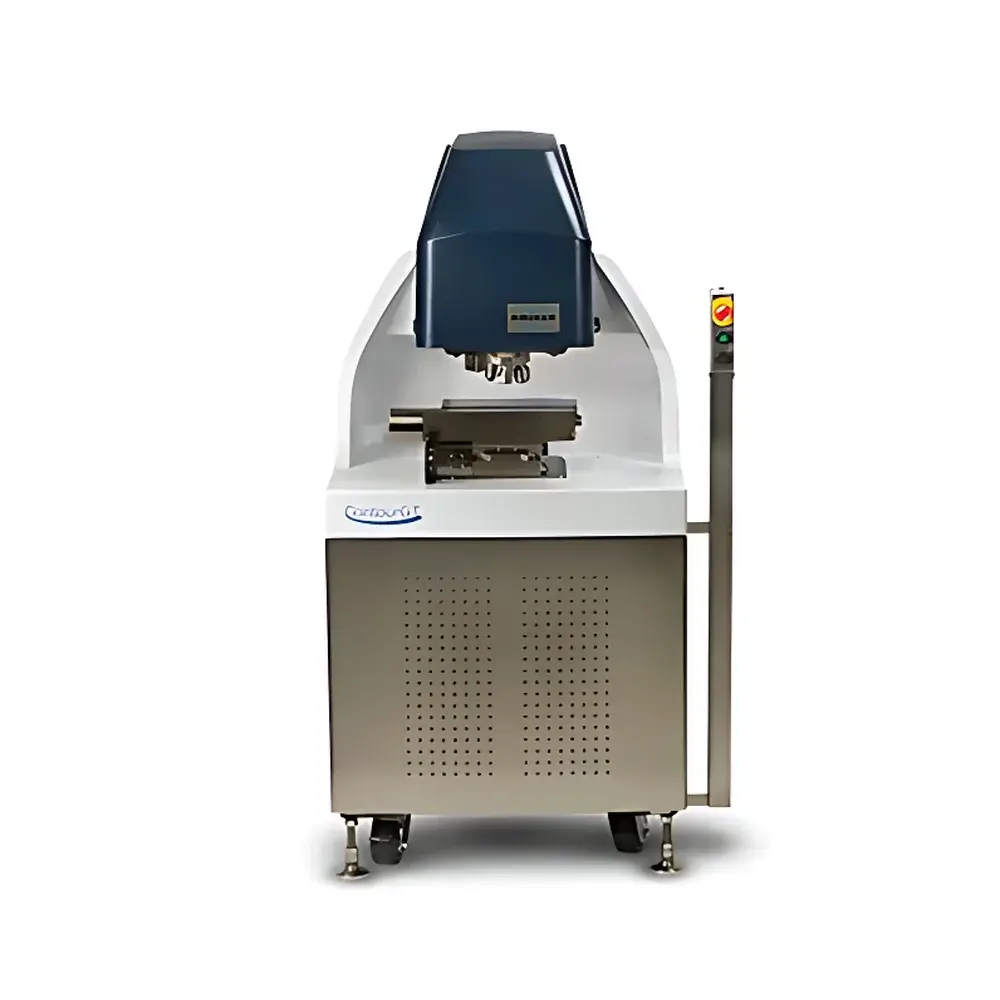
Bruker ContourGT-X Optical Profilometer
| Brand | Bruker |
|---|---|
| Origin | USA |
| Manufacturer Type | Authorized Distributor |
| Product Category | Imported Instrument |
| Model | ContourGT-X |
| Pricing | Upon Request |
| Type | Non-contact Profilometer / Surface Roughness Analyzer |
Overview
The Bruker ContourGT-X Optical Profilometer is a high-performance, non-contact 3D surface metrology system engineered for precision in research laboratories, process development, and high-volume manufacturing environments. Based on white-light interferometry (WLI), the instrument delivers sub-nanometer vertical resolution across an exceptionally broad dynamic range—from atomic-scale surface roughness (sub-Å RMS noise floor) to millimeter-scale step heights—without requiring mode switching or hardware reconfiguration. Its optical architecture integrates a stabilized broadband light source, high-numerical-aperture objectives (0.5× to 200×), and a piezo-scanning interferometer, enabling quantitative topographic mapping with traceable metrological integrity. Designed for operational robustness, the ContourGT-X incorporates an integrated active vibration isolation base and thermally stable granite platform, minimizing environmental drift and ensuring measurement repeatability under typical lab conditions. The system’s laser-based self-calibration mechanism continuously monitors and corrects for thermal or mechanical drift in real time—eliminating reliance on physical calibration artifacts and supporting inter-instrument data comparability across global facilities.
Key Features
- Sub-nanometer vertical resolution (<0.1 nm RMS noise) achieved through advanced phase-shifting WLI and optimized optical path design
- Scalable magnification range (0.5×–200×) supporting characterization of diverse surface geometries—from large-area optical lenses to nanoscale semiconductor features
- Fully programmable XYZ motorized stage with automated objective turret and field-of-view changer for unattended multi-site acquisition
- Laser-assisted real-time drift compensation: eliminates need for external reference standards and ensures long-term measurement stability
- Seamless stitching capability across >1,000 individual fields of view, enabling full-wafer or macro-component topography without interpolation artifacts
- 64-bit Vision64 software architecture leveraging multi-core CPU parallelization—accelerating data processing by >10× versus legacy 32-bit platforms
- Modular hardware design supporting rapid objective exchange, tilt-adjustable sample mount, and optional environmental enclosures (e.g., temperature/humidity control)
Sample Compatibility & Compliance
The ContourGT-X accommodates samples ranging from 10 mm × 10 mm wafers to 300 mm full-diameter silicon wafers, as well as irregularly shaped medical implants, ophthalmic lenses, and automotive power electronics substrates. Its non-contact operation avoids surface damage or loading artifacts common in stylus profilometry. The system complies with ISO 25178-2 (areal surface texture parameters), ISO 10110-8 (optical component surface imperfections), and ASTM E2927-22 (standard test method for surface roughness using optical interferometry). Vision64 software supports audit trails, electronic signatures, and configurable user permissions aligned with FDA 21 CFR Part 11 and GLP/GMP documentation requirements—making it suitable for regulated quality control and failure analysis workflows.
Software & Data Management
Vision64 provides a unified environment for acquisition, analysis, reporting, and automation. Its intuitive interface enables users to define custom measurement routines—including multi-location scanning, conditional pass/fail logic, and batch parameter extraction—via drag-and-drop scripting or Python API integration. Built-in algorithms compute over 300 ISO 25178-compliant parameters (Sa, Sq, Sz, Sdr, etc.), along with specialized metrics for LED phosphor uniformity, TSV sidewall angle, solar cell texturing, and touch sensor electrode continuity. Raw interferograms and processed height maps are stored in vendor-neutral HDF5 format, ensuring long-term archival integrity and third-party interoperability. Data export supports CSV, TIFF, STP, and STEP AP242 for CAD-integrated tolerance analysis.
Applications
The ContourGT-X serves as a primary metrology tool across multiple advanced manufacturing sectors: semiconductor process monitoring (gate oxide thickness, CMP uniformity, trench depth); micro-optics and ophthalmic lens verification (power error, surface form deviation, edge roll-off); biomedical device validation (stent strut roughness, catheter coating homogeneity); photovoltaic R&D (pyramid texturing depth, anti-reflective layer morphology); and automotive ADAS component inspection (LiDAR window flatness, headlamp reflector waviness). Its speed, accuracy, and automation readiness make it equally suited for university materials science labs conducting fundamental thin-film growth studies and Tier-1 suppliers performing IATF 16949-compliant incoming inspection.
FAQ
Does the ContourGT-X require periodic recalibration with physical standards?
No—the system employs continuous laser-based self-calibration to compensate for thermal and mechanical drift, eliminating routine artifact-based recalibration.
Can Vision64 automate measurements across multiple wafers in a cassette?
Yes, via integration with robotic wafer handlers and customizable batch scripts that support barcode-triggered acquisition and report generation.
Is the instrument compatible with cleanroom Class 100 environments?
Yes—optional laminar flow enclosures and ESD-safe configurations are available to meet ISO 14644-1 requirements.
What surface types are unsuitable for WLI measurement?
Highly transparent, specularly reflective, or extremely steep (>85°) surfaces may require supplemental techniques (e.g., coherence scanning interferometry or focus variation); application engineering support is provided for challenging cases.
How does the ContourGT-X ensure data traceability for regulatory submissions?
Vision64 logs all operator actions, instrument settings, environmental metadata, and raw interferograms with cryptographic timestamps—fully compliant with ALCOA+ principles for GxP environments.