
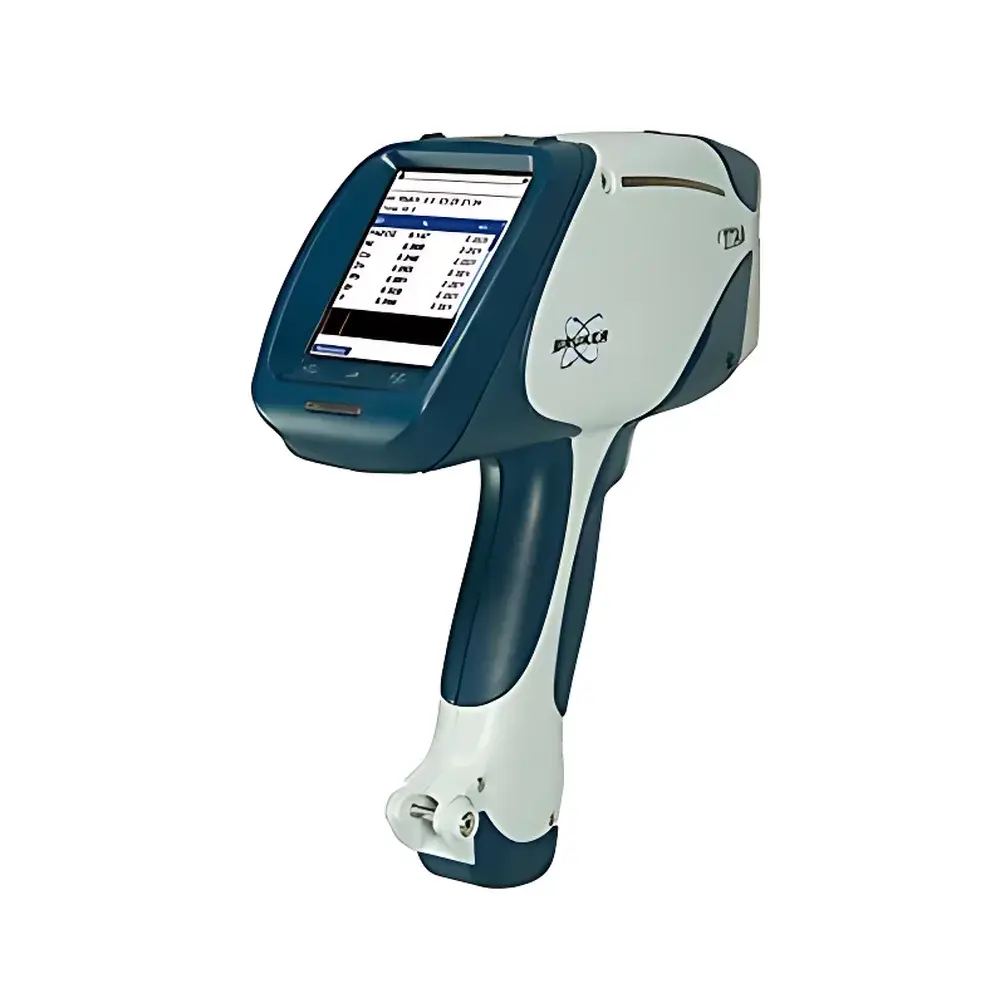
Bruker S1 TITAN Handheld Energy Dispersive X-Ray Fluorescence (ED-XRF) Spectrometer
| Brand | Bruker |
|---|---|
| Origin | Germany |
| Model | S1 TITAN |
| Application | Handheld/Portable |
| Industry Type | General Purpose |
| Elemental Range | Mg–U |
| Quantification Range | 1 ppm – 99.99% |
| Energy Resolution | <140 eV (Mn Kα) |
| Detector | Silicon Drift Detector (SDD) |
| Compliance | CE, RoHS, FCC, IP54 rated |
| Operating Environment | -10 °C to 50 °C, humidity ≤95% non-condensing |
Overview
The Bruker S1 TITAN is a field-deployable, handheld energy dispersive X-ray fluorescence (ED-XRF) spectrometer engineered for rapid, non-destructive elemental analysis of solid and powdered samples in real time. Based on fundamental physics principles—where primary X-rays excite atoms in the sample, causing emission of characteristic secondary (fluorescent) X-rays—the instrument quantifies elemental composition by measuring the energy and intensity of these emitted photons. Its compact, ruggedized chassis integrates a high-output microfocus X-ray tube (up to 50 kV), a large-area silicon drift detector (SDD), and real-time spectrum processing firmware optimized for industrial environments. Designed for operation under demanding conditions—including elevated ambient temperatures, high humidity, rain exposure, and mechanical shock—the S1 TITAN meets IP54 ingress protection standards and operates continuously across a thermal range of −10 °C to +50 °C without performance degradation.
Key Features
- Ruggedized industrial housing with ergonomic grip and integrated trigger interface for one-handed operation
- High-resolution SDD detector delivering <140 eV full-width half-maximum (FWHM) at Mn Kα, enabling precise peak separation for overlapping transitions (e.g., S Kα/Pb Mα, Cr Kβ/Mn Kα)
- Optimized X-ray optics with selectable voltage/current settings (5–50 kV, up to 200 µA) to maximize sensitivity for light elements (Mg–Al–Si) and heavy metals (Pb–U) in a single measurement
- Patented “Puncture-Resistant Detector Window” — a reinforced polymer composite barrier that prevents physical damage from sharp metallic debris (e.g., swarf, wire fragments) while maintaining transmission efficiency >92% down to 1.2 keV
- Real-time spectral averaging with user-configurable dwell times (1–60 s), automatic background subtraction, and matrix-matched calibration libraries (e.g., stainless steel, Ti alloys, Al castings)
- On-device battery status indicator, color-coded element concentration display (traffic-light visual feedback), audible pass/fail alerts, and adaptive power management extending runtime to ≥12 h per charge
Sample Compatibility & Compliance
The S1 TITAN supports direct analysis of conductive and non-conductive solids—including alloys, ores, soils, slags, catalysts, polymers, and coated surfaces—without vacuum or helium purge. It complies with ISO 12885:2020 (XRF instrumentation specifications), ASTM E1621–22 (standard guide for ED-XRF analysis of metals), and EU Directive 2011/65/EU (RoHS). Firmware includes audit-trail logging per FDA 21 CFR Part 11 requirements when connected to Bruker’s PC-based S1 CONTROL software. All factory calibrations are traceable to NIST SRM reference materials (e.g., NIST 679, 680, 681), and analytical performance is validated per ISO 17025-accredited procedures at Bruker’s Karlsruhe facility.
Software & Data Management
Instrument control, spectral acquisition, and quantitative reporting are managed via the embedded Android-based OS and optionally synchronized with Bruker’s S1 CONTROL desktop application. The platform supports method-driven workflows with customizable grade libraries (e.g., UNS, EN, ASTM), statistical process control (SPC) charting, and export of fully annotated reports in PDF, CSV, or XML formats. Data integrity is enforced through role-based access control, electronic signatures, and encrypted local storage. Integration with LIMS systems is enabled via ODBC-compliant database connectors and RESTful API endpoints for automated data ingestion into enterprise QA/QC databases.
Applications
- Positive Material Identification (PMI) for piping, valves, flanges, and pressure vessels in petrochemical, power generation, and nuclear facilities per ASME B31.3 and API RP 578
- Scrap metal sorting and recycling stream optimization using real-time alloy grade classification (e.g., 304 vs. 316 stainless, Inconel 625 vs. 718)
- Field-based geochemical mapping and ore grade estimation in mining exploration, complying with ASTM D5630–21 for bulk soil screening
- Coating thickness and composition verification on galvanized, aluminized, or painted substrates
- Regulatory compliance screening for restricted substances (Pb, Cd, Hg, Cr⁶⁺, Br) in electronics, toys, and packaging per IEC 62321-5
- Quality assurance in aerospace component manufacturing, including turbine disk and fastener material verification against AMS 2249 and AMS 2277
FAQ
What elements can the S1 TITAN detect and quantify?
It measures elements from magnesium (Mg, Z=12) to uranium (U, Z=92) in solid matrices, with detection limits as low as 1 ppm for Ni in stainless steel under optimal conditions.
Is the instrument suitable for light-element analysis in air?
Yes — its optimized X-ray tube filtration and SDD quantum efficiency enable reliable Mg, Al, and Si quantification without vacuum or He flush, though performance for Na and lower-Z elements requires specialized configurations.
How does the puncture-resistant detector window affect analytical accuracy?
Independent validation per ISO 18115-2 confirms no statistically significant difference (p > 0.05, t-test) in detection limits, precision, or bias for Mg–U elements compared to standard beryllium windows.
Can the S1 TITAN be used in GLP or GMP-regulated environments?
When deployed with S1 CONTROL software and configured with 21 CFR Part 11-compliant settings (audit trail, electronic signature, user authentication), it meets documentation and traceability requirements for regulated QC labs.
What maintenance is required for long-term field reliability?
No routine optical alignment or detector recalibration is needed; annual verification against certified reference materials and optional factory recalibration every 24 months are recommended per ISO/IEC 17025 guidelines.





