
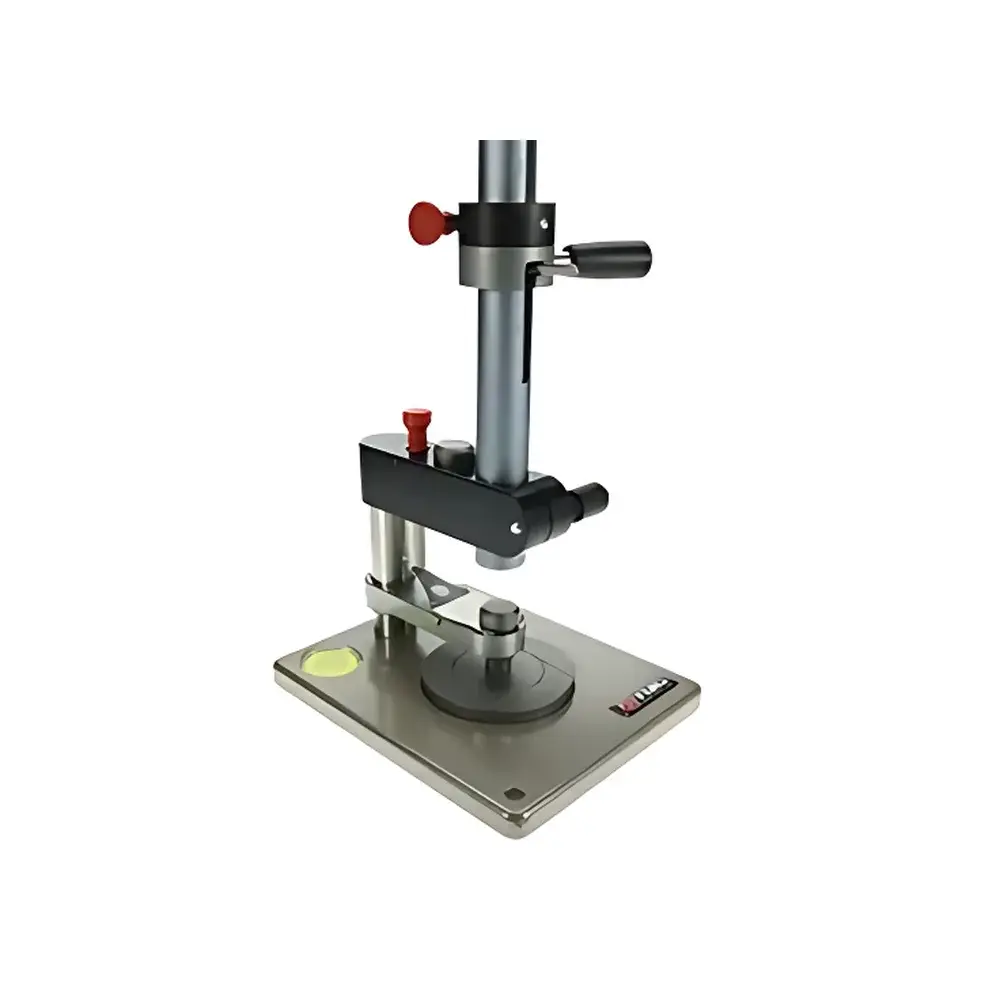
TQC SP1880/SP1895/SP1890/SP1891 Tubular Impact Tester
| Brand | TQC |
|---|---|
| Origin | Netherlands |
| Model | SP1880 / SP1895 / SP1890 / SP1891 |
| Testing Principle | Falling-weight impact (direct & indirect) |
| Compliant Standards | ISO 6272-1, ISO 6272-2, ASTM D2794, ASTM G14 |
| Impact Type | Direct impact (SP1890, SP1891, SP1895) and indirect impact (SP1880) |
| Indenter Options | 12.7 mm & 15.9 mm cylindrical punches |
| Weight Options | 0.9 kg, 1.0 kg, 1.361 kg (2.2 lb) |
| Die Diameter Options | 16.3 mm, 27 mm |
| Sample Holder | V-groove fixture (SP1895), flat die support (SP1880/SP1890/SP1891) |
| Calibration Certificate | Supplied with traceable calibration documentation per ISO/IEC 17025-accredited lab |
| Regulatory Alignment | Designed for GLP-compliant coating QC workflows |
Overview
The TQC SP1880, SP1895, SP1890, and SP1891 Tubular Impact Testers are precision-engineered mechanical impact testing systems designed for standardized evaluation of coating adhesion, ductility, and substrate-coating system resilience under controlled dynamic loading. These instruments operate on the falling-weight impact principle—either direct impact (where the indenter strikes the coated surface directly) or indirect impact (where impact is transmitted through a deformable mandrel or backing bar)—in strict accordance with internationally recognized test protocols including ISO 6272-1 (direct), ISO 6272-2 (indirect), ASTM D2794 (coating resistance to rapid deformation), and ASTM G14 (impact resistance of protective coatings). Each unit features a rigid tubular guiding column, precision-machined drop guide, dual-scale height indicator calibrated in both millimeters and inches, and an integrated spirit level to ensure vertical alignment prior to each test cycle—critical for minimizing angular deviation and ensuring measurement repeatability across laboratories.
Key Features
- Modular configuration supporting four distinct test modes: SP1880 (indirect impact per ISO 6272-2/ASTM D2794), SP1895 (direct impact with V-groove sample holder per ASTM G14), SP1890 (direct impact with 20 mm sphere per ISO 6272-1), and SP1891 (dual-indenter direct impact supporting both 20 mm sphere and 15.9 mm punch per legacy ASTM D2794–1993)
- Interchangeable impact weights (0.9 kg, 1.0 kg, 1.361 kg) and certified indenter sets (12.7 mm and 15.9 mm cylindrical punches; 20 mm hardened steel sphere) enabling method-specific setup without recalibration
- Dual-scale height indicator with ±0.5 mm resolution and built-in bubble level ensures consistent drop height and alignment compliance per standard requirements
- Die support fixtures engineered to DIN/ISO dimensional tolerances—including 16.3 mm and 27 mm diameter dies—guarantee uniform contact geometry and minimize edge effects during indentation
- Pre-assembled, factory-aligned mechanical architecture eliminates field adjustment complexity; supplied with ISO/IEC 17025-traceable calibration certificate covering height scale, weight mass, and indenter geometry
Sample Compatibility & Compliance
These testers accommodate flat metallic, plastic, or composite panels (typically 100 × 150 mm or larger) coated with liquid, powder, or electrodeposited finishes. The SP1895 variant includes a precision-machined V-groove cradle optimized for cylindrical substrates such as pipes or tubes—hence the “tubular” designation—enabling curvature-adapted impact assessment relevant to pipeline, tank, and structural steel applications. All models meet the physical construction and performance criteria defined in ISO/IEC 17025 for testing equipment used in accredited laboratories. They are formally recognized by Qualicoat (for architectural aluminum coatings), QIB (Quality Inspection Bureau), and GSB International for use in third-party certification testing. Their mechanical design inherently satisfies the rigidity, mass inertia, and energy transfer fidelity requirements of ASTM E23 and ISO 148-1 for pendulum-free impact systems.
Software & Data Management
While the core TQC Tubular Impact Testers operate as standalone mechanical instruments, they integrate seamlessly with optional digital documentation modules compliant with FDA 21 CFR Part 11. When paired with TQC’s validated LabManager™ QC software (sold separately), users gain electronic test record generation, operator ID authentication, automatic timestamping, digital signature capture, and immutable audit trails for every impact event. All test parameters—including selected weight, indenter type, die size, drop height, and pass/fail outcome—are stored in structured XML format compatible with LIMS environments. The system supports full GLP/GMP traceability: calibration history, maintenance logs, and user access rights are centrally managed and exportable for regulatory inspection.
Applications
- Coating formulation development: Quantifying brittle-to-ductile transition thresholds in automotive OEM primers, coil coatings, and marine antifoulings
- Production line QC: Rapid pass/fail screening of batch-to-batch consistency in powder-coated aluminum extrusions per Qualicoat Technical Specification
- Failure analysis: Correlating impact-induced cracking patterns with cross-link density (via FTIR), film thickness (per ISO 2808), and interfacial adhesion (per ISO 2409)
- Standards compliance verification: Supporting ISO 9001:2015 Clause 8.5.1 (control of production and service provision) and ISO/IEC 17025:2017 Clause 6.4.1 (equipment suitability)
- R&D validation: Benchmarking novel nanocomposite coatings against reference materials under identical kinetic energy conditions (e.g., 1.0 kg × 0.5 m = 4.9 J)
FAQ
What standards does the SP1880 model comply with?
The SP1880 conforms to ISO 6272-2 (indirect impact) and ASTM D2794 (coating resistance to rapid deformation), utilizing a 1 kg weight and either 12.7 mm or 15.9 mm cylindrical punch.
Can the same instrument perform both direct and indirect impact tests?
No—each model is mechanically configured for one impact mode. SP1880 is dedicated to indirect impact; SP1890, SP1891, and SP1895 are direct-impact variants with differing indenter/die configurations.
Is calibration required before first use?
Yes. Each unit ships with a manufacturer-issued calibration certificate traceable to national metrology institutes. Users must verify alignment, weight mass, and height scale prior to initial operation per ISO 6272 Annex A.
Does TQC provide installation and operator training?
Yes—on-site commissioning and hands-on training are available globally through authorized TQC service partners, including protocol-specific instruction aligned with ISO 17025 internal audit requirements.
Are spare indenters and dies available as consumables?
Yes. TQC supplies certified replacement sets (e.g., 20 mm sphere, 15.9 mm punch, 16.3 mm die) with individual calibration certificates, maintained under controlled storage per ISO 10012.



