
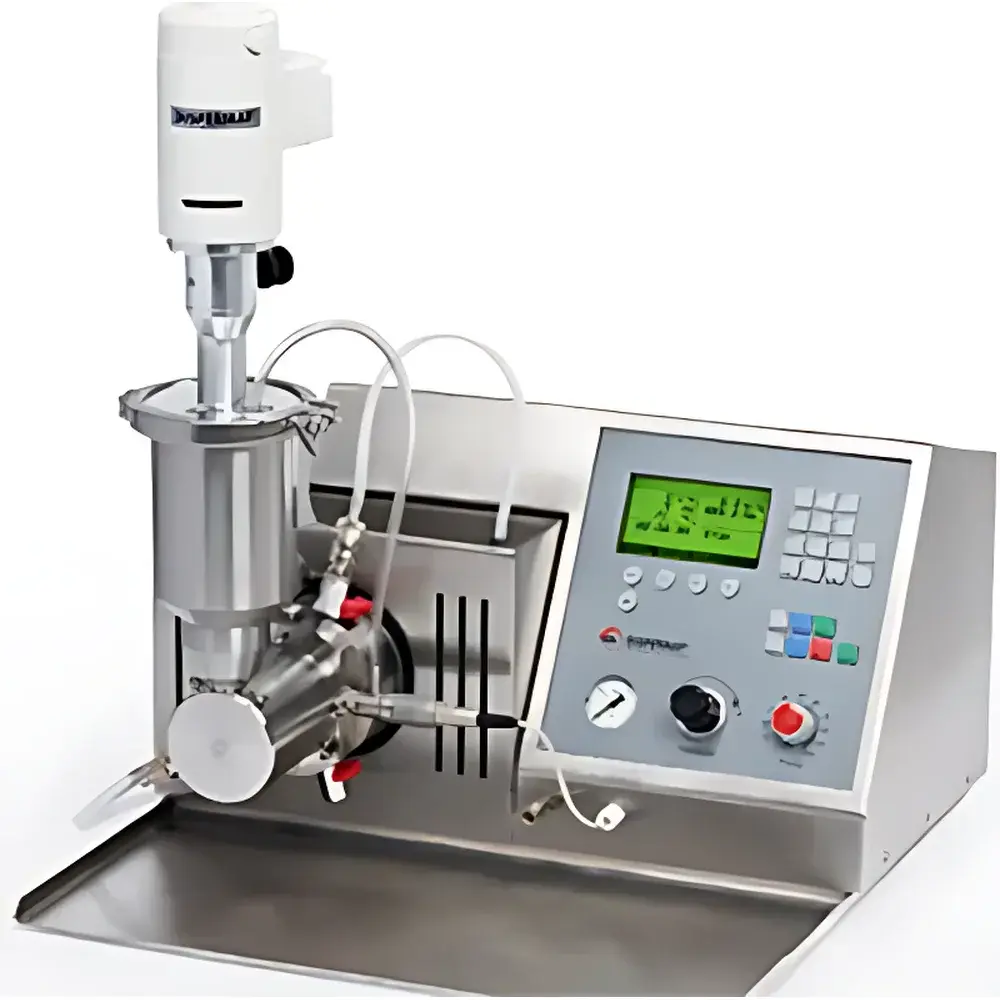
VMA DISPERMAT SL5 Nano Material Dispersion Mill
| Brand | VMA |
|---|---|
| Origin | Germany |
| Model | SL5 |
| Power | 1.1 kW |
| Speed Range | 0–6000 rpm |
| Grinding Chamber Volume | 0.05 L |
| Sample Volume Capacity | 0.05–0.75 L |
| Bead Size | 0.1 mm |
| Compliance | ATEX-certified (C-Ex / M-Ex variants available) |
| Control System | Digital speed/torque/temperature/power monitoring with programmable setpoints and data logging |
Overview
The VMA DISPERMAT SL5 Nano Material Dispersion Mill is a high-precision, horizontal bead mill engineered for reproducible nanoscale dispersion and deagglomeration of advanced materials in laboratory and pilot-scale environments. Operating on the principle of wet grinding via high-shear mechanical attrition, the SL5 utilizes a horizontally oriented grinding chamber where dispersion occurs under controlled hydrodynamic forces generated by rotating discs or pins acting upon sub-millimeter ceramic or zirconia beads (down to 0.1 mm diameter). This design ensures uniform energy input, minimal thermal load, and exceptionally low dead volume—critical for preserving sample integrity and enabling quantitative recovery of nanomaterial suspensions. Unlike open-tank homogenizers or ultrasonic probes, the SL5 employs a fully enclosed, pressurized circulation system that eliminates solvent evaporation, oxygen ingress, and operator exposure to hazardous nanoparticles—making it suitable for processing sensitive, toxic, or air-sensitive formulations under inert atmosphere (e.g., N₂ or Ar) when integrated with optional gas-purge interfaces.
Key Features
- Horizontal bead mill architecture with axial inlet/outlet configuration for laminar, high-throughput material flow and <0.5 mL residual volume after discharge
- Integrated pneumatic pressure recovery system that evacuates residual slurry from the grinding chamber using compressed air or inert gas, achieving >98% material recovery
- Dual-mode operation: single-pass dispersion for rapid screening and recirculation mode for progressive particle size reduction to <100 nm D₉₀
- Modular drive unit with brushless AC motor (1.1 kW), offering continuous variable speed control from 0 to 6000 rpm with ±5 rpm repeatability
- ATEX-compliant explosion-proof variants (C-Ex and M-Ex) certified for use in Zone 1/21 hazardous areas handling flammable solvents or combustible nanopowders
- Real-time digital monitoring of torque (N·m), rotational speed (rpm), product temperature (°C), input power (W), and elapsed time—displayed on a high-resolution TFT interface
- Programmable process parameters: up to ten user-defined protocols with configurable limits for torque overload protection, temperature cutoff, and automatic shutdown on deviation
Sample Compatibility & Compliance
The SL5 accommodates both Newtonian and non-Newtonian suspensions—including high-viscosity pastes (up to 50,000 mPa·s), thixotropic gels, and low-flow slurries—without requiring pre-dilution. Its corrosion-resistant wetted parts (standard: stainless steel 1.4404/316L; optional: Hastelloy C-276 or ceramic-lined chambers) ensure compatibility with aggressive solvents (e.g., DMF, NMP, THF), acidic or basic media, and reactive precursors used in battery cathode slurries, quantum dot inks, or metal-organic framework (MOF) dispersions. The system complies with ISO 8502-2 for surface cleanliness validation, meets mechanical safety requirements per EN 61000-6-2/6-4 (EMC), and supports GLP/GMP traceability through audit-ready electronic records. Optional FDA 21 CFR Part 11-compliant software modules enable secure user authentication, electronic signatures, and immutable process logs for regulated pharmaceutical or medical device R&D.
Software & Data Management
The C-Ex and M-Ex control platforms provide native CSV export of time-stamped operational data (speed, torque, temperature, power) at user-selectable intervals (100 ms to 10 s resolution). All parameter sets—including ramp profiles, hold times, and alarm thresholds—are stored internally with timestamped version history. External connectivity via RS-485 or Ethernet enables integration into centralized LIMS or MES systems. Process files include metadata such as operator ID, batch number, ambient conditions, and calibration status—supporting full analytical traceability from raw material input to final dispersion characterization (e.g., DLS, SEM, or BET validation).
Applications
- Preparation of stable nanocellulose, graphene oxide, and MXene aqueous dispersions for conductive inks
- Deagglomeration of pigment nanoparticles (TiO₂, carbon black) in automotive coatings and inkjet formulations
- Homogenization of lithium iron phosphate (LFP) and nickel-rich NMC cathode slurries for solid-state battery development
- Dispersion of silica, alumina, or ceria nanoparticles in polishing slurries for semiconductor CMP processes
- Production of uniform metal nanoparticle colloids (Ag, Au, Pt) for catalysis and biosensing applications
- Scale-down correlation studies between lab-scale SL5 output and industrial-scale agitated mills (e.g., NETZSCH PremierLine)
FAQ
What bead materials are compatible with the SL5 grinding chamber?
Standard operation uses yttria-stabilized zirconia (YSZ) beads (0.1–0.3 mm); alternative options include silicon carbide, glass, or polymeric beads—subject to chamber liner compatibility and wear rate assessment.
Can the SL5 process heat-sensitive biological nanocarriers?
Yes—the closed-loop cooling jacket (optional) and real-time temperature feedback allow active thermal management; typical ΔT rise is <3°C during 30-min recirculation at 4500 rpm with water-based buffers.
Is cleaning validation supported for multi-product labs?
The low-dead-volume design and pneumatic purge enable rapid cleaning; swab testing and rinse recovery studies confirm ≤10 ppm cross-contamination between batches when following VMA-recommended SOPs.
Does the system support automated cleaning-in-place (CIP)?
While not fully automated, the SL5’s modular pump manifold and standardized fluid paths allow integration with external CIP skids using validated detergent and rinse cycles.
How is calibration maintained across extended operation?
Torque and speed sensors are factory-calibrated to DIN ISO 17025 standards; annual recalibration is recommended, with drift verification possible via built-in diagnostic routines and reference load tests.



