
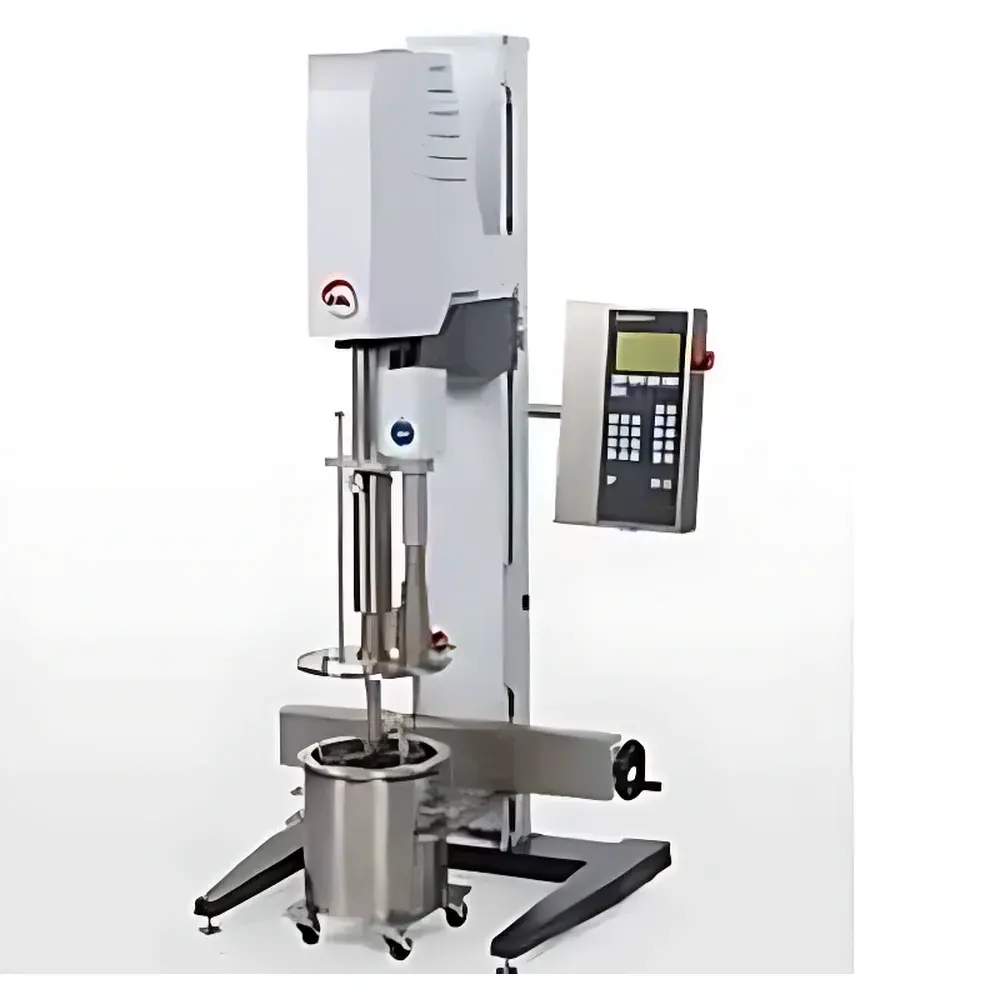
VMA DISPERMAT LH10 Laboratory-Scale Vacuum Dispersion Mixer
| Brand | VMA |
|---|---|
| Origin | Germany |
| Model | LH10 |
| Type | Vacuum-Assisted High-Shear Dispersion System with Integrated Dual-Stage Agitation (High-Speed Disperser + Three-Blade Butterfly Impeller) |
| Drive System | Digital Brushless Motor with Closed-Loop Torque Control |
| Speed Range | 0–3,500 rpm |
| Maximum Torque | 12 N·m |
| Power Input | 1.1 kW |
| Vacuum Capability | Up to 50 mbar (absolute) |
| Temperature Monitoring | Integrated Pt100 Sensor (–20 to +120 °C) |
| Height Adjustment | Motor Head Vertical Travel: 280 mm |
| Data Interface | RS485 + USB |
| Compliance | CE, EMC Directive 2014/30/EU, Machinery Directive 2006/42/EC |
| Safety Features | Interlocked Vacuum Lid, Over-Torque Shutdown, Thermal Overload Protection |
| Predefined Programs | 100 User-Configurable Protocols (Speed Ramp, Hold Time, Torque Limit, Temp Threshold, Vacuum Sequence) |
Overview
The VMA DISPERMAT LH10 is a laboratory-scale vacuum dispersion mixer engineered for the reproducible preparation of highly viscous, yield-stress, and shear-thinning materials. It operates on a dual-stage dispersion principle: high-speed rotor-stator shearing in the dispersion head—combined with low-shear, high-volume circulation via an integrated three-blade butterfly impeller—enables simultaneous deagglomeration and homogenization under controlled vacuum. This architecture mitigates bubble entrapment, suppresses volatile loss, and prevents oxidation-sensitive formulation degradation—critical for R&D workflows in pigment-rich systems, reactive adhesives, and thermally labile emulsions. Designed and manufactured in Germany, the LH10 conforms to stringent European engineering standards for mechanical stability, thermal management, and operational safety.
Key Features
- Vacuum-assisted dispersion chamber with pneumatic lid locking and real-time absolute pressure monitoring (down to 50 mbar)
- Dual-agitation system: precision-machined dispersing disc (Ø 40 mm) for high-shear breakdown + coaxial butterfly impeller (Ø 90 mm) for bulk material turnover and heat distribution
- C-Technology control interface featuring dynamic graphical display of speed, torque, power consumption, product temperature, timer, and motor height position
- Process repeatability assurance via programmable constant-torque or constant-speed modes, with automatic ramp-and-hold profiles
- Integrated Pt100 temperature sensor with ±0.5 °C accuracy, enabling closed-loop thermal feedback during exothermic dispersion
- Motor head with 280 mm vertical travel range and optical height calibration—compatible with vessels from 100 mL to 5 L (standardized DIN 28121 neck sizes)
- WinDisp 7 software integration for GxP-aligned data capture: timestamped parameter logging, electronic signature support, audit trail export (CSV/PDF), and protocol validation reports
Sample Compatibility & Compliance
The LH10 accommodates non-Newtonian fluids with viscosities up to 100,000 mPa·s (at 20 °C, 10 s⁻¹), including solvent-borne and water-based pastes, filled polymer dispersions, UV-curable formulations, and high-solids cosmetic bases. Its stainless-steel wetted parts (AISI 316L) meet FDA 21 CFR Part 11 requirements for material contact when validated per user SOPs. The system supports GLP/GMP documentation workflows through WinDisp 7’s 21 CFR Part 11-compliant user access levels, electronic signatures, and immutable audit trails. All electrical and mechanical design complies with EN 61000-6-2 (immunity) and EN 61000-6-4 (emission), as well as EN ISO 12100 for risk assessment and safeguarding.
Software & Data Management
WinDisp 7 serves as the native control and documentation platform for the LH10. It enables full remote operation, real-time parameter overlay on time-series graphs, and automated generation of dispersion curves (torque vs. time, temperature rise vs. energy input). Each run is assigned a unique ID with metadata including operator, batch ID, ambient conditions, and calibration status. Data exports comply with ASTM E2500-13 (verification of computerized systems) and ISO/IEC 17025:2017 Annex A2 (data integrity). Raw datasets are stored in encrypted SQLite format; PDF reports include digital signatures and hash-verified checksums for regulatory submission readiness.
Applications
The LH10 is routinely deployed in formulation laboratories developing: pigment dispersions for gravure and flexographic inks; conductive pastes for printed electronics; thixotropic sealants and construction adhesives; ceramic slurries for tape casting; pharmaceutical suspensions requiring particle size stabilization; and anhydrous cosmetic gels where moisture exclusion is mandatory. Its vacuum capability makes it particularly suitable for air-sensitive lithium-ion battery cathode slurries and oxygen-scavenging packaging adhesives.
FAQ
What vacuum level can the LH10 achieve, and how is it monitored?
The system reaches a minimum absolute pressure of 50 mbar, measured continuously via an integrated piezoresistive vacuum transducer with digital compensation.
Can the LH10 be integrated into a larger automated lab workflow?
Yes—via RS485 Modbus RTU or optional Ethernet/IP interface, it supports SCADA-level orchestration with LIMS and MES platforms.
Is WinDisp 7 qualified for use in regulated pharmaceutical environments?
WinDisp 7 v7.3+ includes IQ/OQ documentation templates and supports 21 CFR Part 11 compliance when deployed on validated Windows OS configurations.
What maintenance intervals are recommended for the dispersing disc and impeller?
Visual inspection every 200 operating hours; dimensional verification and surface roughness check every 1,000 hours per ISO 13320 guidance for dispersion tooling.
Does the LH10 support variable-speed ramping with torque limiting during startup?
Yes—programmable acceleration profiles with dynamic torque capping prevent splashing and ensure gentle incorporation of dry powders into viscous media.



