
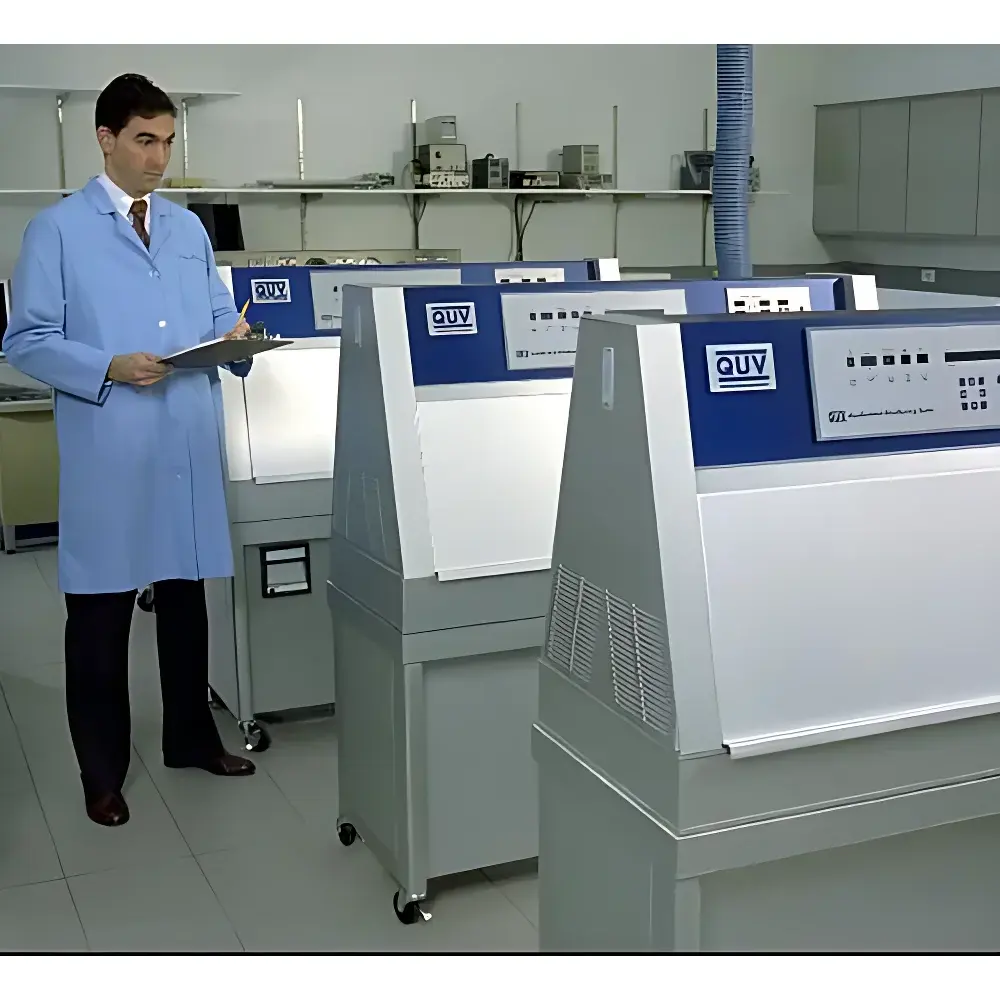
Q-LAB QUV Series UV Aging Test Chambers for Photovoltaic Modules
| Brand | Q-LAB |
|---|---|
| Origin | USA |
| Manufacturer Type | Authorized Distributor |
| Origin Category | Imported |
| Model | QUV/basic, QUV/se, QUV/spray, QUV/cw |
| Price | Upon Request |
| Illuminant Temperature Range (°C) | As specified in operation manual |
| Black Panel Temperature Range (°C) | As specified in operation manual |
| UV Wavelength Range (nm) | UVA-340 (295–365 nm), UVB-313 (280–360 nm) |
| Chamber Internal Dimensions (L×W×H) | Model-dependent, per Q-LAB technical datasheets |
Overview
The Q-LAB QUV Series UV Aging Test Chambers are engineered for accelerated weathering evaluation of photovoltaic (PV) modules and related encapsulation materials under controlled ultraviolet radiation, temperature, and moisture conditions. Based on the ASTM G154 and IEC 61215-2 MQT03 standards, these chambers replicate critical degradation drivers—primarily short-wave UV exposure (295–365 nm), thermal cycling, and condensation-induced hygrothermal stress—to assess polymer yellowing, EVA delamination, backsheet embrittlement, and interfacial adhesion loss. Unlike broad-spectrum xenon arc testers, the QUV platform employs fluorescent UV lamps to deliver high-intensity, spectrally stable irradiance in the most photochemically active region of solar spectrum. Its compact, rack-mounted architecture enables laboratory-scale reproducibility with minimal footprint and operational overhead.
Key Features
- Modular lamp configuration supporting UVA-340 and UVB-313 fluorescent tubes, each calibrated to NIST-traceable irradiance standards
- Black panel temperature control (typically 40–70°C) with precision ±1.5°C stability across all models
- Condensation humidity simulation via water-cooled panel condensation system (standard on all QUV variants)
- SunEye irradiance feedback control system (exclusive to QUV/se and QUV/cw) enabling real-time UV intensity monitoring and automatic lamp power compensation to maintain setpoint irradiance within ±5% tolerance
- Optional water spray system (QUV/spray) featuring 12-nozzle array, programmable spray duration (1–120 min), and integrated deionized water delivery (conductivity >2 MΩ·cm, pH 6.0–8.0)
- Compliant with ISO 4892-3, ASTM D4329, and IEC 61215-2 MQT03 test protocols for PV module qualification
Sample Compatibility & Compliance
The QUV accommodates standard PV module specimens up to 75 mm × 150 mm (3″ × 6″) per rack position, with optional custom fixtures available for mini-module or cell-level testing. All models meet GLP documentation requirements for traceable calibration records, lamp usage logs, and environmental parameter audit trails. The QUV/se and QUV/cw variants support 21 CFR Part 11-compliant software packages (via Q-LAB’s SOLAR-EYE™ v5.2) for electronic signatures, user access controls, and immutable data archiving. For PV-specific validation, the chamber satisfies IEC TS 63209-1:2021 requirements for UV preconditioning prior to damp heat and thermal cycling tests.
Software & Data Management
Q-LAB’s proprietary SOLAR-EYE™ software provides full-cycle test scheduling, real-time parameter visualization (irradiance, black panel temperature, condensation time), and automated report generation compliant with ISO/IEC 17025 laboratory accreditation criteria. Data export is supported in CSV, PDF, and XML formats, with optional integration into LIMS platforms via OPC UA or RESTful API. All QUV/se and QUV/cw units include built-in Ethernet connectivity, remote diagnostics, and firmware update capability. Audit trail functionality records operator actions, parameter modifications, and alarm events with timestamped metadata—essential for FDA, TÜV, and UL certification audits.
Applications
- Accelerated UV durability screening of ethylene-vinyl acetate (EVA), polyolefin encapsulants, and fluoropolymer backsheets
- Comparative aging studies between monocrystalline, PERC, TOPCon, and heterojunction PV architectures
- Validation of anti-UV coatings and edge-sealant formulations under cyclic UV/condensation exposure
- Preconditioning per IEC 61215-2 MQT03 prior to thermal cycling (MQT10), damp heat (MQT02), and PID testing (MQT17)
- Research-grade spectral response analysis using cold white (CW) fluorescent lamps (QUV/cw) for indoor PV applications such as BIPV and low-light energy harvesting systems
FAQ
What is the primary difference between QUV/basic and QUV/se?
QUV/basic lacks irradiance feedback control and lamp power regulation; it operates at fixed lamp output and is recommended only for comparative, non-quantitative exposure trials. QUV/se integrates SunEye closed-loop control for stable, repeatable UV dose delivery.
Can QUV chambers be used for IEC 61215-2 MQT03 compliance testing?
Yes—when configured with UVA-340 lamps, black panel temperature set to 60°C ± 3°C, and condensation cycle per Clause 7.3, QUV/se and QUV/spray meet MQT03 requirements when operated under documented SOPs and calibrated instrumentation.
Is deionized water mandatory for the spray function?
Yes. Conductivity must exceed 2 MΩ·cm to prevent nozzle clogging and mineral deposition on test specimens; tap water or softened water is not acceptable.
How often do UV lamps require replacement?
UVA-340 lamps are rated for 1,500 hours of operation at nominal irradiance; UVB-313 lamps for 1,000 hours. Replacement intervals are tracked automatically in SOLAR-EYE™ and trigger maintenance alerts.
Does Q-LAB provide installation qualification (IQ) and operational qualification (OQ) documentation?
Yes—factory-verified IQ/OQ protocols, including temperature uniformity mapping, irradiance homogeneity verification, and condensation cycle validation, are supplied with each unit and align with ISO/IEC 17025 Annex A.2 requirements.



