
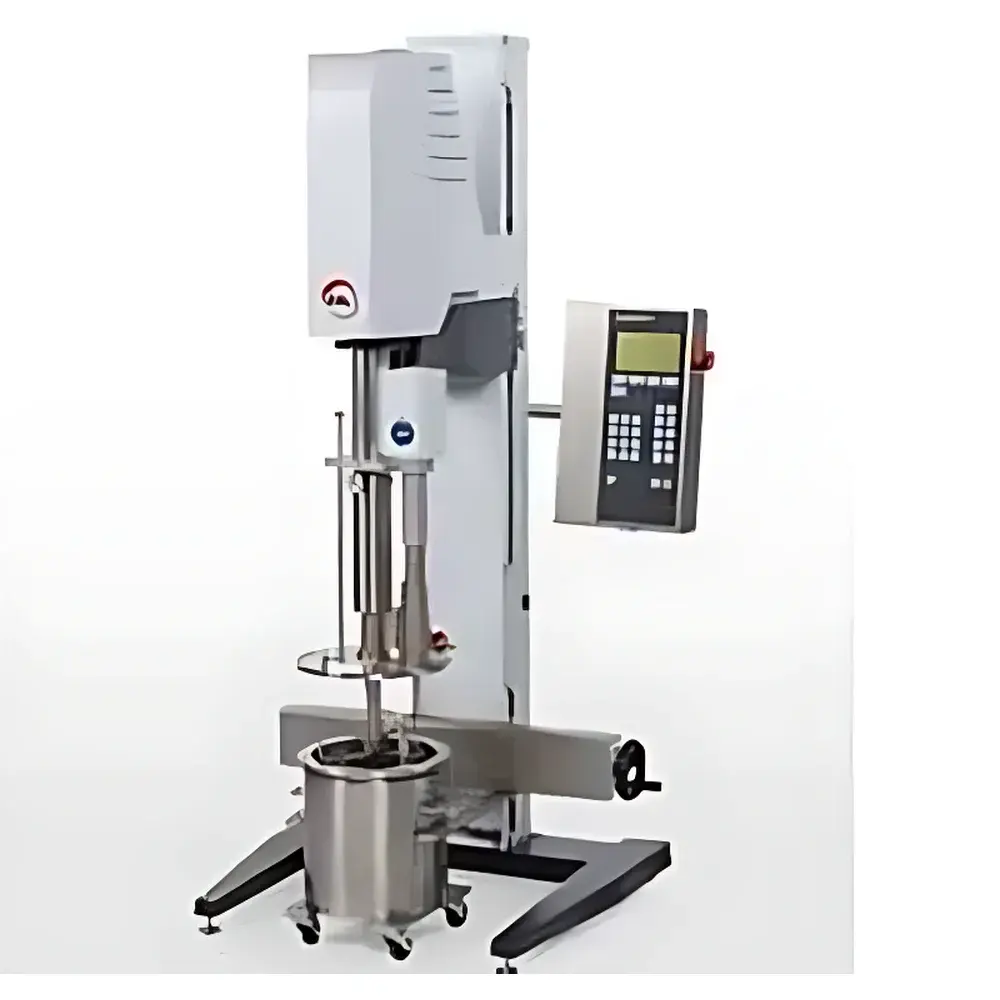
VMA DISPERMAT SL200 Laboratory Paint Dispersion Mill
| Brand | VMA |
|---|---|
| Origin | Germany |
| Model | SL200 |
| Power | 4 kW |
| Speed Range | 0–3000 rpm |
| Minimum Sample Volume | 2 L |
| Maximum Batch Volume | 50 L |
| Grinding System Type | Recirculating & Single-Pass Wet Milling |
| Drive | Pneumatically Adjustable Feed + Integrated Variable-Speed Pump & Agitator |
| Construction | Stainless Steel (316L contact parts), GMP-compliant design |
| Compliance | CE, ISO 9001, ASTM D1210, ISO 787-24, USP <1058> for analytical instrument qualification |
Overview
The VMA DISPERMAT SL200 is a high-precision laboratory-scale dispersion and wet grinding mill engineered for reproducible particle size reduction and homogenization of pigment dispersions, coatings, inks, pastes, and high-viscosity suspensions. Based on the principle of high-shear rotor-stator milling combined with controlled recirculation dynamics, the SL200 employs a dual-mode operation—single-pass and closed-loop recirculation—to ensure consistent energy input per unit mass. This architecture enables precise correlation between lab-scale development and full-scale production parameters, particularly critical for formulation optimization, raw material qualification, and QC release testing in regulated environments.
Key Features
- 4 kW high-torque drive system with digitally regulated speed control (0–3000 rpm), delivering stable shear profiles across viscosity ranges from 100 mPa·s to >50,000 mPa·s
- Modular grinding chamber with interchangeable rotor-stator geometries (fine, medium, coarse) for tailored energy input and particle breakage efficiency
- Integrated recirculation loop featuring a stainless steel (316L) diaphragm pump and magnetic-coupled agitator, enabling programmable residence time and multi-pass processing
- Single-pass mode optimized for rapid screening: material flows once through the mill at defined flow rate and RPM, yielding immediate dispersion assessment
- GMP-aligned mechanical construction—including traceable materials of construction, surface roughness ≤0.8 µm Ra on wetted parts, and clean-in-place (CIP)-compatible geometry
- Touchscreen HMI with preloaded SOP templates, real-time torque monitoring, and automatic batch logging (timestamp, RPM, duration, temperature)
Sample Compatibility & Compliance
The SL200 accommodates sample volumes from 2 L to 50 L in standard operation, supporting both low-flow (e.g., solvent-borne acrylics) and high-yield (e.g., water-based architectural paints, battery cathode slurries) formulations. Its wet-milling capability extends to non-Newtonian, thixotropic, and yield-stress fluids without pre-dilution. The system conforms to ISO 787-24 (pigment dispersion evaluation), ASTM D1210 (Hegman fineness of grind), and ISO 8781-3 (dispersion quality assessment). For regulated laboratories, it supports IQ/OQ documentation packages aligned with FDA 21 CFR Part 11 requirements, including electronic signature support, audit trail generation, and user-access-level permissions.
Software & Data Management
DISPERMAT ControlSuite v4.2 provides validated firmware for method storage, parameter locking, and export of structured CSV/Excel reports compliant with LIMS integration protocols. All process data—including rotational speed, motor torque (N·m), elapsed time, and optional inline temperature readings—are timestamped and stored locally with SHA-256 hash integrity verification. The software includes built-in statistical process control (SPC) tools for tracking dispersion consistency across batches (e.g., %RSD of torque at fixed RPM), facilitating GLP/GMP trend analysis and deviation investigation.
Applications
- R&D formulation development: optimizing dispersant type/concentration, pigment loading, and binder compatibility
- Raw material qualification: assessing batch-to-batch variability of TiO₂, carbon black, or nanoscale additives via repeatable dispersion energy input
- QC release testing: verifying grind fineness (Hegman units), color strength, gloss stability, and rheological recovery post-milling
- Scale-up validation: correlating lab-scale energy density (kWh/m³) with pilot-plant attritor or bead mill performance
- Stability studies: generating accelerated dispersion aging data under controlled shear history for shelf-life modeling
FAQ
What is the minimum usable volume for reliable dispersion results?
The SL200 achieves metrologically valid dispersion performance starting at 2 L batch volume, provided the recirculation loop is fully primed and flow rates are adjusted to maintain laminar-to-transitional Reynolds number conditions in the grinding zone.
Can the SL200 be used for dry powder dispersion?
No—the SL200 is designed exclusively for wet milling applications; dry powder feeding would risk rotor-stator seizure and inconsistent energy transfer. Pre-wet slurry preparation is required.
Is calibration traceable to national standards?
Yes—torque sensor calibration is performed annually using NIST-traceable deadweight testers, and speed calibration is verified with Class 0.1 optical tachometers per ISO 17025-accredited procedures.
How does the SL200 support regulatory audits?
It maintains a complete electronic audit trail (user ID, timestamp, parameter changes, error logs) with immutable storage and export functionality meeting ALCOA+ principles for data integrity.
What maintenance intervals are recommended for GMP use?
Daily visual inspection of seals and hoses; monthly verification of pump flow linearity and torque sensor zero drift; annual full recalibration and surface finish measurement of grinding components.



