
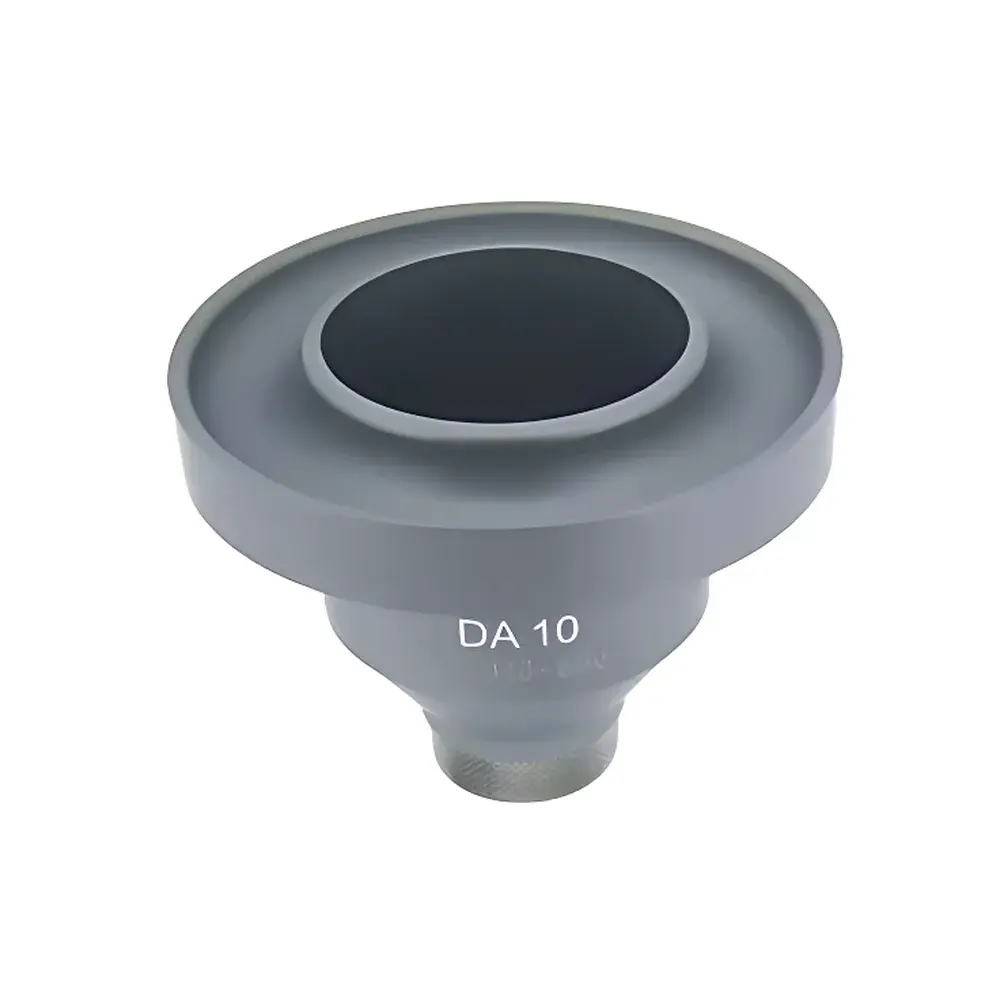
TQC VF2020 DIN Flow Cup Viscometer
| Brand | TQC |
|---|---|
| Origin | Netherlands |
| Model | VF2020 |
| Material | Anodized Aluminum Body with Stainless Steel Orifice Holder |
| Orifice Diameter Options | 1–7 mm (VF2181–VF2027), 4 mm Orifice Complies Fully with DIN 53211 |
| Capacity | 100 mL |
| Weight | 226 g |
| Max Width | 84 mm |
| Height | 74 mm |
| Compliance | DIN 53211 (4 mm orifice), ASTM D1200 (approximate equivalence), ISO 2431 (methodological alignment) |
| Calibration Recommendation | Annual traceable calibration recommended |
| Accessories Available | Leveling stands (VF2061, VF2062), temperature controllers (VF1982, VF2067), certified stopwatch (DI0076), viscosity conversion chart (VF2053) |
Overview
The TQC VF2020 DIN Flow Cup Viscometer is a precision-engineered gravity-driven efflux viscometer designed for rapid, standardized measurement of kinematic viscosity in low-to-medium viscosity liquids—primarily coatings, varnishes, lacquers, inks, and solvent-based formulations. It operates on the principle defined in DIN 53211:2021 (“Determination of flow time using flow cups”), where viscosity is inferred from the efflux time required for a fixed volume (100 mL) of liquid to drain under gravity through a precisely dimensioned orifice at controlled temperature (23.0 ± 0.2 °C). Unlike rotational or capillary viscometers, the VF2020 delivers reproducible, operator-independent results without requiring complex fluid rheology assumptions—making it ideal for routine QC in paint manufacturing, R&D laboratories, and contract testing facilities where compliance with international coating standards is mandatory.
Key Features
- High-precision anodized aluminum cup body (226 g) engineered for dimensional stability, thermal uniformity, and corrosion resistance in aggressive solvent environments.
- Interchangeable stainless steel orifice inserts (1–7 mm diameter, part numbers VF2181–VF2027), each individually calibrated and marked with tolerance class; the 4 mm orifice (VF2024) fully complies with DIN 53211 dimensional and performance specifications.
- Integrated stainless steel orifice holder with positive mechanical retention—ensures repeatable seating and eliminates misalignment-induced flow errors.
- Ring-shaped overflow groove at the rim captures excess sample during filling, preventing edge contamination and ensuring consistent meniscus positioning per standard requirements.
- Optimized external geometry (84 mm max width × 74 mm height) enables seamless integration with TQC leveling stands (e.g., VF2061 S40B with built-in spirit level) for strict horizontal alignment—critical for efflux time accuracy.
- Smooth internal surfaces and absence of recesses or dead volumes facilitate complete cleaning with non-abrasive solvents and lint-free wipes—reducing carryover risk between samples.
- Each unit bears a permanent laser-engraved serial number for traceability, audit readiness, and calibration record linkage.
Sample Compatibility & Compliance
The VF2020 is validated for Newtonian and near-Newtonian fluids within the kinematic viscosity range of approximately 20–1500 mm²/s (cSt), depending on selected orifice size and test temperature. It is routinely employed for solvent-borne architectural paints, automotive refinish systems, coil coatings, and industrial primers. Its design conforms fully to DIN 53211 for the 4 mm orifice configuration; other orifices (1–3 mm, 5–7 mm) are manufactured to dimensional tolerances aligned with the standard’s methodology, enabling extended dynamic range while maintaining procedural consistency. The instrument supports regulatory workflows compliant with ISO/IEC 17025-accredited testing labs and satisfies documentation requirements for GLP and GMP environments when used with traceable temperature control (e.g., VF2067) and calibrated timing devices (e.g., DI0076).
Software & Data Management
As a manual efflux device, the VF2020 does not incorporate embedded electronics or firmware. However, its operational protocol is fully compatible with laboratory information management systems (LIMS) and electronic lab notebooks (ELN) via structured data entry. When paired with the DI0076 high-resolution stopwatch (0.01 s resolution, 9h59m59.99s capacity), timing data can be exported digitally or logged directly into validated spreadsheets. For full 21 CFR Part 11 compliance, users may integrate the VF2020 into SOP-controlled workflows that mandate dual-operator verification, timestamped calibration certificates (recommended annually), and version-controlled test records—including ambient temperature logs, orifice ID, sample batch number, and efflux time replicates (n ≥ 3 per sample).
Applications
- Final product release testing of decorative and protective coatings against specification limits (e.g., “efflux time 22–26 s @ 23 °C, VF2024”)
- Batch-to-batch consistency monitoring during production scale-up
- Raw material qualification (e.g., resin solutions, pigment dispersions)
- Formulation development screening for viscosity modifiers and solvent blends
- Third-party certification testing per EN ISO 9001, ISO 14001, and customer-specific QM systems
- Educational demonstration of Newtonian fluid behavior and efflux-based viscosity principles
FAQ
What is the difference between “complies with DIN 53211” and “approximates DIN 53211”?
Only the 4 mm orifice variant (VF2024) meets all dimensional, surface finish, and performance criteria specified in DIN 53211:2021. Other orifices maintain geometric fidelity to the standard’s method but are designated “approximate” due to intentional range extension beyond the standard’s nominal scope.
Can the VF2020 be used for non-Newtonian fluids?
No—it assumes constant shear rate during efflux and is unsuitable for shear-thinning or thixotropic materials. For such samples, rotational rheometry (e.g., Brookfield DVNext) is required.
Is temperature control mandatory?
Yes. DIN 53211 mandates 23.0 ± 0.2 °C. Deviations > ±0.2 °C invalidate results. Use VF1982 or VF2067 temperature regulators with immersion thermometers traceable to NIST or EU NMIs.
How often should the orifice be cleaned and inspected?
Before every test series—and immediately after testing viscous or particulate-laden samples—to prevent clogging or bore deformation. Inspect under 10× magnification for scratches or burrs.
Does TQC provide calibration certificates?
Certificates of Conformance are supplied with each unit. Traceable calibration certificates (including orifice diameter verification and efflux time validation using certified reference oils) are available upon request and require annual renewal.



