
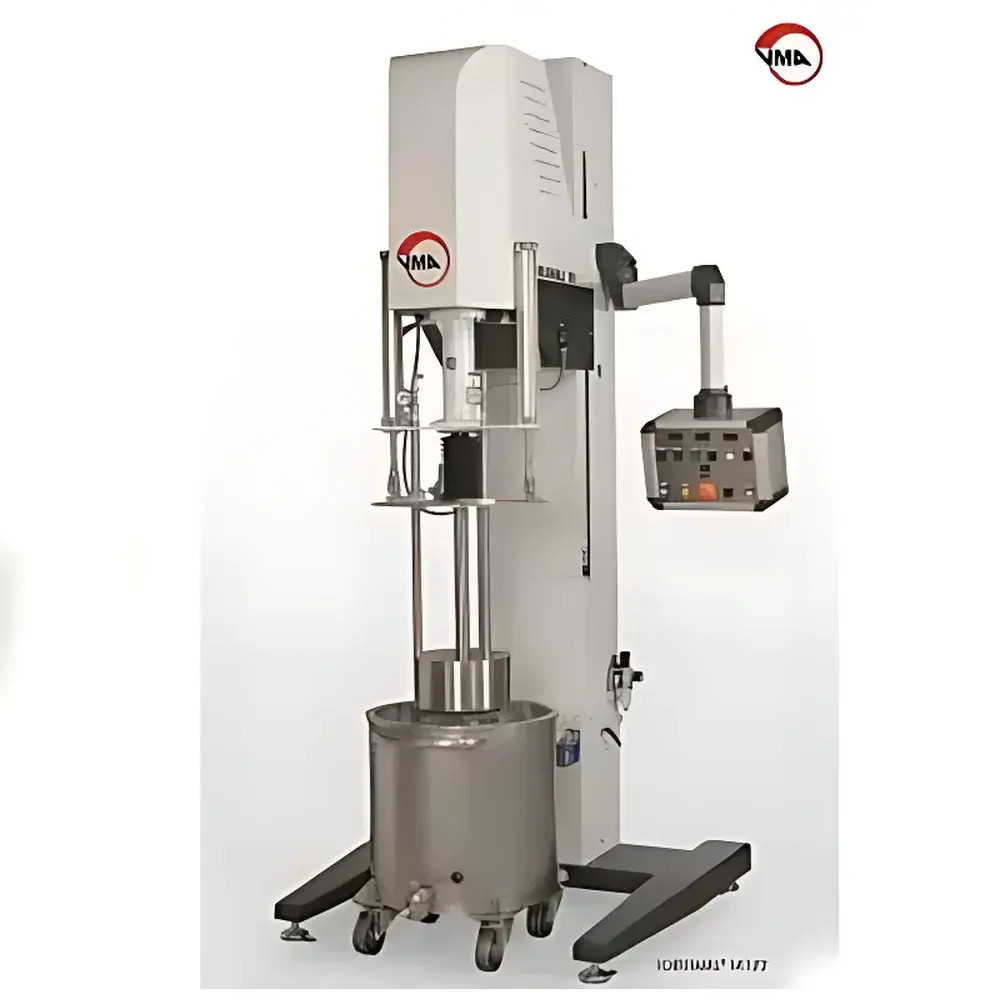
VMA SK537 Torusmill® SK Series Laboratory-Scale High-Power Basket Mill
| Brand | VMA |
|---|---|
| Origin | Germany |
| Model | SK537 |
| Power Output | 37 kW |
| Working Volume Range | 200–1250 L |
| Cooling/Heating Capability | Dual-Wall Grinding Basket |
| Drive | Variable-Frequency Drive (VFD) |
| Pump System | Integrated Patented Rotor-Stator Circulation Pump |
| Dispersing Disc | Bottom-Mounted, Dead-Zone-Free |
| Viscosity Range | Low to Medium |
| Compliance | CE, ISO 9001, Designed per ASTM D4290 & ISO 8770 for Particle Size Reduction Validation |
Overview
The VMA SK537 Torusmill® SK Series Laboratory-Scale High-Power Basket Mill is an engineered solution for scalable, reproducible wet grinding and dispersion of pigments, ceramics, battery slurries, pharmaceutical suspensions, and advanced nanocomposites. Operating on the principle of high-shear recirculation grinding, the SK537 utilizes a rotating basket containing grinding media (e.g., zirconia or glass beads) immersed in the process slurry. A patented internal rotor-stator pump continuously draws material from the vessel base, forces it upward through the grinding basket, and returns it to the tank—ensuring multiple passes per unit time. This closed-loop circulation architecture delivers narrow particle size distributions (PSD), minimized thermal load via dual-wall basket cooling, and exceptional batch-to-batch consistency. Designed for technology transfer—from lab-scale formulation (200 L) to pilot or pre-production batches (up to 1250 L)—the SK537 bridges the gap between R&D validation and GMP-compliant scale-up.
Key Features
- 37 kW High-Efficiency Drive System: Delivers consistent torque across the full speed range (0–1500 rpm, VFD-controlled), enabling precise shear rate modulation for sensitive materials such as shear-thinning polymer dispersions or fragile nano-agglomerates.
- Dual-Wall Temperature-Controlled Grinding Basket: Integrated jacketed design allows simultaneous heating (up to 80°C) or cooling (down to 5°C) using external thermo-regulated fluid, maintaining process stability during extended grinding cycles and preventing thermal degradation.
- Bottom-Mounted Dispersing Disc + Patented Circulation Pump: Eliminates sedimentation and dead zones in the vessel floor; ensures complete homogenization of high-density fillers (e.g., LiFePO₄, TiO₂, carbon black) without manual scraping or supplemental agitation.
- Modular Vessel Compatibility: Accommodates standard stainless-steel tanks (DIN 11850 / ASME BPE compliant) with volumes from 200 L to 1250 L—no re-engineering required when transitioning between development and pilot-scale trials.
- Robust Mechanical Architecture: Fully welded 316L stainless-steel construction, IP55-rated motor housing, explosion-proof optional configuration (ATEX Zone 1/21), and vibration-damped mounting for long-term operational reliability under continuous duty.
Sample Compatibility & Compliance
The SK537 is validated for use with low- to medium-viscosity suspensions (≤ 5,000 mPa·s at 25°C), including aqueous, solvent-based, and polar non-aqueous systems. It supports grinding media sizes from 0.3 mm to 2.0 mm and is routinely employed in applications requiring compliance with ISO 8770 (determination of pigment dispersion quality), ASTM D4290 (particle size analysis of pigment dispersions), and ICH Q5a (characterization of particulate impurities in biopharmaceuticals). Its mechanical design conforms to EU Machinery Directive 2006/42/EC and carries CE marking. Full traceability documentation—including FAT/SAT reports, material certificates (EN 10204 3.1), and electrical safety test records—is provided upon delivery.
Software & Data Management
While the SK537 operates as a standalone instrument, its VFD drive and optional PLC interface support integration into centralized process control networks (Modbus TCP, Profibus DP). All operational parameters—including rotational speed, circulation flow rate (via optional inline flowmeter), basket temperature, and runtime—are logged with timestamped records. When paired with VMA’s optional ProcessLog™ software module, data export complies with FDA 21 CFR Part 11 requirements (electronic signatures, audit trail, user access levels), supporting GLP/GMP environments where regulatory traceability is mandatory.
Applications
- Electrode slurry milling for lithium-ion battery cathode/anode formulations
- Dispersion of quantum dots, metal oxides, and conductive nanomaterials for printed electronics
- Stabilization of organic pigment dispersions in automotive and industrial coatings
- Preparation of uniform ceramic slurries for tape casting and additive manufacturing feedstocks
- Particle size refinement of active pharmaceutical ingredients (APIs) in suspension-based drug products
FAQ
What is the minimum recommended working volume for stable operation?
The SK537 achieves optimal circulation dynamics and heat dissipation at ≥200 L; operation below this threshold may compromise media retention and temperature control.
Can the grinding basket be cleaned in place (CIP)?
Yes—the basket assembly is fully removable and compatible with standard CIP protocols using caustic or solvent-based cleaning agents; all wetted surfaces are electropolished 316L SS (Ra ≤ 0.4 µm).
Is validation support available for GMP process qualification?
VMA provides IQ/OQ documentation templates, calibration certificates for integrated sensors, and assistance with protocol development aligned with Annex 15 and ASTM E2500.
What grinding media types are compatible?
Zirconium oxide (Y-TZP), silicon carbide, and high-alumina ceramics are routinely used; media density and hardness must be selected based on target PSD and chemical compatibility per ASTM F2634.
Does the system include safety interlocks for basket access?
Yes—mechanical door interlocks and emergency stop circuitry comply with EN ISO 13857 and EN 60204-1, preventing rotation during maintenance access.



