
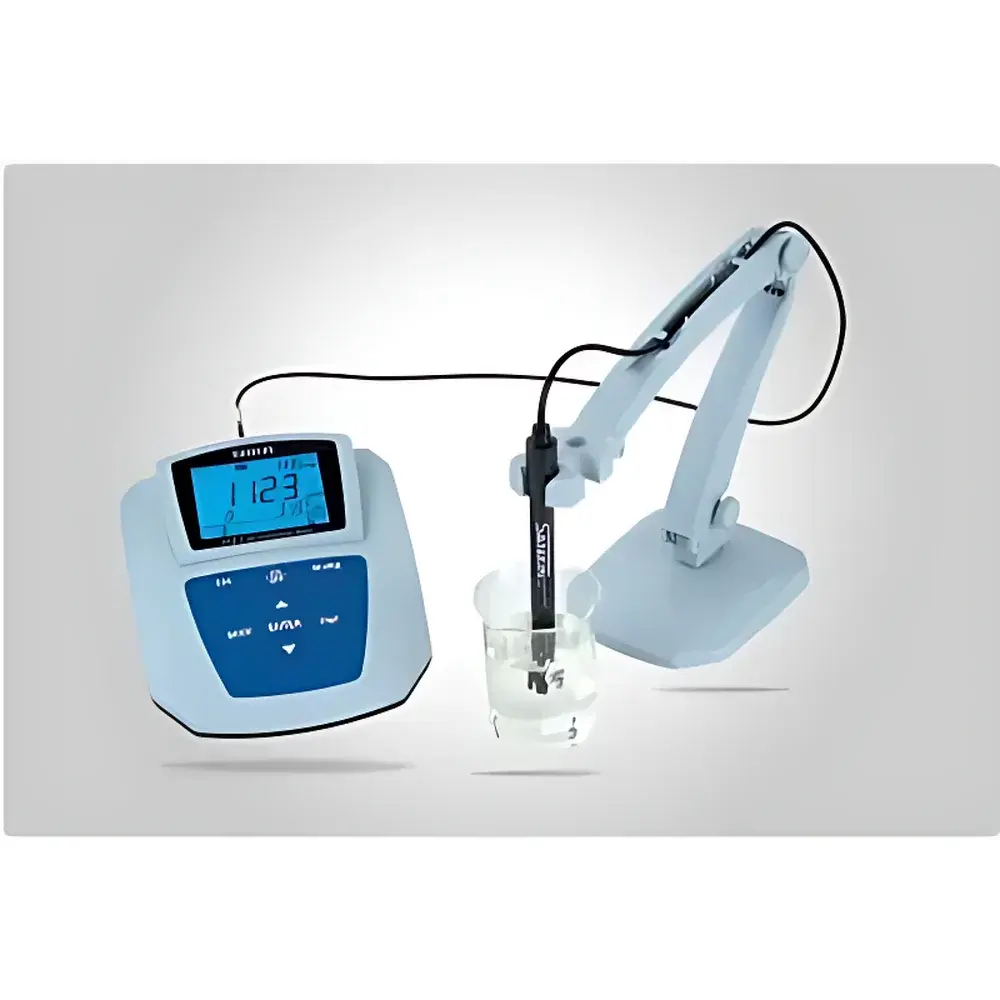
SANXIN MP513 Benchtop Conductivity Meter
| Brand | SANXIN |
|---|---|
| Origin | Shanghai, China |
| Manufacturer Type | Direct Manufacturer |
| Instrument Type | Benchtop |
| Measurement Parameters | Single-Parameter (Conductivity) |
| Conductivity Range | 0–200 mS/cm (5 auto-ranging segments) |
| TDS Range | 0–100 g/L |
| Resistivity Range | 0–100 MΩ·cm |
| Salinity Range | 0–100 ppt |
| Temperature Range | −10 to +100 °C |
| Accuracy | ±1.0% FS (Conductivity), ±1.5% FS (Overall Specified Range) |
| Minimum Resolution | 0.001 µS/cm |
| Temperature Compensation | Automatic (0–50 °C, ATC) |
| Data Storage | 100 sets |
| Interface | RS232 |
| Power Supply | DC 9 V / 300 mA |
| Dimensions | 160 × 190 × 70 mm |
| Weight | 880 g |
| IP Rating | IP54 |
| Compliance | GLP-compliant design with audit-ready data handling |
Overview
The SANXIN MP513 Benchtop Conductivity Meter is a precision-engineered electrochemical instrument designed for routine, high-reproducibility conductivity measurements in laboratory water quality analysis, pharmaceutical QC, environmental monitoring, and academic research settings. It operates on the principle of two-electrode AC conductometric measurement, applying a low-frequency alternating current across a K = 1.0 cell to determine solution conductance while minimizing polarization effects and electrode fouling. The instrument supports full-range coverage from ultrapure water (0.001 µS/cm) to highly concentrated brines (200 mS/cm) through intelligent auto-ranging—divided into five overlapping segments—to ensure optimal signal-to-noise ratio and linearity at all concentrations. Built-in automatic temperature compensation (ATC) adheres to the DIN/ISO 7888 standard algorithm, referencing conductivity to 25 °C using a built-in NTC thermistor integrated into the 2301-M electrode. Its robust architecture, sealed interface design, and GLP-aligned functionality make it suitable for regulated environments requiring traceable, repeatable results.
Key Features
- Single-point calibration capability with K = 1.0 cell—enabling full 0–200 mS/cm range coverage without manual range switching or multi-point verification
- Digital filtering and sliding-average algorithms to suppress noise and enhance stability; visual “stable reading” indicator confirms measurement convergence
- Simultaneous real-time display and on-demand toggle between conductivity (µS/cm, mS/cm), resistivity (MΩ·cm), TDS (g/L, ppm), and salinity (ppt)
- Integrated clock and calendar for time-stamped data logging; 100 measurement records stored with parameter, date, time, and temperature metadata
- RS232 serial interface with included PC communication software for export to CSV or direct integration into LIMS or ELN systems
- IP54-rated enclosure with silicone-capped ports and rugged ABS housing—designed for benchtop use in humid or splash-prone lab environments
- Auto-variable frequency and voltage excitation technology minimizes electrode polarization and improves accuracy across wide concentration gradients
Sample Compatibility & Compliance
The MP513 is optimized for aqueous solutions including deionized water, process water, wastewater effluents, buffer solutions, saline standards, and electrolyte preparations. It is not intended for non-aqueous, viscous, or suspended-particle-laden samples without prior filtration. The supplied 2301-M plastic-bodied conductivity cell features a built-in ATC sensor and platinum black plating for stable performance in low- to medium-conductivity matrices. All firmware and data handling comply with GLP requirements: each stored reading includes immutable timestamps, operator ID fields (configurable), and uneditable audit trails. While not certified to FDA 21 CFR Part 11 out-of-the-box, the instrument’s deterministic output, non-volatile memory, and RS232 traceability support validation protocols for ISO/IEC 17025-accredited laboratories and USP purified water testing workflows.
Software & Data Management
Data transfer is facilitated via the included Windows-compatible RS232 communication suite, supporting batch export in comma-separated values (CSV) format with column headers for conductivity, temperature, TDS, resistivity, salinity, date, and time. The software enables basic graphing, statistical summary (mean, SD, min/max), and report generation compliant with internal QA templates. No cloud dependency or proprietary drivers are required—standard Windows COM port configuration suffices. All stored measurements retain their original acquisition context; no post-hoc editing or deletion is possible from the device interface, preserving data integrity per ALCOA+ principles.
Applications
- Pharmaceutical water system validation (PW, WFI, Purified Water per USP )
- Environmental lab analysis of surface water, groundwater, and wastewater discharge compliance (EPA Method 120.1, ISO 7888)
- Quality control of buffer solutions, cleaning agents, and rinse waters in biomanufacturing
- Academic teaching labs for fundamental electrochemistry and solution property characterization
- Food & beverage production—monitoring conductivity of process streams, brines, and sanitizing solutions
- Calibration verification of inline conductivity sensors in pilot-scale systems
FAQ
Does the MP513 support multi-point conductivity calibration?
No—the MP513 implements a single-point calibration protocol optimized for K = 1.0 cells. This design eliminates inter-calibration drift and simplifies SOP execution while maintaining ±1.0% FS accuracy across its full dynamic range.
Can the instrument measure conductivity below 1 µS/cm reliably?
Yes—when used with proper technique (e.g., air-free cell handling, shielded cables, low-contamination environment), the MP513 achieves stable readings down to 0.001 µS/cm in the lowest range segment (0.00–20.00 µS/cm).
Is the RS232 interface compatible with modern laptops lacking serial ports?
Yes—standard USB-to-RS232 adapters (FTDI chipset recommended) enable seamless connectivity; no additional drivers beyond those provided with the adapter are required.
What is the service life expectation of the 2301-M electrode?
Under typical lab use and proper storage (in KCl solution or damp sponge), the 2301-M electrode maintains calibration stability for ≥12 months; periodic verification against traceable standards is advised per ISO/IEC 17025 clause 6.4.
Does the MP513 meet ASTM D1125 or ISO 7888 requirements?
Yes—the instrument’s measurement algorithm, temperature compensation model, and specified accuracy align with the core performance criteria defined in both ASTM D1125-22 and ISO 7888:2019 for laboratory conductivity meters.



