
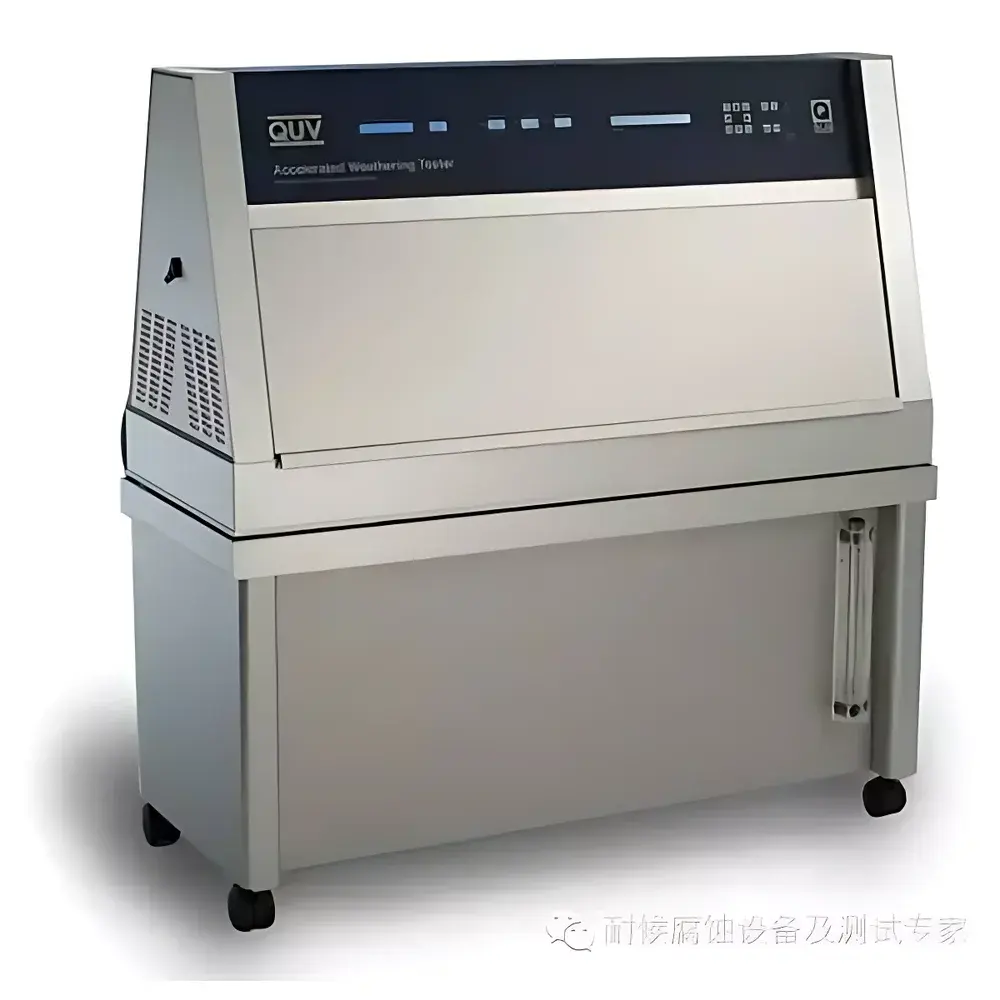
Q-Lab QUV Accelerated UV Weathering Test Chamber
| Brand | Q-LAB |
|---|---|
| Origin | USA |
| Model | QUV |
| Type | UV Aging Test Chamber |
| Light Source | Fluorescent UV Lamps (UVA-340, UVB-313, or UVA-351) |
| Condensation System | Yes |
| Water Spray System | Optional (QUV/spray, QUV/se) |
| Irradiance Control | Yes (via calibrated sensor & feedback loop) |
| Black Panel Temperature Range | 40–80 °C |
| Chamber Temperature Range (Condensation) | 40–60 °C |
| Sample Capacity | Up to 48 specimens (75 mm × 150 mm) |
| Power Supply | 120/230 V, 50/60 Hz, up to 1800 W |
| Water Consumption | 8 L/day (condensation), 7 L/min (spray, peak) |
| Lamp Life | 1600–5000 h (model-dependent) |
| Compliance | ASTM G154, ISO 4892-3, SAE J2020, IEC 61215, MIL-STD-810, FDA 21 CFR Part 11 (with optional software) |
Overview
The Q-Lab QUV Accelerated UV Weathering Test Chamber is an industry-standard instrument engineered for reproducible, controlled simulation of solar ultraviolet radiation and moisture-induced degradation mechanisms. Unlike broad-spectrum xenon arc or carbon arc testers, the QUV employs fluorescent UV lamps—primarily UVA-340 (mimicking terrestrial sunlight down to 295 nm) and UVB-313 (for aggressive, accelerated testing)—to deliver high-intensity, spectrally stable short-wave UV exposure. Its core design integrates two distinct yet complementary moisture mechanisms: condensation cycling (simulating dew formation) and optional water spray (simulating thermal shock and surface erosion). This dual-moisture architecture enables precise replication of key outdoor aging stressors—photochemical degradation, hydrolysis, and cyclic thermal-mechanical strain—within a compact, programmable laboratory environment.
Key Features
- UV Spectral Fidelity: Standard lamp options include UVA-340 (closest match to solar UV below 365 nm), UVB-313 (enhanced photodegradation for rapid screening), and UVA-351 (simulating through-window exposure); all calibrated per ISO 4892-3 and ASTM G154 Annex A2.
- Condensation-Driven Humidity Control: A heated water pan generates saturated vapor; specimen backs are cooled by ambient lab air, inducing continuous, uniform condensate formation on exposed surfaces—replicating >12 hours/day dew exposure typical in real-world field conditions.
- Programmable Irradiance Regulation: Closed-loop control via broadband UV radiometer (calibrated traceable to NIST standards) maintains setpoint irradiance (e.g., 0.68 W/m² @ 340 nm) within ±5% tolerance across lamp life, compensating for spectral drift and intensity decay.
- Black Panel Temperature Monitoring: Integral black panel sensors (ASTM D4329 compliant) measure surface temperature directly on specimen holders, enabling accurate correlation between radiant heating and material thermal response.
- Modular Configuration Options: Base models (QUV/basic) support condensation-only cycles; QUV/se adds irradiance control and extended temperature range; QUV/spray integrates timed water spray with programmable pressure, duration, and cooldown intervals.
- Robust Construction & Safety: Stainless steel chamber interior, corrosion-resistant hardware, overtemperature cutoff, UV interlock door switch, and leak-detection circuitry ensure long-term operational integrity and personnel protection.
Sample Compatibility & Compliance
The QUV accommodates flat, rigid specimens up to 75 mm × 150 mm × 10 mm thick (standard fixture), with custom racks available for non-standard geometries including coatings on metal panels, polymer films, automotive trim, and photovoltaic module encapsulants. All models comply with critical international test standards including ASTM G154 (Cycle A1–A5), ISO 4892-3 (Method A, B, C), SAE J2020, IEC 61215 (for PV materials), and MIL-STD-810G Method 505.5. When paired with Q-Lab’s optional QUV Software Suite (v5.0+), the system supports full audit trail generation, electronic signatures, and 21 CFR Part 11 compliance—including user access controls, data immutability, and change history logging—meeting GLP and GMP documentation requirements for regulated industries.
Software & Data Management
Q-Lab’s proprietary QUV Software Suite provides intuitive cycle programming, real-time monitoring of irradiance, black panel temperature, chamber temperature, and condensation duration. It enables creation of multi-step sequences (e.g., 4-hr UV @ 60 °C + 4-hr condensation @ 50 °C), automatic data export to CSV or PDF reports, and integration with enterprise LIMS platforms via OPC UA or RESTful API. The software logs all parameter changes, operator IDs, calibration events, and alarm states with timestamped entries—fully satisfying FDA 21 CFR Part 11 requirements for electronic records and signatures. Optional cloud-based data backup and remote diagnostics extend system uptime and support global lab coordination.
Applications
The QUV is deployed across R&D, quality assurance, and regulatory submission workflows for polymers, paints & coatings, automotive interiors/exterior trim, architectural glazing, medical device packaging, and photovoltaic materials. Typical use cases include: evaluating UV stabilizer efficacy in polyolefins; assessing gloss retention and chalking resistance in acrylic emulsion paints; validating weatherability claims for exterior signage substrates; qualifying adhesion durability of laminated safety glass interlayers; and screening encapsulant yellowing in solar modules per IEC 61215. Its acceleration ratio—typically 2–5× faster than xenon arc for UV-driven failures—enables rapid iteration while maintaining mechanistic relevance to field performance.
FAQ
What UV lamp types are supported, and how do they differ?
Standard options include UVA-340 (best solar match), UVB-313 (high-energy, accelerated failure mode induction), and UVA-351 (for indoor/filtered-light exposure). Lamp selection is application-specific and defined in ASTM G154 and ISO 4892-3.
Can the QUV replicate visible light or infrared effects?
No—the QUV focuses exclusively on UV-driven degradation mechanisms. For full-spectrum solar simulation including visible and IR heating, Q-Lab’s Q-SUN xenon test chambers are recommended.
Is distilled or deionized water required for operation?
Deionized water is mandatory for spray systems to prevent nozzle clogging and mineral deposits; condensation systems accept tap water but perform optimally with DI water to minimize maintenance.
How often must UV sensors be recalibrated?
Annual recalibration against a NIST-traceable reference sensor is recommended; Q-Lab offers certified calibration services with documented uncertainty budgets per ISO/IEC 17025.
Does the QUV meet environmental compliance standards such as RoHS or REACH?
Yes—Q-Lab certifies full compliance with EU RoHS Directive 2011/65/EU and REACH Regulation (EC) No. 1907/2006 for all materials used in chamber construction and lamp assemblies.



