
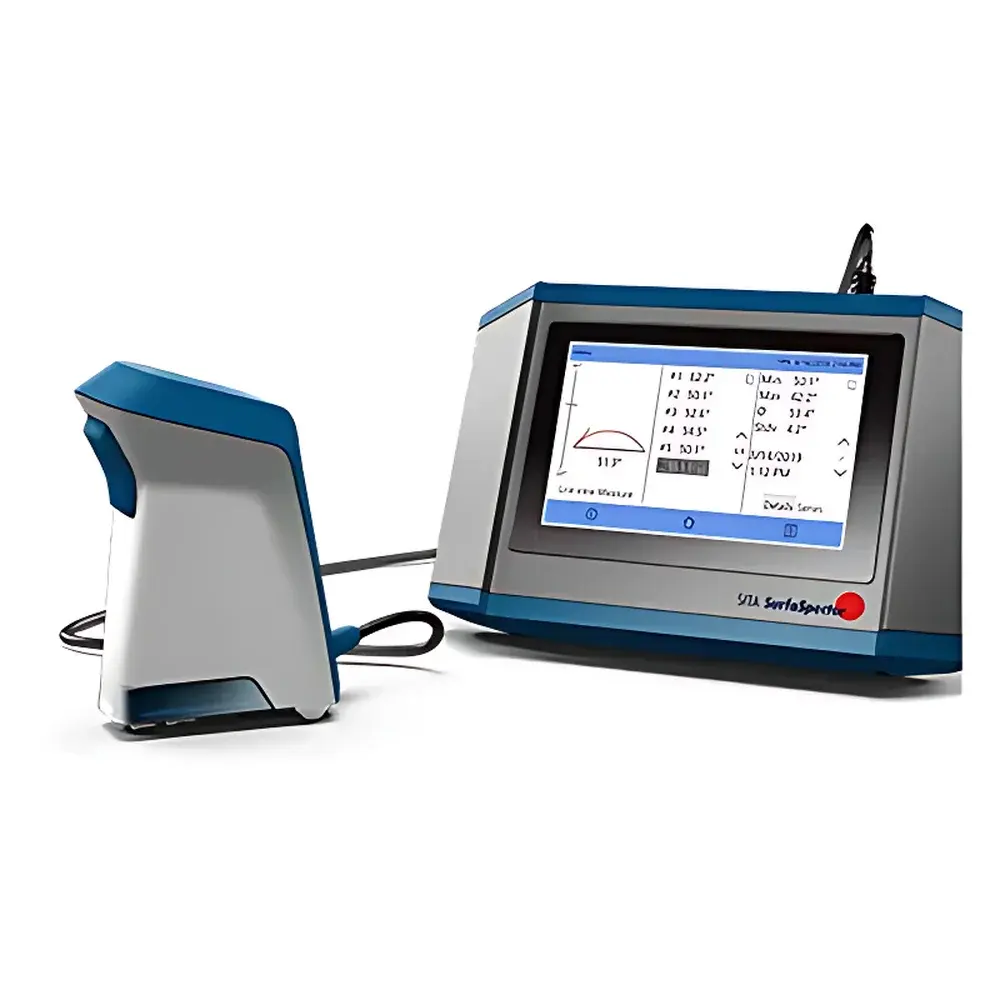
SITA SurfaSpector Portable Dynamic Contact Angle Analyzer
| Brand | SITA |
|---|---|
| Origin | Germany |
| Model | SurfaSpector |
| Instrument Type | Portable Dynamic Contact Angle Analyzer |
| Contact Angle Range | 5°–175° |
| Contact Angle Accuracy | ±0.1° |
| Sample Stage Size | 5 × 5 mm |
| Optical Magnification | 100× |
| Surface/Interfacial Tension Range | 0–100 mN/m |
| Surface/Interfacial Tension Accuracy | ±0.01 mN/m |
| Measurement Method | Optical Sessile Drop with Shadow Projection & Perspective-Corrected Image Analysis |
| Minimum Sample Area | 5 × 5 mm |
| Test Liquid | Ultra-Pure Water (5 mL internal reservoir, ~5,000 measurements per fill) |
| Power | Rechargeable Battery (≥6 h continuous operation) |
| Interface | USB (data transfer & charging) |
| Display | 5" TFT Touchscreen (800 × 480 px) |
Overview
The SITA SurfaSpector Portable Dynamic Contact Angle Analyzer is an engineered optical instrument designed for rapid, field-deployable assessment of surface wettability and interfacial energetics on solid substrates. It operates on the sessile drop principle, enhanced by a patented shadow projection methodology: an automated micro-dosing system dispenses a precisely controlled 1 µL water droplet onto the sample surface; side-illuminated light casts the droplet’s silhouette onto a calibrated inclined reference plane; and a top-mounted high-resolution camera captures the perspective-distorted shadow image. Proprietary real-time perspective correction algorithms reconstruct the true droplet profile, enabling robust contact angle calculation via tangent-fitting at the three-phase boundary line. This approach eliminates reliance on lens-based magnification calibration and minimizes operator-induced parallax errors—critical for reproducible measurements on curved, textured, or irregularly shaped industrial parts. The device is optimized for routine quality control in manufacturing environments where surface cleanliness, plasma activation efficacy, coating adhesion readiness, or cleaning process validation must be verified objectively and traceably.
Key Features
- True portable architecture: self-contained unit with integrated battery, touch interface, and onboard processing—no external PC required for basic measurement execution.
- Automated workflow: fully motorized liquid dispensing, auto-focus imaging, shadow capture, geometric correction, and contact angle computation within <3 seconds per measurement.
- Robust optical design: 100× effective magnification achieved via fixed-focus shadow projection optics, eliminating focus drift during field use or thermal cycling.
- Intuitive 5-inch TFT touchscreen (800 × 480 px) with gesture-enabled UI for threshold adjustment, pass/fail limit setting, and immediate result visualization.
- On-device data logging: stores up to 10,000 measurement records with timestamp, location tag (optional GPS integration), operator ID, and environmental metadata (ambient temperature/humidity if externally sensed).
- Modular software compatibility: optional SITA-SurfaceLog desktop application supports advanced statistical analysis, multi-curve overlay, GLP-compliant audit trails, and export to CSV, PDF, or XML formats compliant with ISO/IEC 17025 documentation requirements.
Sample Compatibility & Compliance
The SurfaSpector accommodates flat, convex, concave, or moderately curved surfaces—provided the local measurement area exceeds 5 × 5 mm and exhibits sufficient optical contrast for shadow delineation. It is routinely deployed for post-cleaning verification of metallic components (e.g., aluminum die-cast housings, stainless-steel medical devices), plasma-treated polymer films (PET, PP, PE), silanized glass substrates, and printed circuit board (PCB) solder masks. Its measurement protocol aligns with ASTM D7334–22 (“Standard Practice for Surface Energy Determination of Polymer Coatings Using Contact Angle Measurements”) and supports traceable compliance with ISO 8251–2 (“Metallic coatings — Wettability testing”) and VDA 230-204 (“Surface cleanliness of metallic materials”). All firmware and software modules are designed to meet FDA 21 CFR Part 11 requirements for electronic records and signatures when used with validated SITA-SurfaceLog configurations under GMP/GLP environments.
Software & Data Management
SITA-SurfaceLog provides full lifecycle data governance: raw image archives, corrected droplet contours, dynamic contact angle sequences (advancing/receding), surface energy estimation (Owens-Wendt, Wu, Fowkes models), and statistical summaries (mean, SD, Cp/Cpk). Audit trail functionality logs every user action—including parameter changes, result edits, and report generation—with immutable timestamps and digital signature support. Data exports conform to LIMS-compatible schemas and include embedded metadata required for ISO/IEC 17025 accreditation audits. Optional cloud synchronization enables centralized fleet monitoring across multiple production lines or supplier sites, with role-based access control and encrypted TLS 1.3 transmission.
Applications
- Validation of aqueous cleaning efficacy in automotive brake component manufacturing.
- Quantitative assessment of plasma activation decay over time on polyolefin packaging films.
- In-line verification of corona treatment uniformity prior to flexographic printing.
- Root-cause analysis of adhesive bonding failures via surface energy mapping.
- Quality release testing of medical-grade silicone tubing after solvent degreasing.
- Monitoring hydrophobic recovery kinetics on UV-ozone treated quartz optical components.
FAQ
Does the SurfaSpector require calibration with standard reference surfaces?
Yes—annual recalibration using certified polystyrene (65° ± 2°) and PTFE (110° ± 3°) reference slides is recommended per ISO 15985 and documented in the instrument’s calibration certificate.
Can it measure advancing and receding contact angles dynamically?
Yes—the automated dosing system supports sequential incremental volume addition (0.1–2 µL steps) to generate dynamic contact angle curves, enabling hysteresis quantification.
Is the internal water reservoir compatible with surfactant solutions or organic solvents?
No—the fluid path and reservoir are validated exclusively for ultra-pure water (resistivity ≥18.2 MΩ·cm); alternative test liquids require external syringe pump integration and separate validation.
What environmental conditions affect measurement stability?
Ambient air currents >0.2 m/s, relative humidity 80%, and surface temperatures outside 15–35°C may introduce edge detection artifacts; built-in environmental sensors trigger advisory alerts when thresholds are exceeded.
How is measurement traceability ensured for regulatory submissions?
Each measurement record includes embedded cryptographic hash, firmware version, sensor serial number, and NIST-traceable time stamp; SITA-SurfaceLog generates 21 CFR Part 11–compliant electronic signatures upon report finalization.
Related Products



