
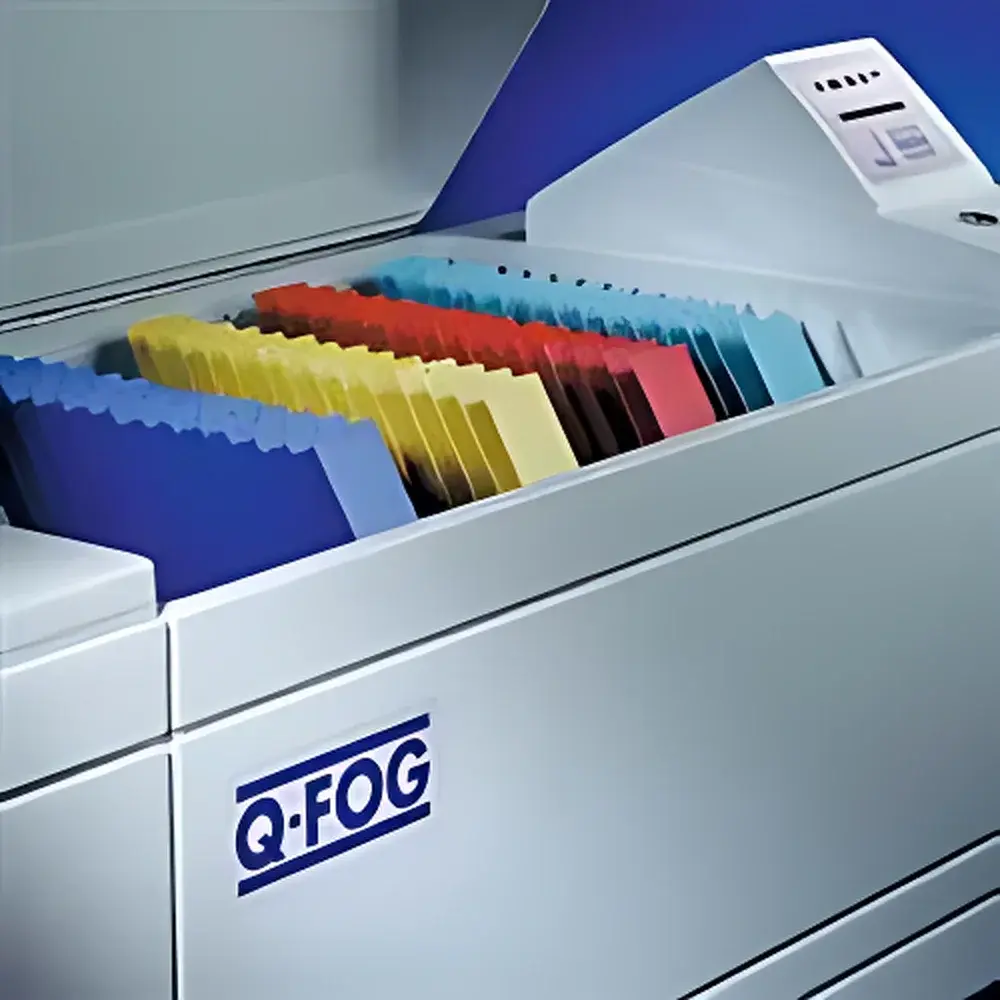
Q-LAB SSP1100 Salt Spray Corrosion Test Chamber
| Brand | Q-LAB |
|---|---|
| Origin | USA |
| Model | SSP1100 |
| Salt Fog Deposition Rate | Compliant with ASTM B117 and ISO 9227 (adjustable via calibrated nozzles) |
| Temperature Range | 15–50 °C (operational stability ±1 °C) |
| Chamber Capacity | 1100 L (internal usable volume) |
| Compliance | ASTM B117, ISO 9227, JIS Z2371, DIN 50021, GB/T 10587 |
| Control System | Programmable touchscreen controller with audit trail capability |
| Humidity Control | 100% RH during wet/humid cycles (via steam generator) |
| Dry Cycle Capability | Down to ≤30% RH (forced-air heated drying) |
| Prohesion™-Ready Configuration | Yes (dual-solution reservoirs, rapid transition logic) |
Overview
The Q-LAB SSP1100 Salt Spray Corrosion Test Chamber is an engineered environmental test system designed for accelerated evaluation of material resistance to chloride-induced degradation under standardized laboratory conditions. Based on the fundamental principles of electrochemical corrosion acceleration—where NaCl aerosol exposure drives anodic dissolution and cathodic oxygen reduction—the SSP1100 replicates critical failure mechanisms observed in coastal, industrial, and de-icing environments. Unlike single-condition salt fog chambers, the SSP1100 supports full-cycle corrosion testing per ASTM G85 Annex A5 (Prohesion™), enabling precise simulation of real-world exposure sequences: alternating salt spray, dry, and high-humidity phases. Its thermally stable chamber architecture ensures uniform temperature distribution (±1 °C), while calibrated nozzle arrays deliver reproducible fog deposition rates compliant with ASTM B117 (1.0–2.0 mL/80 cm²/h) and ISO 9227. As a U.S.-manufactured instrument certified to UL 61010-1 and CE standards, it serves as a primary tool for R&D validation, QC release testing, and regulatory compliance documentation across automotive, aerospace, electronics, and coating industries.
Key Features
- Programmable multi-segment cycle control supporting up to 999 steps per test profile, with independent setpoints for temperature, humidity, spray duration, and solution type
- Dual-reservoir design for seamless Prohesion™ operation: one reservoir for neutral 5% NaCl, another for acidic (0.35% NH₄SO₄ + 0.05% NaCl) or alkaline solutions
- Steam-based humidification system delivering 100% RH at temperatures up to 49 °C; integrated steam generator maintains thermal equilibrium without condensate pooling
- Forced-air drying subsystem with PID-controlled air heater and exhaust modulation, achieving ≤30% RH in <15 minutes from saturated conditions
- Self-diagnostic firmware with maintenance alerts (e.g., nozzle clogging, solution level, compressor pressure, heater status) logged with timestamps and severity codes
- Touchscreen controller with password-protected user roles, real-time graphing, and exportable CSV data logs compliant with FDA 21 CFR Part 11 requirements
Sample Compatibility & Compliance
The SSP1100 accommodates test specimens up to 600 mm × 600 mm × 500 mm (W×D×H) on adjustable racks, supporting flat panels, assembled components, PCBs, fasteners, coated substrates, and small enclosures. Its chamber geometry and airflow dynamics are validated per ISO 9227 Annex B to ensure spatial uniformity of fog distribution and temperature homogeneity. The system meets mandatory regulatory frameworks including ASTM B117 (neutral salt spray), ASTM G85 Annex A1–A5 (modified cyclic tests), ISO 14993 (cyclic corrosion testing), and JIS Z2371. For GLP/GMP environments, optional IQ/OQ documentation packages and electronic signature modules are available. All hardware and software configurations undergo annual traceable calibration against NIST-traceable references.
Software & Data Management
The embedded Q-Lab Controller OS v4.2 provides intuitive graphical programming of complex corrosion protocols—including ramped temperature transitions, variable spray pressures, and timed solution switching—with built-in validation checks to prevent invalid parameter combinations. Data acquisition records chamber temperature, relative humidity, spray status, solution conductivity, and fault events at 1-second intervals. Raw logs are stored internally (16 GB SSD) and exportable via USB or Ethernet to LIMS-compatible formats. Audit trails include operator ID, timestamp, parameter changes, and system diagnostics—fully aligned with FDA 21 CFR Part 11 requirements for electronic records and signatures. Optional Q-Lab’s SunTest® Cloud integration enables remote monitoring, multi-site fleet management, and automated report generation (PDF/Excel).
Applications
- Qualification of automotive exterior coatings and galvanized steel components per SAE J2334 and GMW14872
- Corrosion resistance validation of printed circuit board finishes (ENIG, immersion silver, OSP) per IPC-J-STD-003
- Comparative assessment of zinc-nickel, aluminum-zinc, and chromate conversion coatings per ASTM B633 and ISO 4520
- Accelerated lifetime prediction of marine-grade stainless steels (e.g., 316L, duplex 2205) under cyclic chloride exposure
- Process control verification for electroplating, powder coating, and e-coat lines in accordance with ISO 2081 and ISO 27208
- Material screening for offshore wind turbine components subjected to combined salt fog, UV, and thermal cycling
FAQ
What standards does the SSP1100 support out-of-the-box?
ASTM B117, ISO 9227, JIS Z2371, DIN 50021, and ASTM G85 Annex A5 (Prohesion™) — all enabled via preloaded test templates and calibrated hardware.
Can the SSP1100 perform humidity-only or dry-only cycles independently?
Yes. The controller allows standalone humidification (100% RH), drying (≤30% RH), or ambient storage modes without initiating salt spray.
Is third-party calibration and certification available?
Q-LAB offers factory-certified IQ/OQ services, NIST-traceable calibration reports, and ISO/IEC 17025-accredited verification through authorized service partners.
How is fog deposition rate verified and maintained?
Deposition is measured daily using ASTM B117-compliant funnels and volumetric collection; nozzle cleaning schedules and compressed air dew point monitoring are enforced by the self-diagnostic system.
Does the SSP1100 support remote access or integration with lab automation systems?
Yes — via Ethernet TCP/IP interface supporting Modbus TCP and RESTful API for integration with SCADA, MES, or custom LIMS platforms.



