
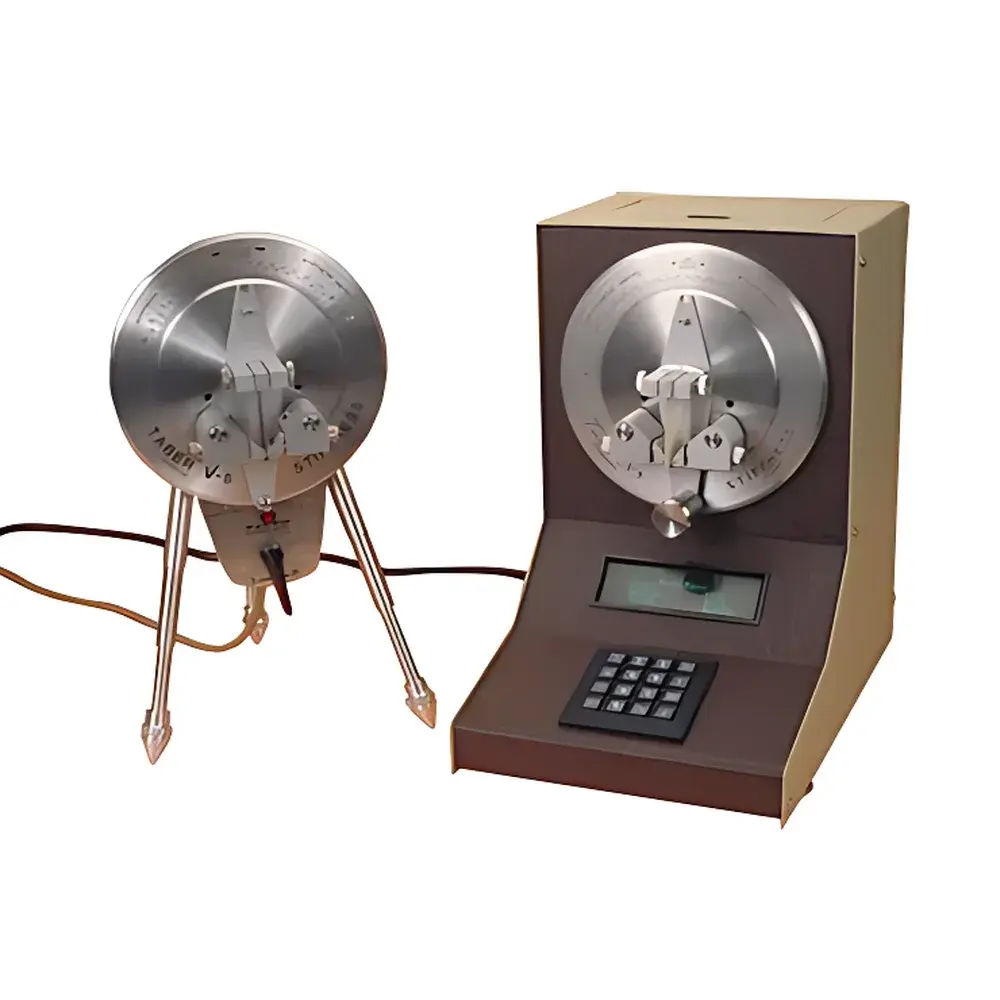
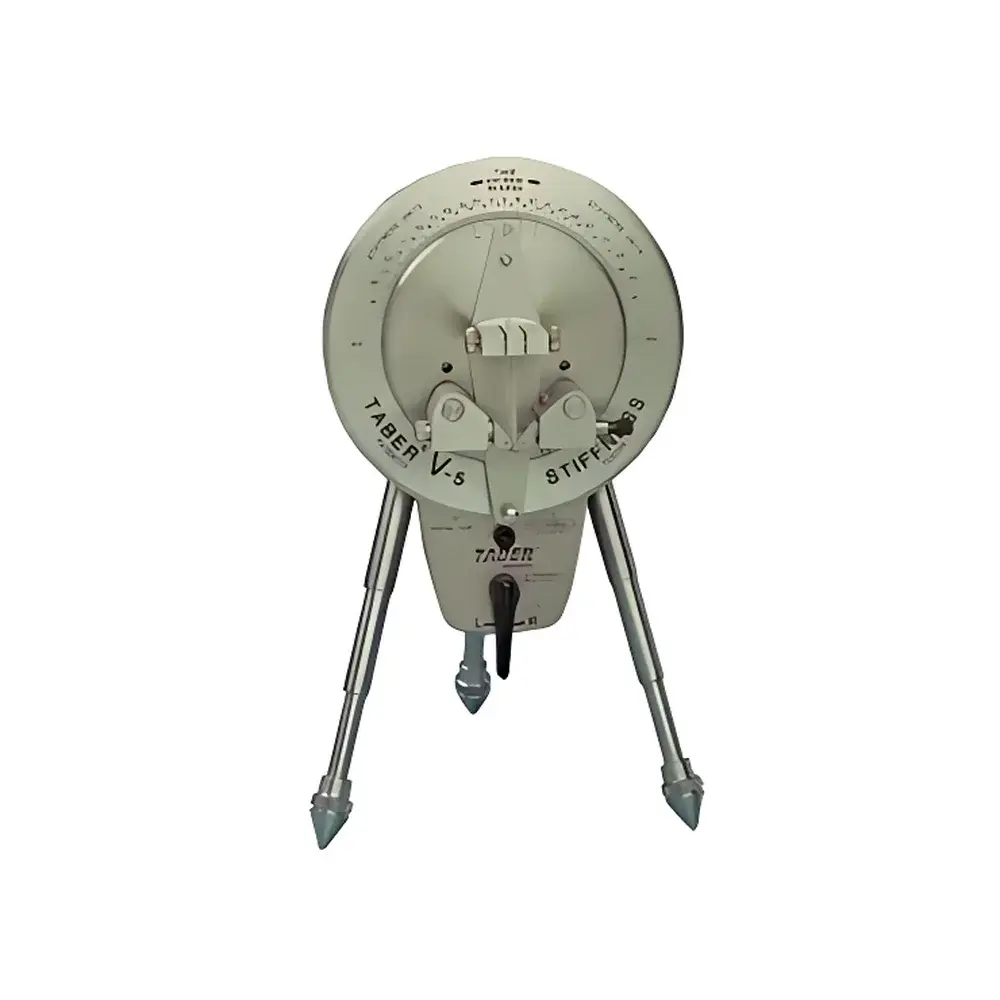
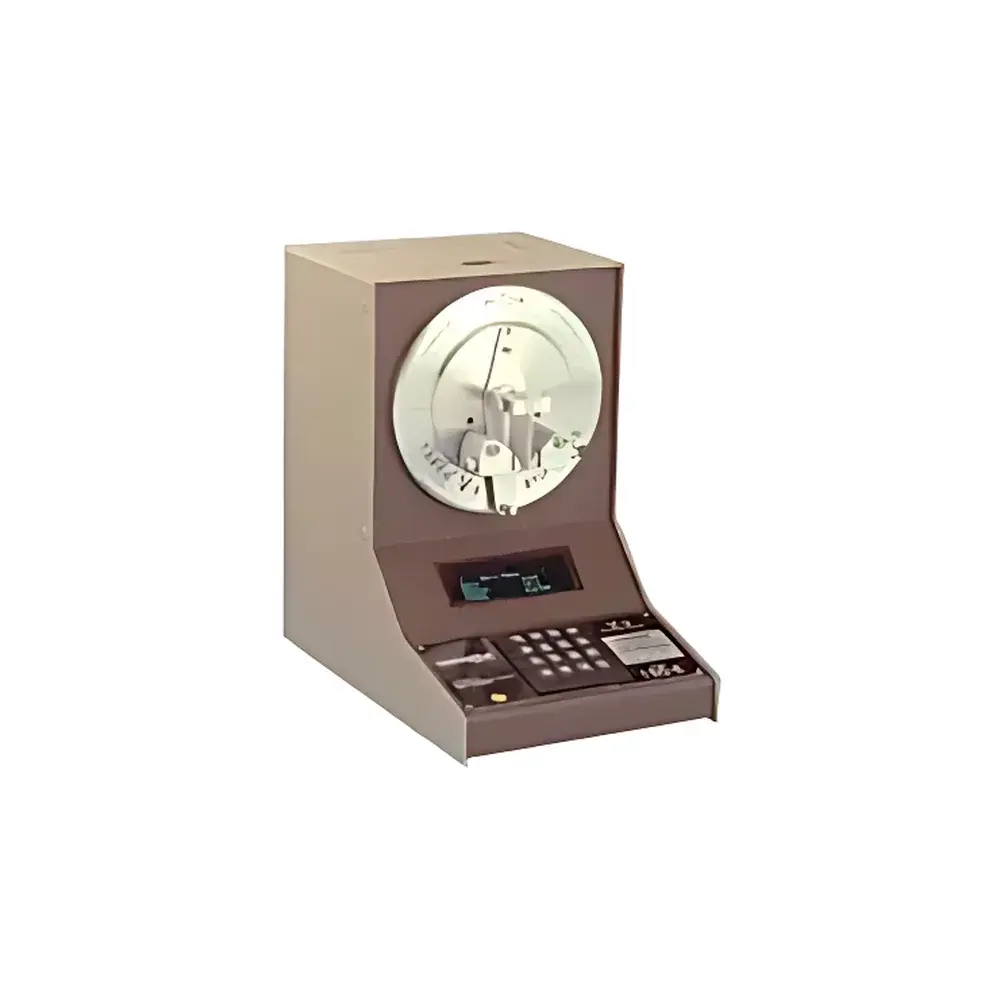
Taber 150-E Digital Stiffness Tester
| Brand | Taber |
|---|---|
| Origin | USA |
| Model | 150-E |
| Measurement Range | 0–10,000 Taber Stiffness Units (g·cm) |
| Compliance | CE Marked |
| Power Supply | 115/230 VAC, 50/60 Hz |
| Display | 4×20 Vacuum Fluorescent Display |
| Data Storage | 1,000 readings with timestamp & user-defined labels |
| Interface | RS-232 serial port, parallel printer port |
| Test parameters programmable | deflection angle, direction, cycle count |
| Accuracy | ±1% full scale (factory calibrated) |
| Sample thickness range | 0.1–5.5 mm |
Overview
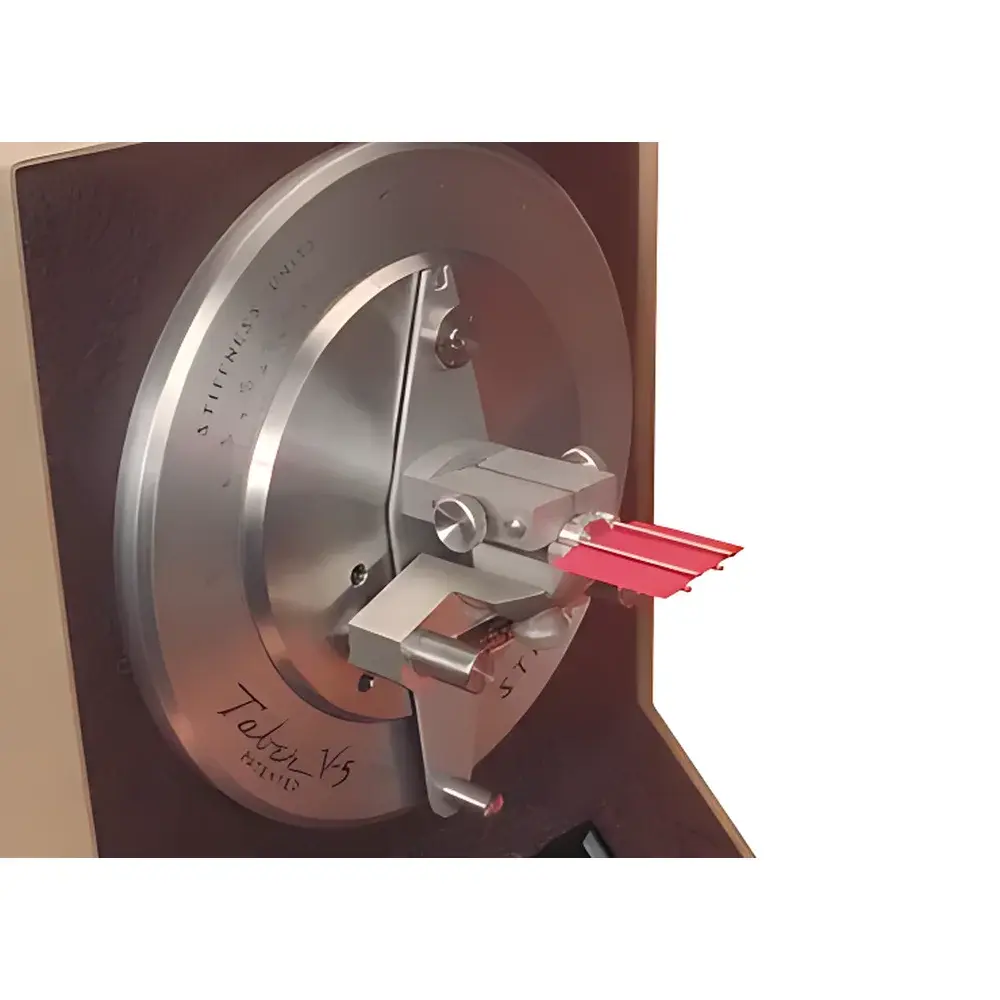
The Taber 150-E Digital Stiffness Tester is an electromechanical instrument engineered for the precise quantification of bending resistance—commonly referred to as stiffness or flexural rigidity—in thin, flexible sheet materials. It operates on the standardized Taber method, a torsional pendulum principle first established in 1937 and codified in ASTM D745, ISO 2493, TAPPI T823, and DIN 53121. In this method, a rectangular specimen (50 mm × 38 mm) is clamped at one end and subjected to a controlled angular deflection (typically 15°) via a rotating gear-driven disc. A calibrated pendulum arm, loaded with a known mass, applies torque to the specimen; the resulting angular displacement of the pendulum is directly proportional to the material’s resistance to bending. One Taber Stiffness Unit (TSU) is defined as the torque required to deflect a standard specimen by 15° under a 0.2 g load—equivalent to 1 g·cm. The 150-E implements this classical mechanical principle with digital signal acquisition, microprocessor-based calculation, and automated data logging—ensuring traceability, repeatability, and compliance with GLP and internal QA protocols.
Key Features
- Digital microprocessor control with real-time calculation of stiffness values, eliminating manual interpolation or unit conversion errors
- Programmable test parameters: deflection angle (15° standard), direction (forward/reverse), number of cycles, and sample orientation
- Integrated vacuum fluorescent display (4×20 characters) for clear readout of instantaneous and statistical results
- Onboard non-volatile memory storing up to 1,000 test records, each stamped with date, time, and user-defined identifier
- Statistical analysis engine computing mean, standard deviation, maximum, and minimum values automatically
- RS-232 serial interface and parallel printer port for direct data export to LIMS, Excel, or proprietary QA software
- CE-marked design compliant with IEC 61000-6-2 (EMC immunity) and IEC 61000-6-3 (EMC emission) standards
- Adjustable stop wheels ensure consistent specimen engagement depth across operators—minimizing inter-operator variability and clamp-induced stress artifacts
- Factory-calibrated to ±1% full-scale accuracy using NIST-traceable reference standards
Sample Compatibility & Compliance
The Taber 150-E accommodates specimens ranging from 0.1 mm to 5.5 mm in thickness, including paper, paperboard, metallic foils, plastic films, rubber sheets, vinyl laminates, textile composites, leather, felt, and rigidized fabrics. Its dual-clamp geometry—featuring fixed upper jaws and spring-loaded lower rollers—maintains uniform clamping force without slippage or localized deformation. The instrument satisfies requirements for routine QC testing under ISO/IEC 17025-accredited laboratories and supports audit readiness for FDA 21 CFR Part 11 (when paired with validated data management software), USP , and GMP documentation workflows. Calibration certificates include uncertainty budgets aligned with ISO/IEC 17025 Annex A.5.
Software & Data Management
While the 150-E operates autonomously, its RS-232 output enables seamless integration with third-party laboratory information systems (LIS) or custom Python/Excel-based data pipelines. All stored readings retain full metadata: timestamp (RTC-synchronized), operator ID, test configuration, and raw analog-to-digital converter counts. No proprietary software is required for basic data retrieval; ASCII-formatted output follows ANSI X3.4 conventions. For regulated environments, users may implement electronic signature validation, audit trail logging, and data integrity controls externally—consistent with ALCOA+ principles (Attributable, Legible, Contemporaneous, Original, Accurate, Complete, Consistent, Enduring, Available).
Applications
- Quality control of folding cartons and corrugated board stiffness for packaging integrity assessment
- Development of metallized polymer films used in flexible electronics and barrier packaging
- Evaluation of crease recovery and fold endurance in coated papers and synthetic substrates
- Material selection support for medical device packaging requiring validated sealant layer rigidity
- Research into fiber orientation effects on paperboard anisotropy using directional stiffness profiling
- Validation of thermal aging impacts on PVC and polyolefin film stiffness retention
- Comparative analysis of biodegradable films versus conventional plastics under humidity-controlled conditions
FAQ
What is the physical definition of one Taber Stiffness Unit?
One Taber Stiffness Unit equals 1 gram-centimeter (g·cm)—the torque required to deflect a 50 mm × 38 mm specimen by 15° under a 0.2 g applied load.
Does the 150-E require annual recalibration?
Yes. While factory-calibrated to ±1% full scale, periodic verification against certified reference standards (e.g., Taber Calibration Standard 62) is recommended per ISO/IEC 17025 Clause 6.6 and internal SOPs.
Can the 150-E measure dynamic stiffness or creep behavior?
No. It performs static, single-angle deflection tests. For time-dependent modulus evaluation, a dynamic mechanical analyzer (DMA) or universal testing machine with controlled strain-rate capability is required.
Is the instrument compatible with 220 V / 50 Hz mains power in Europe?
Yes. The 150-E supports auto-ranging input (115/230 VAC, 50/60 Hz) without external transformers.
How does the stop wheel mechanism improve measurement reproducibility?
It mechanically limits roller-to-specimen contact distance, ensuring identical moment arm geometry and eliminating operator-dependent clamping depth variation.





