
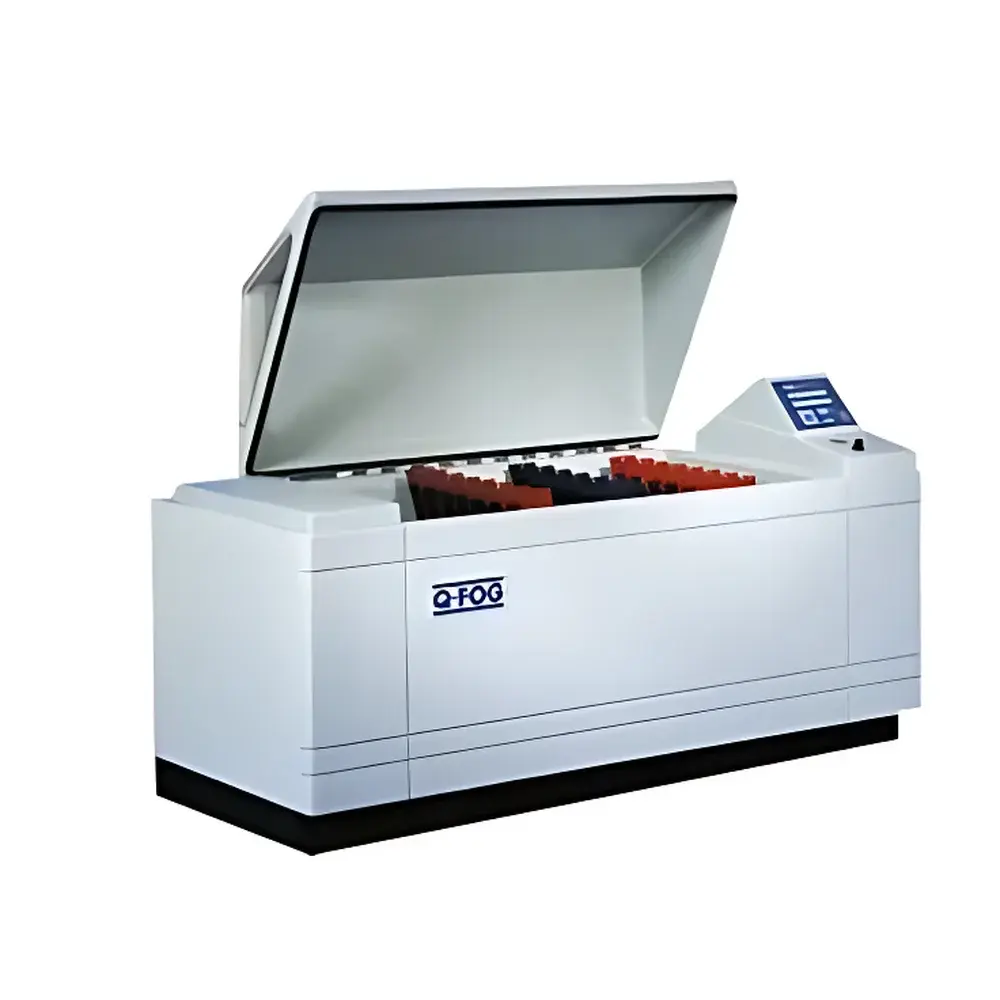
Q-Lab Q-FOG CRH600-HSC Advanced Corrosion Test Chamber with Humidity Control and Spray Function
| Brand | Q-Lab |
|---|---|
| Origin | USA |
| Model | CRH600-HSC |
| Salt Spray Deposition Rate | 0.5–3 mL/h·80 cm² |
| Temperature Range | Ambient to 70 °C |
| Chamber Capacity | 640 L |
| Humidity Control | Yes (RH 10–95% RH, ramp rate programmable) |
| Optional Features | Spray Module, Nozzle Auto-Cleaning System, Preconditioned Air Humidification |
| Compliance | ASTM B117, ISO 9227, GMW 14872, SAE J2334, Ford CETP, VW PV1210, Renault D17 2027, GB/T 10125, ISO 16701, Prohesion™ |
Overview
The Q-Lab Q-FOG CRH600-HSC is a high-precision, fully programmable corrosion test chamber engineered for advanced cyclic corrosion testing (CCT) under controlled environmental conditions. Unlike conventional salt spray chambers operating solely under static saline fog, the CRH600-HSC integrates three independent environmental control modules: saturated salt fog generation, programmable relative humidity (RH) conditioning (10–95% RH), and an optional high-flow spray function. This tri-modal architecture enables precise replication of real-world atmospheric degradation mechanisms—including wet/dry transitions, chloride deposition, hygroscopic moisture absorption, and thermal cycling—critical for evaluating coating durability, galvanic protection integrity, and substrate passivation performance. The chamber employs air-heating technology rather than steam-based heating to maintain consistent salt concentration throughout exposure cycles; this eliminates vapor dilution effects that compromise field correlation in steam-heated systems. Its 640-liter working volume accommodates full-size automotive components, multi-tiered test panels, and electronic assemblies while maintaining uniformity per ASTM G151 and ISO 16701 requirements.
Key Features
- Triple-environment capability: Salt fog (ASTM B117-compliant), RH-controlled humidification (programmable ramp rates), and optional high-volume spray mode with adjustable duration and flow rate
- Air-heating system ensures stable chamber temperature and prevents salt solution dilution from condensate re-evaporation
- Integrated nozzle auto-cleaning mechanism reduces maintenance downtime and eliminates clogging—a common failure point in competitive units
- Preconditioned air humidification system delivers rapid, repeatable RH transitions without introducing uncontrolled moisture or temperature gradients
- Q-FOG controller with intuitive touchscreen interface supports up to 100 user-defined test programs, each containing up to 99 steps with independent control of temperature, RH, spray/fog timing, and dwell periods
- Compliance-ready audit trail logging (time-stamped parameter changes, operator ID, alarm events) aligned with GLP/GMP documentation practices
Sample Compatibility & Compliance
The CRH600-HSC accommodates diverse specimen geometries via standardized mounting options—including F-9008-K panel racks (8-position), F-9014-K 20 mm suspension rod kits (6-piece), and F-8290/F-8292 grid-style sample support plates (rack- or scatter-mounted). It meets or exceeds performance criteria specified in major international standards: ASTM B117 (neutral salt fog), ISO 9227 (acetic acid/salt fog variants), GMW 14872 (cyclic corrosion for automotive coatings), SAE J2334 (multi-stage CCT for under-hood components), Ford CETP 00.00-L-467, VW PV1210, Renault D17 2027, and GB/T 10125. Its RH control module satisfies the dynamic humidity requirements of ISO 16701 (electrochemical corrosion under thin electrolyte layers) and enables direct implementation of Prohesion™ testing protocols (ASTM G85 Annex A5).
Software & Data Management
The embedded Q-FOG controller runs firmware compliant with FDA 21 CFR Part 11 for electronic records and signatures when configured with user access levels, password protection, and immutable audit logs. All test parameters—including actual vs. setpoint temperature/RH profiles, spray activation timestamps, and fault diagnostics—are stored internally and exportable via USB or Ethernet to CSV or XML formats. Optional Q-Lab’s SunX software provides remote monitoring, multi-chamber synchronization, automated report generation (PDF/Excel), and integration with LIMS environments. Data integrity safeguards include checksum validation, write-once storage for critical logs, and automatic backup on external drives.
Applications
This chamber serves quality assurance laboratories in automotive OEMs and Tier-1 suppliers for validating corrosion resistance of painted body panels, fasteners, brake calipers, and EV battery enclosures. It supports electronics manufacturers in qualifying conformal coatings on PCBs and connectors exposed to coastal or de-icing salt environments. Aerospace component suppliers use it to assess chromate conversion coatings on aluminum alloys per MIL-DTL-5541. Coating formulators rely on its reproducible RH transitions to benchmark primer adhesion loss, blistering onset, and cathodic delamination kinetics. Academic corrosion research groups apply it to study chloride-induced pitting initiation thresholds in stainless steels and Mg alloys under simulated marine atmospheres.
FAQ
What distinguishes the CRH600-HSC from standard salt spray chambers?
It adds programmable relative humidity control and optional spray functionality—enabling true cyclic corrosion testing beyond static fog exposure.
Does the CRH600-HSC meet ISO 16701 requirements?
Yes—the RH control module achieves the specified 30–95% RH range with ≤±3% RH accuracy and supports the required 30-minute ramp times between wet/dry phases.
Can the chamber operate unattended for extended test cycles?
Yes—its robust architecture, redundant safety interlocks, and integrated data logging support continuous operation for up to 30-day cycles without manual intervention.
Is the spray module compatible with all Q-FOG CRH models?
The spray module is factory-installed or retrofitted only on CRH-series chambers (CRH600-HSC and CRH1100-HSC); it is not available for non-RH Q-FOG SSP or SE models.
How is calibration traceability maintained?
Temperature and RH sensors are NIST-traceable; Q-Lab provides factory calibration certificates and recommends annual third-party verification per ISO/IEC 17025 guidelines.



