
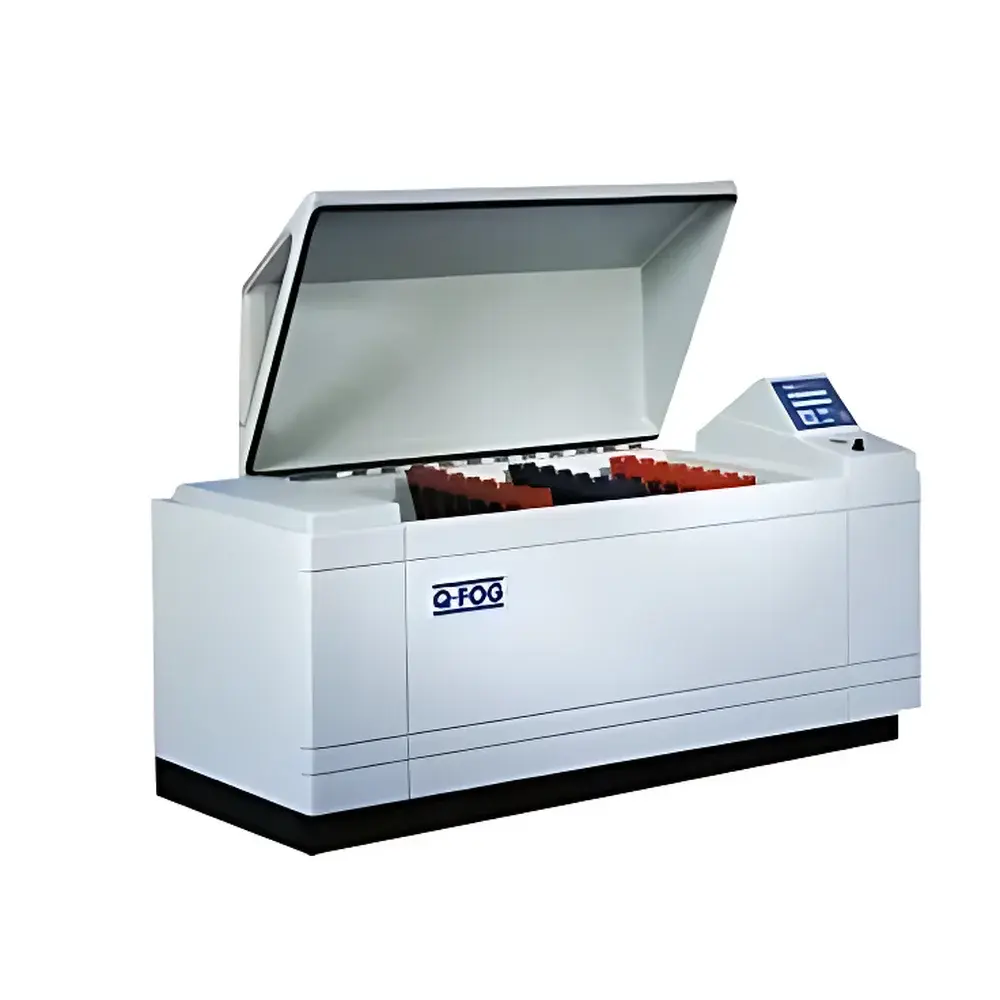
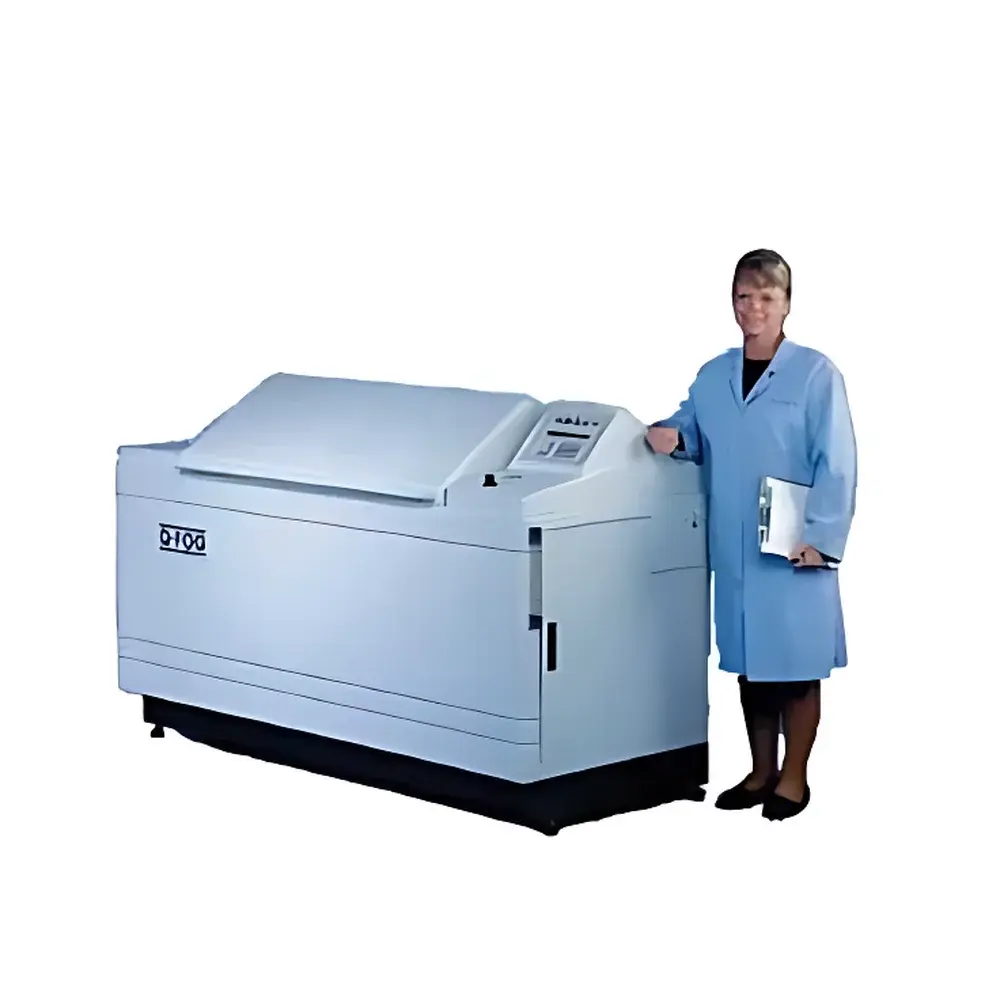
Q-LAB Q-FOG CCT600 Cyclic Corrosion Test Chamber
| Brand | Q-LAB |
|---|---|
| Origin | USA |
| Model | Q-FOG CCT600 |
| Chamber Capacity | 640 L |
| Cycle Modes | Salt Spray / Dry / 100% RH Humidity / Ambient Hold |
| Compliance | ASTM B117, ISO 9227, ISO 11997-1/2, GMW 14872, SAE J2334, VW PV1210, Ford CETP, Renault D17 2025, GB/T 10587, GB/T 2423.17/18/33 |
Overview
The Q-LAB Q-FOG CCT600 is a fully programmable cyclic corrosion test chamber engineered for high-fidelity simulation of real-world atmospheric degradation mechanisms. Unlike conventional continuous-salt-spray systems (e.g., ASTM B117), the CCT600 implements multi-phase environmental cycling—including controlled salt fog, hot dry air, saturated humidity (100% RH), and ambient stabilization—to replicate the wet-dry transitions, condensation events, and electrolyte concentration dynamics observed in outdoor service environments. Its core architecture follows the Couette-flow principle for uniform aerosol generation and employs precision-matched air saturation and solution delivery subsystems to ensure reproducible droplet size distribution (median diameter ~1–3 µm) and consistent deposition rates across the test volume. Designed for laboratory-grade reliability and regulatory traceability, the CCT600 serves as a primary tool for accelerated corrosion qualification in automotive, aerospace, coatings, fasteners, and electronics industries.
Key Features
- Integrated four-phase cycle capability: Salt spray (NaCl or synthetic seawater), forced-air drying (up to 70 °C), 100% RH humidity (at 40–60 °C), and ambient hold—each phase independently adjustable in duration, temperature, and transition ramp rate
- Patented dual-control雾 dispersal system: Variable-speed peristaltic pump regulates brine flow rate; independent compressed-air pressure regulator fine-tunes spray distance and plume geometry—enabling decoupled control of deposition mass and spatial uniformity
- Front-access observation window with integrated LED lighting and anti-fog coating for real-time visual monitoring without opening the chamber door
- Self-diagnostic controller with predictive maintenance alerts, service interval tracking, and automatic safety shutdown on thermal runaway, low solution level, or pressure fault
- Corrosion-resistant 316 stainless steel interior construction with seamless welded corners and drainable floor pan; external cabinet finished in powder-coated mild steel
- Compliance-ready firmware supporting audit trails, user access levels (admin/operator), and electronic signature-capable operation logs per FDA 21 CFR Part 11 requirements
Sample Compatibility & Compliance
The CCT600 accommodates specimens up to 600 mm in height and supports standardized sample racks (ASTM G85 Annex A5), flat panels, coated metal substrates, assembled components, and small assemblies. Its chamber geometry and airflow design meet ISO 11997-1 Annex A requirements for uniform exposure across the working zone (±10% variation in salt deposition rate). The system is validated for full conformance with major international corrosion standards including: ASTM B117 (continuous salt fog), ASTM G85 (modified cyclic tests), ISO 9227 (salt mist), ISO 11997-1/2 (cyclic corrosion testing), GMW 14872 (General Motors), SAE J2334 (automotive cyclic corrosion), VW PV1210 (Volkswagen), Ford CETP 00.00-L-467 (Ford Motor Company), Renault D17 2025, and GB/T 2423.17, 2423.18, and 2423.33 (Chinese national standards). All calibration and performance verification procedures align with ISO/IEC 17025-accredited laboratory practices.
Software & Data Management
The embedded Q-FOG Touch Controller runs proprietary firmware with a real-time graphical interface for cycle programming, live parameter visualization (chamber temp, RH, spray status, solution level), and event logging. Users can store ≥200 custom test profiles with nested sub-cycles and conditional branching logic. Exportable data files (CSV, PDF) include timestamped environmental parameters, alarm history, and controller diagnostic codes. Optional Q-LAB’s CRITICAL software enables remote monitoring, centralized fleet management, automated report generation, and integration into LIMS or MES platforms via OPC UA or Modbus TCP. Audit trail records preserve operator ID, timestamp, parameter changes, and execution status—fully compliant with GLP and GMP documentation requirements.
Applications
- Qualification of automotive exterior trim, chassis components, and under-hood materials per OEM-specific cyclic protocols
- Evaluation of protective coatings (e-coat, zinc-nickel, chromate conversion, organic topcoats) against blistering, undercutting, and filiform corrosion
- Corrosion resistance validation of fasteners, springs, and stamped metal parts used in marine and infrastructure applications
- Accelerated aging studies of printed circuit board (PCB) conformal coatings and solder joint integrity under humid chloride environments
- Development and benchmarking of corrosion inhibitors, rust preventatives, and self-healing polymer systems
- Regulatory submission support for ISO 12944 (paints and varnishes) and IEC 60068-2-52 (environmental testing of electrotechnical products)
FAQ
What distinguishes the CCT600 from basic salt spray chambers (e.g., SSP series)?
Unlike SSP models limited to continuous salt fog, the CCT600 adds precise 100% RH humidity control and programmable dry phases—enabling true cyclic corrosion testing that correlates strongly with field performance.
Can the CCT600 perform Prohesion testing?
Yes. The controller includes preloaded Prohesion cycles (ASTM G85 Annex A2) and allows user-defined variants combining acidified salt spray with drying intervals.
Is humidity control limited to 100% RH, or does it support intermediate setpoints?
The CCT600 delivers only 100% RH in its standard configuration. For variable RH control (e.g., 30–95%), the CRH-series model is required.
How is solution concentration and pH monitored during testing?
Manual verification per ASTM B117 is recommended at start-up and after each solution refill. Integrated conductivity/pH sensors are not included but can be added via third-party OEM interfaces.
Does the system support automated solution replenishment?
No. The CCT600 uses a gravity-fed reservoir requiring periodic manual refilling. Optional external solution delivery modules are available for extended unattended operation.



