
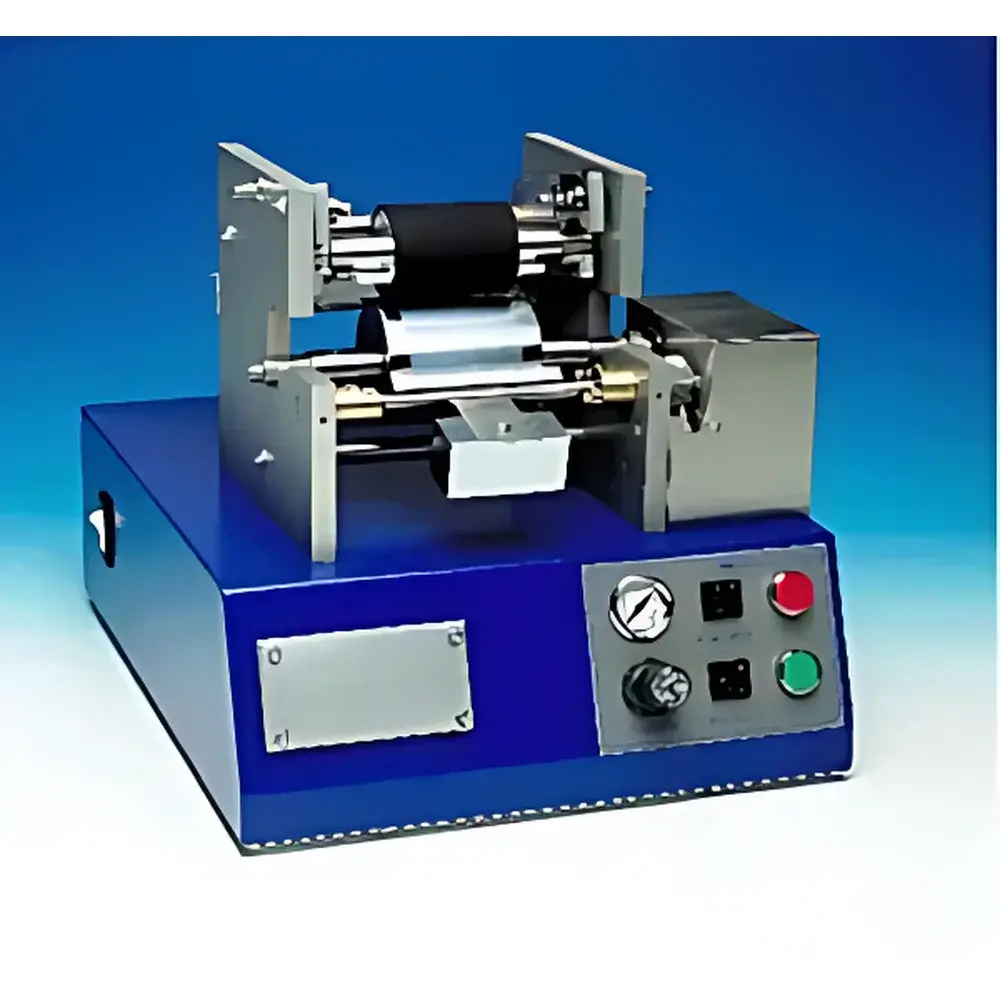
RK PIP Paste Ink Proofer – Precision Offset Ink Proofing System
| Brand | RK |
|---|---|
| Origin | United Kingdom |
| Manufacturer Type | Authorized Distributor |
| Origin Category | Imported |
| Model | PIP |
| Pricing | Upon Request |
Overview
The RK PIP Paste Ink Proofer is a precision-engineered laboratory-scale offset ink proofing system designed for rapid, highly reproducible ink film deposition on flexible and rigid substrates. It operates on the principle of gravure-style metering using laser-etched ceramic anilox rollers to deliver controlled, quantifiable ink layers—eliminating reliance on manual weighing or volumetric dispensing. Unlike conventional proofers requiring calibrated ink tubes and multi-roller ink trains, the PIP employs a simplified two-roller (ceramic anilox + elastomeric impression roller) architecture with automated doctor blade action. Ink is manually applied to the engraved ceramic surface, then uniformly distributed under programmable rotational speed and dwell time. Excess ink is removed by a precision-ground stainless steel doctor blade, leaving a consistent, repeatable ink film on the 70 Shore A rubber impression roller. This film is subsequently transferred to substrate under adjustable nip pressure (0–150 N/cm²) and linear speed (5–40 m/min), enabling accurate simulation of press conditions for lithographic, rotogravure, and flexographic inks.
Key Features
- High-reproducibility ink film deposition via laser-etched ceramic anilox rollers with traceable, certified ink mass values (e.g., PIP.10 = 1.1 g/m², PIP.11 = 1.5 g/m², PIP.12 = 1.9 g/m²)
- Dual-proofer capability: simultaneous preparation of two independent ink samples for side-by-side visual or instrumental comparison
- Full proofing cycle—including ink application, metering, printing, and cleaning—completed in ≤3 minutes
- Modular ceramic roller interchangeability for precise control across multiple ink film thicknesses and rheological profiles
- Integrated digital controls for independent adjustment of line speed, nip pressure, and metering duration
- Minimal ink-contact surfaces: only ceramic roller, rubber impression roller, and stainless steel doctor blade—enabling rapid solvent-based cleaning
Sample Compatibility & Compliance
The PIP accommodates standard sheet-fed substrates up to 124 mm × 300 mm, with a printable area of 75 mm × 245 mm. Compatible materials include uncoated and coated papers, cardboard, tinplate, PET, PVC, and other industrially relevant flexible or rigid media. The system supports ISO 2846-1 (process color inks for offset lithography), ISO 12647-2 (process control for offset printing), and ASTM D3418 (thermal transitions of polymers)—critical for evaluating ink drying kinetics, rub resistance (per ISO 11997-1), gloss (ISO 8254-1), opacity (ISO 2471), and set-off behavior. Its mechanical design and operational repeatability meet GLP-aligned validation requirements for QC laboratories in ink manufacturing and prepress departments.
Software & Data Management
While the PIP operates via intuitive front-panel controls without embedded software, its deterministic mechanical architecture ensures full traceability for audit-ready documentation. Each ceramic roller is supplied with a certified calibration sheet listing nominal ink mass per unit area (g/m²) measured gravimetrically under standardized ambient conditions (23 °C, 50% RH). Users may integrate the PIP into LIMS or color management workflows via external spectrophotometers (e.g., X-Rite eXact, Datacolor 600) and spectral database platforms compliant with ISO 13655 and CIE S 002. Full audit trails—including operator ID, date/time stamp, roller ID, substrate lot, and environmental log—can be maintained externally to satisfy FDA 21 CFR Part 11 requirements where electronic records are mandated.
Applications
- Rapid formulation screening and batch-to-batch consistency verification of offset, rotogravure, and flexographic inks
- Prepress color matching for brand-critical packaging and commercial print jobs
- Quantitative evaluation of ink properties: drying time (gravimetric or FTIR), rub resistance (crockmeter testing), gloss retention, and trapping efficiency
- Substrate interaction studies—ink absorption, penetration, and surface energy correlation
- Supporting digital color management systems (e.g., GMG ColorProof, CGS ORIS) through physically representative hard proofs
- Training and process optimization in printing technology education programs
FAQ
What substrates can be used with the RK PIP?
Standard paper, board, metalized films, tinplate, and synthetic substrates up to 124 mm wide and 300 mm long are supported. Thickness limitations depend on nip gap adjustment range (typically 0.1–3.0 mm).
How is ink film thickness controlled and verified?
Film mass is determined solely by the geometry of the laser-etched ceramic roller (cell volume, depth, and open area). Each PIP roller carries a factory-calibrated certificate specifying nominal ink mass (g/m²) under defined conditions.
Is the PIP suitable for regulatory-compliant QC environments?
Yes—the absence of variable human dispensing steps, combined with metrologically traceable rollers and repeatable mechanical parameters, supports IQ/OQ/PQ validation and aligns with ISO/IEC 17025 and GMP documentation practices.
Can the system be integrated with spectral measurement instruments?
Absolutely. The PIP produces physically stable, press-representative prints ideal for reflectance measurement with benchtop or handheld spectrodensitometers adhering to ISO 13655 M1/M2 illumination standards.
What maintenance is required beyond routine cleaning?
Annual verification of roller parallelism, doctor blade edge integrity, and pressure transducer calibration is recommended. RK provides certified service kits and traceable calibration services through authorized regional technical centers.




