
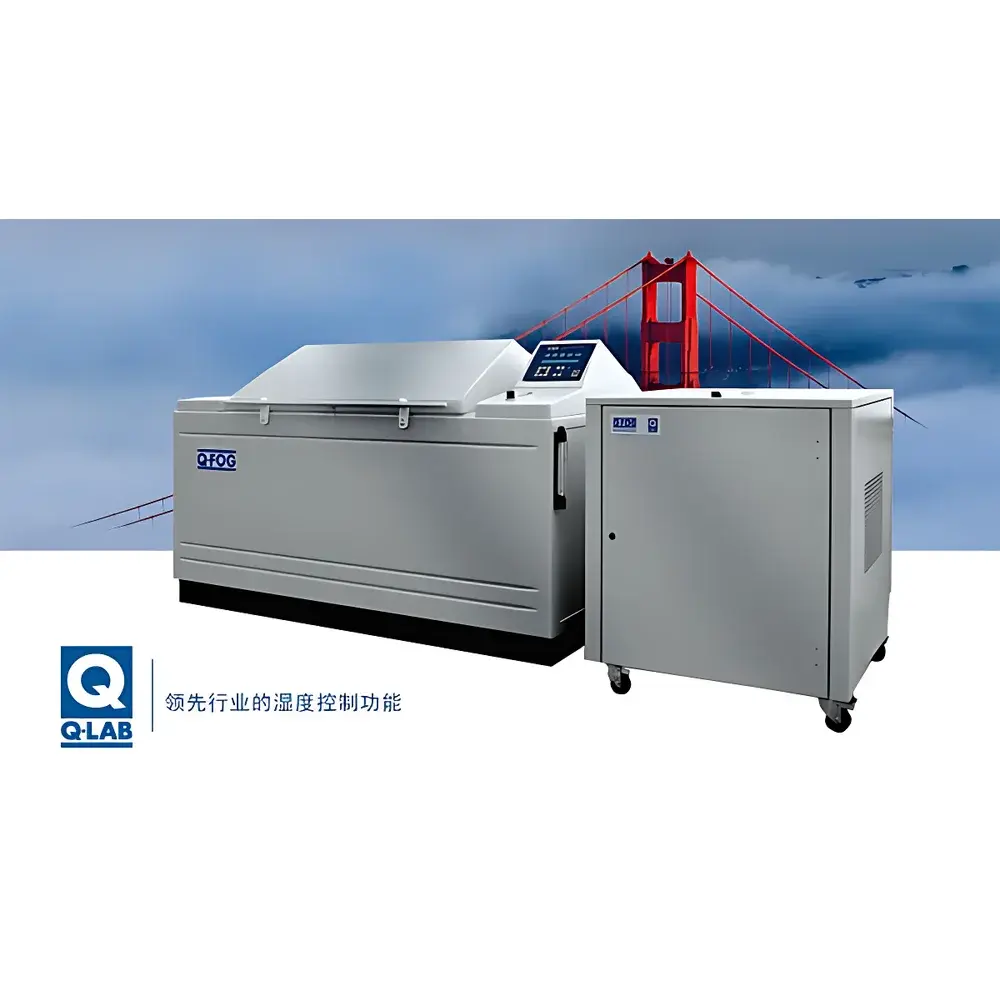
Q-Lab Q-FOG CCT Series Salt Spray Test Chamber
| Brand | Q-LAB |
|---|---|
| Origin | USA |
| Model | CCT Series |
| Type | Cyclic Corrosion Test Chamber |
| Compliance | ASTM B117, ISO 9227, ASTM G85 (Annexes A1–A5), SAE J2334, GMW 14872, Ford CETP 00.00-L-467, VW PV1210 |
| Temperature Range | 10–70 °C (operational range per test method) |
| Humidity Control | 100% RH (CCT only) |
| Salt Fog Deposition Rate | 1.0–2.0 mL/80 cm²/h (adjustable per ASTM B117) |
| Chamber Volume | Available in multiple standard sizes (e.g., CCT-1100: 1100 L) |
| Controller | Q-FOG Touchscreen Microprocessor with Multi-Step Program Logic, Audit Trail Logging, and User Access Levels |
Overview
The Q-Lab Q-FOG CCT Series Salt Spray Test Chamber is an engineered solution for accelerated cyclic corrosion testing (CCT) in compliance with internationally recognized standards including ASTM G85, ISO 9227, SAE J2334, and major automotive OEM specifications (e.g., GMW 14872, Ford CETP 00.00-L-467, VW PV1210). Unlike conventional single-environment salt fog chambers operating exclusively under ASTM B117 conditions (35 °C continuous neutral salt spray), the CCT series replicates the dynamic environmental transitions observed in real-world outdoor exposure—specifically wet/dry cycles, humidity fluctuations, and saline deposition events. Its core architecture integrates three distinct environmental modules: salt fog generation via compressed-air atomization, forced-air drying with dual-stage heating control, and saturated steam-based 100% relative humidity conditioning. This tri-modal capability enables precise, repeatable execution of multi-step corrosion protocols within a single chamber, eliminating inter-chamber transfer errors and operator-induced variability.
Key Features
- Triple-environment capability: simultaneous or sequential operation of salt fog, dry-off, and 100% RH humidification—exclusive to CCT models
- Microprocessor-based Q-FOG controller with intuitive touchscreen interface, supporting up to 100 user-defined multi-step programs with time-, temperature-, and humidity-dependent logic
- Real-time display of current test parameters (chamber temperature, humidity, elapsed time, active step) and full-cycle progress tracking
- Integrated audible alarm and programmable auto-termination for unattended operation
- Optical observation window with internal LED lighting for non-intrusive visual monitoring during all test phases
- Corrosion-resistant stainless-steel construction (316 SS interior), precision-calibrated fog nozzles, and bubble-tower humidification for ASTM B117-compliant salt deposition
- Dual heating system: chamber wall heaters for ambient thermal stability + dedicated air heater for rapid dry-cycle ramp rates
Sample Compatibility & Compliance
The Q-FOG CCT accommodates flat panels, coated components, fasteners, electronic enclosures, and automotive subassemblies up to standard chamber dimensions (e.g., 1100 L internal volume). All operational modes meet traceable metrological requirements for GLP and GMP environments. The system supports full audit trail logging per FDA 21 CFR Part 11 when configured with optional software validation packages. Test methods executed include Prohesion (ASTM G85 Annex A5), acidic salt fog (ASTM G85 Annex A2), humidity cycling (ASTM G85 Annex A3), and OEM-specific sequences requiring ≥4-phase transitions. Calibration certificates for temperature, humidity, and fog deposition rate are available upon request and conform to ISO/IEC 17025-accredited laboratory practices.
Software & Data Management
The embedded Q-FOG controller stores program logs, cycle history, and real-time sensor data with timestamped entries. Optional Q-Lab’s CR-100 software enables remote monitoring, report generation (PDF/CSV), and integration with enterprise LIMS platforms. All data files include digital signatures, user authentication records, and immutable timestamps to satisfy regulatory documentation requirements. Firmware updates maintain alignment with evolving test standards; version history and change logs are retained internally for audit readiness.
Applications
- Automotive component qualification per GM, Ford, and Volkswagen corrosion durability specifications
- Coating adhesion and blistering assessment for aerospace primers and marine-grade finishes
- Electrochemical material degradation studies under controlled electrochemical stressors
- Validation of cathodic protection systems on galvanized steel substrates
- Accelerated life-cycle testing of consumer electronics housings exposed to coastal environments
- Comparative evaluation of inhibitor formulations in chloride-rich electrolytes
FAQ
What distinguishes the CCT model from the SSP model?
The CCT includes full 100% RH humidification capability and supports complex multi-phase automotive cycles; the SSP is limited to salt fog and dry cycles only.
Is the Q-FOG CCT compliant with ASTM B117?
Yes—when operated in continuous salt fog mode, it meets all apparatus, solution, and deposition rate requirements specified in ASTM B117.
Can test programs be exported or backed up externally?
Yes—via USB port, programs and logs can be archived in encrypted binary format compatible with Q-Lab’s CR-100 analysis suite.
What maintenance intervals are recommended for optimal performance?
Daily: drain and rinse fog nozzle assembly; weekly: inspect steam generator water level and clean condensate traps; quarterly: verify temperature/humidity sensor calibration using NIST-traceable references.
Does the system support remote diagnostics?
With optional Ethernet connectivity and licensed CR-100 software, engineers can perform secure remote firmware checks, parameter verification, and log review without physical access.



