
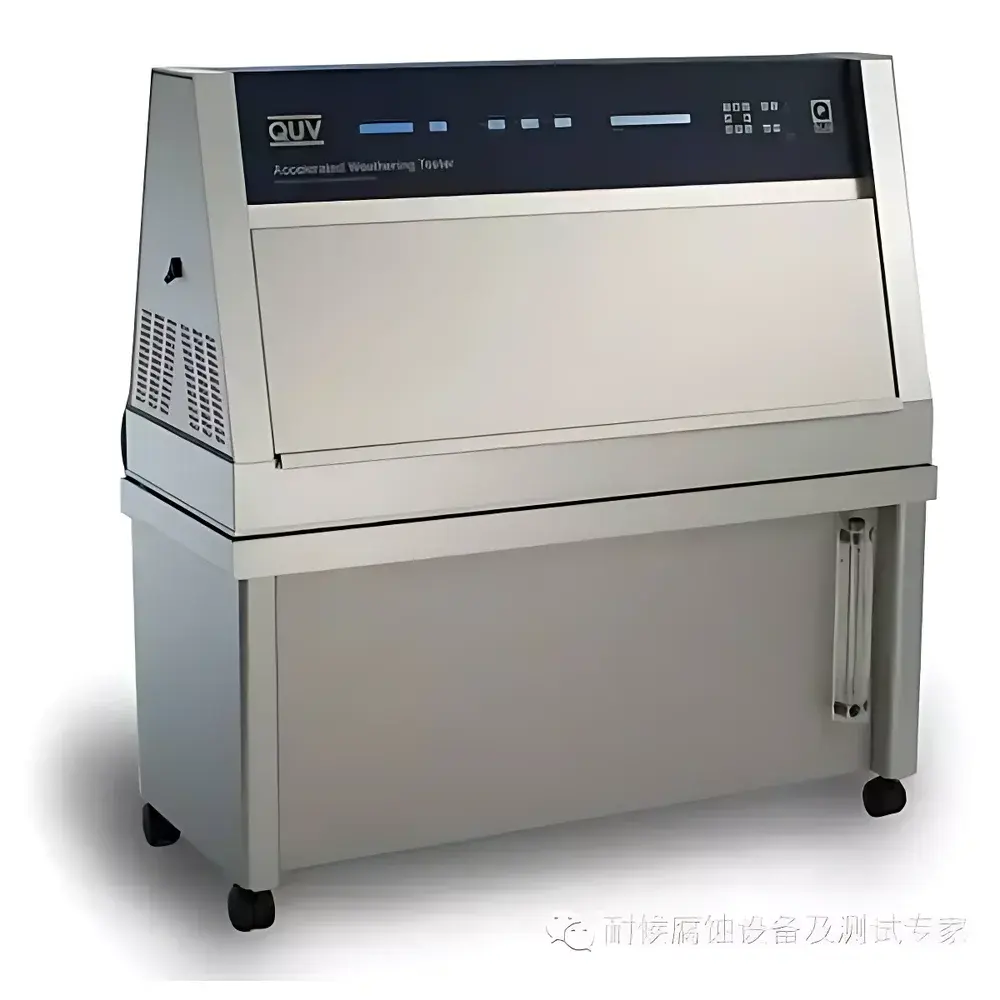
Q-Lab QUV/basic UV Accelerated Weathering Tester
| Brand | Q-LAB |
|---|---|
| Origin | USA |
| Model | QUV/basic |
| Chamber Dimensions (L×W×H) | 114 × 50 × 42 cm |
| Light Source | Fluorescent UV-B (UV-340) or UV-A (UV-351) lamps |
| Irradiance Control | None (fixed-output lamps) |
| Condensation Humidity Simulation | Yes |
| Water Spray Function | No |
| Sample Capacity | 50 specimens (75 × 150 mm) |
| Black Panel Temperature Range | 35–60 °C |
| Irradiance Stability | ±5% over lamp life |
| Lamp Life | ~1600 hours (UV-B), ~5000 hours (UV-A) |
| Power Supply | 120 V/60 Hz, 14 A or 230 V/50–60 Hz, 7 A |
| Water Consumption | 8 L/day (condensation only) |
| Compliance | ASTM G154, ISO 4892-3, JIS D0205, SAE J2020 |
Overview
The Q-Lab QUV/basic is a rigorously engineered UV accelerated weathering tester designed for laboratories requiring cost-effective, reproducible simulation of solar ultraviolet radiation and condensation-driven moisture exposure. It operates on the principle of controlled fluorescent UV irradiation—primarily using UV-B (310 nm peak, UV-340 lamps) or UV-A (340 nm peak, UV-351 lamps)—to replicate the most photochemically aggressive portion of terrestrial sunlight. Unlike broadband xenon arc or full-spectrum solar simulators, the QUV/basic focuses exclusively on UV-induced degradation mechanisms, enabling accelerated evaluation of polymer photostability, coating chalking, pigment fading, and adhesive bond integrity. Its thermal management system maintains precise black panel temperature control during irradiation cycles, while a water-jacketed condensation cycle replicates nocturnal dew formation without mechanical spray hardware. This dual-cycle architecture—UV exposure followed by dark, high-humidity condensation—is standardized in ASTM G154 and ISO 4892-3 for non-metallic materials testing.
Key Features
- Fixed-output fluorescent UV lamp system with calibrated spectral emission profiles per ASTM E1548 and ISO 11341; no irradiance feedback or real-time adjustment capability
- Integrated black panel thermometer with NIST-traceable calibration support for accurate surface temperature monitoring (35–60 °C range)
- Condensation humidity generation via heated water reservoir and chamber wall cooling—no external humidifier or compressed air required
- Robust stainless-steel interior chamber with removable specimen racks accommodating up to 50 standard 75 × 150 mm test coupons
- Simple analog timer-based cycling control supporting customizable UV-only, UV/condensation, or extended dark cycles
- Low operational footprint: consumes only 8 liters of deionized or tap water per day and operates on standard single-phase power (120/230 V)
- Lamp replacement protocol includes positional rotation to mitigate spatial irradiance drift—documented in Q-Lab’s Maintenance Manual Rev. 5.2
Sample Compatibility & Compliance
The QUV/basic accommodates rigid flat specimens up to 3 mm thickness, including thermoplastics, automotive clearcoats, architectural sealants, textile laminates, and printed electronics substrates. Its geometry supports standardized specimen mounting per ASTM D6675 and ISO 11341 fixture requirements. While not equipped with SOLAR EYE irradiance monitoring, the unit meets the minimum performance criteria for comparative exposure testing when used strictly in paired-sample configurations—as defined in ASTM D7869 and ISO 16474-3 Annex B. It is routinely deployed in GLP-compliant quality assurance labs for internal reference material aging, supplier qualification, and formulation screening where absolute irradiance traceability is secondary to intra-unit repeatability. The absence of water spray excludes compliance with ASTM D5238 (cyclic corrosion + UV) or ISO 11341 Annex C (spray-condensation protocols).
Software & Data Management
The QUV/basic operates without embedded microprocessor control or digital data logging. All operational parameters—including cycle duration, UV-on time, and condensation duration—are set manually via front-panel mechanical timers. Temperature readings are displayed on an analog black panel thermometer with ±1.0 °C accuracy (per Q-Lab Calibration Certificate QL-CAL-2023-087). Users are expected to record chamber conditions externally using validated logbooks or LIMS-integrated manual entry workflows. For laboratories requiring audit-ready records, Q-Lab recommends pairing the QUV/basic with third-party USB data loggers compliant with FDA 21 CFR Part 11 (e.g., Omega OM-DAQPRO-5300) for temperature and runtime tracking. Firmware updates or remote diagnostics are not supported.
Applications
This instrument is optimized for comparative durability assessment in industrial R&D and manufacturing QA environments. Typical use cases include: evaluating UV stabilizer package efficacy in polyolefin films; benchmarking gloss retention of OEM automotive basecoats under identical irradiance history; verifying batch-to-batch consistency of silicone encapsulants in photovoltaic module production; validating shelf-life claims for medical device packaging polymers per ISO 10993-12; and conducting pre-qualification screening of architectural elastomeric coatings prior to outdoor Florida exposure. Its fixed-lamp architecture ensures low inter-unit variability across multi-site laboratories performing synchronized round-robin studies—provided lamp batches and replacement schedules are harmonized per Q-Lab Technical Bulletin TB-012.
FAQ
Can the QUV/basic be used for regulatory submission testing?
No—it lacks irradiance feedback control and automated data capture required for ISO/IEC 17025-accredited testing. It is suitable only for internal comparative studies.
What lamp types are compatible with the QUV/basic?
UV-B340 (peak 340 nm, simulates short-wave UV below 360 nm) and UV-A351 (peak 351 nm, simulates longer-wave UV through window glass); lamp interchange requires recalibration of black panel temperature settings.
Is deionized water mandatory for condensation operation?
Not mandatory, but strongly recommended to prevent mineral buildup on condensing surfaces; tap water may be used if total dissolved solids (TDS) < 100 ppm.
How often must lamps be replaced?
UV-B340 lamps require replacement every ~1600 hours; UV-A351 lamps last ~5000 hours—both figures assume continuous operation at rated voltage and ambient temperatures < 30 °C.
Does the QUV/basic support multi-step cyclic programs?
Yes, via manual timer sequencing—users can define discrete UV-only, condensation-only, or alternating phases, though transitions are not programmable with ramp rates or dwell stabilization.



