
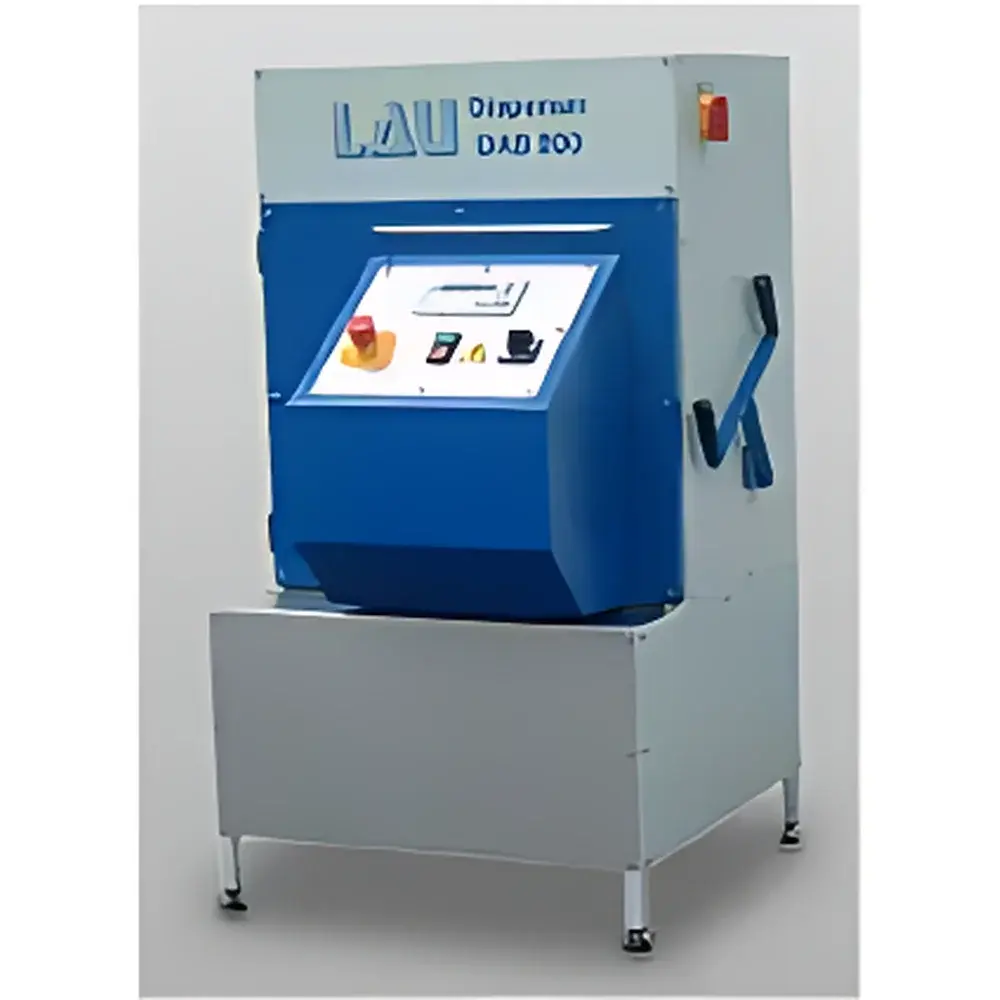
LAU DAS200 High-Speed Ink & Paint Shaker
| Brand | LAU |
|---|---|
| Origin | Germany |
| Model | DAS200 |
| Motor Power | 740 W |
| Voltage | 230 V, 50 Hz |
| Max. Sample Load | 20 kg |
| Platform Dimensions | 320 × 320 mm |
| Vibration Frequency | 660 ± 40 rpm |
| Unloaded Stroke | 45 mm |
| Loaded Stroke (20 kg) | 32 mm |
| Centrifugal Force | Up to 20×g |
| Cooling | Dual Low-Pressure Fans with Adjustable Output |
| Enclosure | Fully Sealed Chamber |
| Display | Siemens TD200 Operator Interface |
| Certification | ATEX EExd Compliant |
| Net Weight | 220 kg |
| Overall Dimensions (H×W×D) | 118 × 65 × 80 cm |
Overview
The LAU DAS200 High-Speed Ink & Paint Shaker is an engineered laboratory dispersion system designed for standardized, reproducible evaluation of pigment dispersion stability and efficiency in liquid-phase formulations—primarily within coatings, printing inks, and pigment concentrates. Operating on the principle of high-frequency elliptical orbital vibration, the DAS200 subjects samples to controlled mechanical shear and impact forces without rotating or grinding media. Its motion profile—vertical elliptical oscillation from rear to front—generates uniform energy input across all sample positions, enabling direct comparison of multiple formulations under identical dynamic conditions. Unlike rotor-stator or bead-milling systems, the DAS200 delivers dispersion via inertial acceleration and interfacial stress, making it especially suitable for assessing binder–pigment adhesion, dispersant efficacy, and color strength development without introducing contamination or particle attrition. The unit’s ATEX-certified EExd explosion-proof motor housing ensures safe operation with flammable solvents commonly used in ink and varnish systems.
Key Features
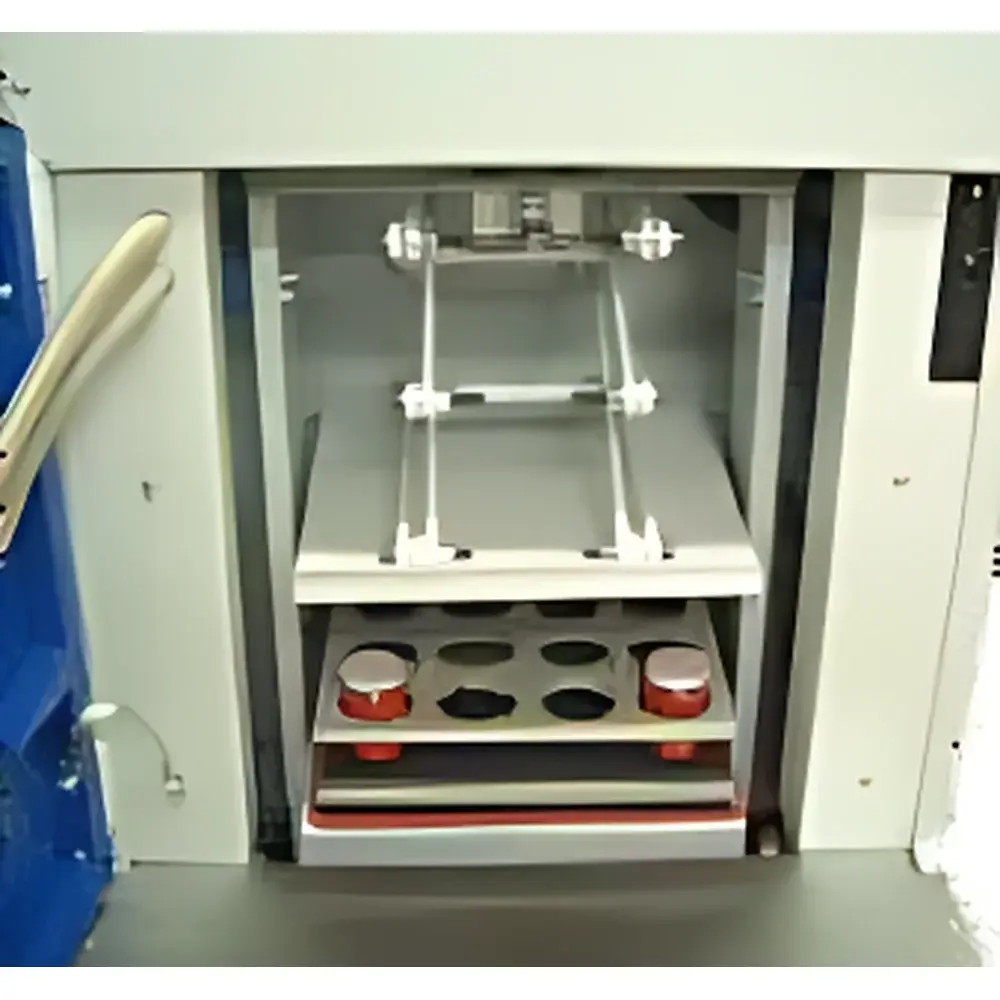
- Fully sealed, sound-dampened chamber minimizes acoustic emissions and contains potential glass breakage or chemical spillage—critical for GLP-compliant laboratories handling hazardous solvents.
- Dual independently adjustable low-pressure cooling fans maintain sample temperature rise ≤10 °C above ambient during extended cycles; fan output is stepwise controllable to match solvent volatility and thermal sensitivity.
- Siemens TD200 operator interface supports precise time programming (dispersion duration, clamp duration), real-time countdown display, cumulative operating hours logging, and frequency monitoring—enabling full traceability per ISO/IEC 17025 requirements.
- Elliptical vibration trajectory (45 mm stroke unloaded, 32 mm at 20 kg load) combined with 660 ± 40 rpm frequency delivers consistent centrifugal acceleration up to 20×g across the entire 320 × 320 mm platform—ensuring positional equivalence for multi-sample parallel testing.
- Robust cast-steel frame and vibration-isolated base structure eliminate cross-talk between adjacent sample containers, eliminating positional bias—a known limitation in conventional horizontal shakers.
- Integrated torque-assisted clamping mechanism ensures uniform fixation of glass or polymer sample vessels (e.g., DIN 500 mL jars, ASTM D1210 tubes), minimizing slippage-induced variability.
Sample Compatibility & Compliance
The DAS200 accommodates standard cylindrical containers ranging from 15 mL to 1 L in volume—including borosilicate glass vials, HDPE/PET bottles, and stainless-steel cartridges—without requiring adapters. Its design conforms to ASTM D281 (Standard Test Method for Dispersion Characteristics of Pigments), ISO 8781-2 (Pigments and extenders — Evaluation of dispersion characteristics — Part 2: Assessment by tinting strength), and EN ISO 15528 (Paints, varnishes and raw materials for paints and varnishes — Sampling). The ATEX EExd rating certifies suitability for Zone 1 hazardous areas per Directive 2014/34/EU. All electronic controls comply with IEC 61000-6-3 (EMC emission) and IEC 61000-6-2 (immunity), supporting integration into regulated QC environments governed by FDA 21 CFR Part 11 and EU Annex 11 requirements for audit-trail-capable instrumentation.
Software & Data Management
While the DAS200 operates via standalone Siemens TD200 HMI, its parameter setpoints (time, fan level, clamp duration) are stored in non-volatile memory and timestamped upon execution. Optional RS485 Modbus RTU interface enables connection to centralized LIMS or MES platforms for automated data capture—including start/stop timestamps, total runtime, and fault logs. All operational events are retained for ≥10,000 cycles, satisfying GLP documentation standards for instrument qualification (IQ/OQ/PQ) and routine performance verification. No proprietary software installation is required; configuration remains accessible through the front-panel interface without external dependencies.
Applications
- Quantitative assessment of pigment dispersion quality via spectrophotometric colorimetry (ΔE, L*a*b*, Yellowness Index) before and after standardized shaking cycles.
- Evaluation of dispersant dosage optimization in aqueous and solvent-borne systems using viscosity profiling and particle size tracking (e.g., via laser diffraction post-shaking).
- Accelerated stability screening of inkjet inks, UV-curable formulations, and nano-pigmented dispersions under controlled thermal–mechanical stress.
- Correlation studies between DAS200 dispersion energy input and downstream mill performance (e.g., bead mill residence time reduction).
- Batch release testing for pigment masterbatches where consistency of wetting and deagglomeration directly impacts extrusion throughput and final film optical properties.
FAQ
What safety certifications does the DAS200 hold for use with flammable solvents?
The DAS200 carries ATEX EExd certification for Zone 1 hazardous locations, permitting operation with common organic solvents including toluene, xylene, ethyl acetate, and aliphatic hydrocarbons.
Can the DAS200 be integrated into a validated laboratory information management system (LIMS)?
Yes—via optional RS485 Modbus RTU, enabling bidirectional communication for parameter upload, cycle initiation, and event log retrieval compliant with 21 CFR Part 11 electronic record requirements.
Is calibration required prior to routine use?
No routine calibration is mandated; however, annual verification of vibration amplitude (using certified laser vibrometer) and timer accuracy (±0.5 s over 60 min) is recommended for ISO/IEC 17025 accreditation.
What is the maximum allowable temperature rise inside the chamber during a 30-minute run?
Under continuous operation at full 20 kg load with fans at maximum setting, internal chamber temperature rise remains ≤8 °C above ambient—verified per DIN EN 60068-2-14 thermal shock test protocol.
Does the DAS200 support custom vibration profiles or variable frequency control?
No—the DAS200 operates at fixed nominal frequency (660 rpm); its design prioritizes inter-laboratory reproducibility over programmable waveform flexibility, aligning with ASTM and ISO dispersion test standardization principles.



