
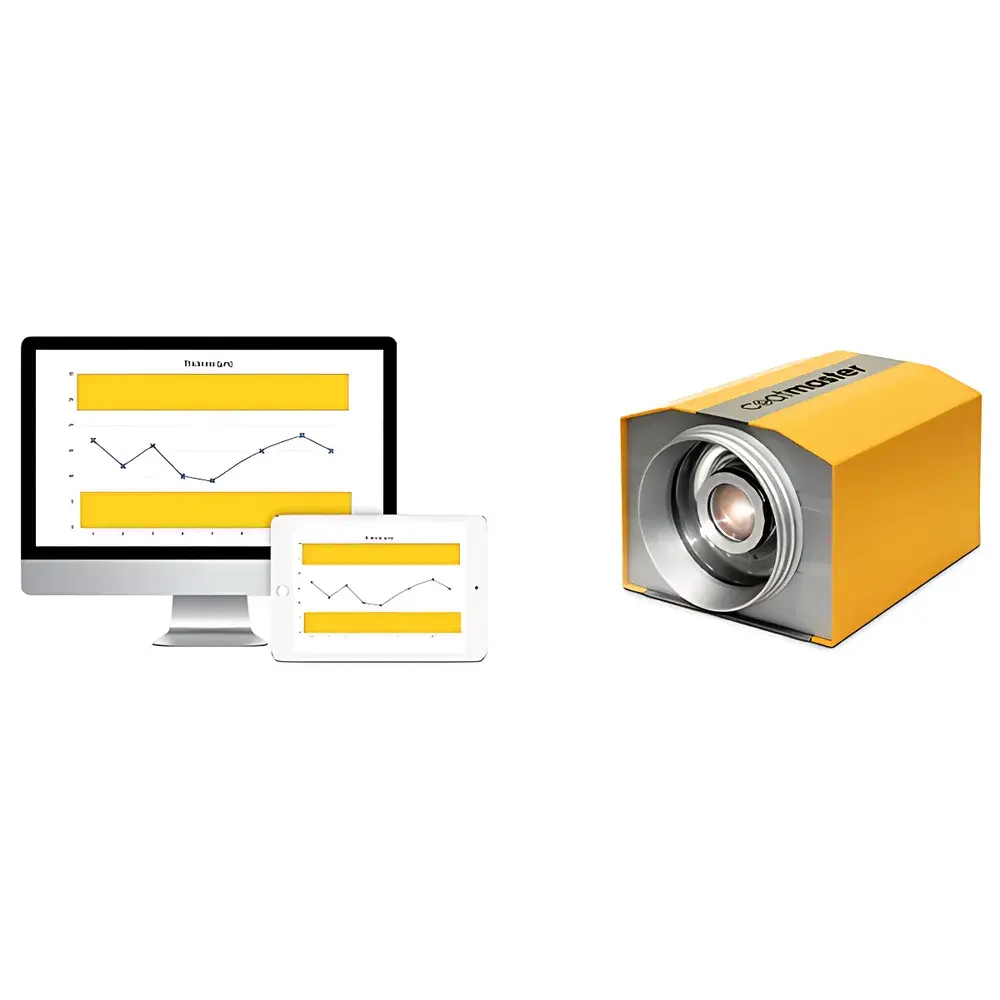
Coatmaster Inline & Flex Non-Contact Thermal-Optical Coating Thickness Gauge for Composite Materials
| Brand | Coatmaster |
|---|---|
| Origin | Switzerland |
| Model | Coatmaster Inline, Coatmaster Flex |
| Measurement Principle | Thermal-Optical (Patented) |
| Application | Non-destructive, real-time thickness measurement of wet/dry/powder coatings on carbon fiber composites and other non-metallic substrates |
| Compliance | Designed for GLP/GMP environments |
| IP Rating | IP20 (Flex), IP65-rated enclosure options available for Inline |
| Measurement Distance Range | 2–15 cm (Flex), 10–120 cm (Inline) |
| Tilt Tolerance | ±45° (substrate-dependent) |
| Repeatability | <1% RSD (Flex), <2% RSD (Inline, Al substrate, 60 µm uncured powder) |
| Throughput | Up to 120 m/min (Inline) |
| Coating Types | All colors including white |
| Output | Real-time dry-film equivalent (DFE) thickness from wet or uncured layers |
| Data Access | Browser-based cloud dashboard + ERP integration |
| Measurement Speed | 0.3 s (Flex), 0.5 s (Inline) |
Overview
The Coatmaster Inline and Flex are industrial-grade, non-contact coating thickness gauges engineered specifically for advanced composite substrates—particularly carbon fiber reinforced polymers (CFRP)—where conventional electromagnetic, eddy current, or ultrasonic methods fail due to non-conductive, anisotropic, or multi-layered surface structures. Unlike contact profilometers or destructive cross-sectioning techniques, the Coatmaster series employs a patented thermal-optical measurement principle: a controlled, low-energy infrared pulse heats the coating surface transiently, and high-speed infrared detection captures the thermal decay signature, which correlates directly with coating thickness through calibrated thermal diffusivity models. This physics-based approach enables accurate, repeatable quantification of both uncured (wet or powder) and cured (dry) organic, ceramic, and metallic coatings—without requiring electrical conductivity, magnetic permeability, or acoustic coupling. The system is optimized for aerospace, defense, and high-performance automotive applications where coating integrity directly governs oxidation resistance, thermal stability, and structural longevity under extreme thermal cycling.
Key Features
- Real-time dry-film equivalent (DFE) prediction: Calculates final cured thickness from uncured wet film or powder layer in a single 0.3–0.5 s measurement—enabling immediate process correction before thermal curing.
- True non-contact operation: No physical probe contact, zero risk of surface damage or contamination—critical for pre-cure handling of delicate CFRP layups and prepregs.
- Robust geometric tolerance: Measures reliably at distances up to 120 cm (Inline) and ±45° tilt angles—accommodating curved surfaces, recessed zones, edges, and complex 3D geometries common in wing skins, fuselage panels, and propulsion housings.
- Color-agnostic performance: Validated across full spectral reflectance range—including highly reflective white, metallic, and matte black coatings—eliminating calibration drift associated with optical reflectivity variations.
- Production-integrated architecture: Flex model supports handheld, portable use on moving conveyors; Inline model mounts directly into continuous production lines with synchronization to encoder-triggered sampling at speeds up to 120 m/min.
- Regulatory-ready data infrastructure: Built-in timestamped audit logs, user access controls, and encrypted cloud storage—fully compatible with FDA 21 CFR Part 11, ISO 9001, and AS9100 traceability requirements.
Sample Compatibility & Compliance
The Coatmaster systems are validated for use on non-metallic, low-thermal-diffusivity substrates including carbon fiber, glass fiber, aramid, ceramic matrix composites (CMCs), and polymer laminates. It measures coatings such as epoxy primers, polyurethane topcoats, silicon carbide (SiC) ceramic overlays, nickel-chromium alloy thermal barrier layers, and electrostatically applied polyester powders. Each instrument is supplied with substrate-specific calibration kits traceable to NIST-certified reference standards. Measurement uncertainty is verified per ISO 2808 Annex B and ASTM D7091 for non-magnetic, non-conductive substrates. Full compliance documentation—including IQ/OQ protocols, calibration certificates, and material compatibility matrices—is provided for GxP-regulated environments.
Software & Data Management
Coatmaster instruments operate via the web-native Coatmaster Cloud Platform—a secure, role-based SaaS interface accessible via any modern browser. Real-time thickness maps, statistical process control (SPC) charts (X̄/R, Cpk), and trend analytics are generated automatically. All raw thermal decay waveforms and metadata (timestamp, position, operator ID, environmental temperature/humidity) are archived with immutable SHA-256 hashing. ERP integration is achieved via RESTful API or OPC UA—enabling direct feed to MES systems (e.g., Siemens Opcenter, Rockwell FactoryTalk) for closed-loop process adjustment. Optional on-premise deployment and air-gapped network configurations meet ITAR and EAR export control requirements.
Applications
- Aerospace: In-line verification of anti-oxidation ceramic coatings on CFRP nozzle extensions and leading edges.
- Defense: Quality assurance of radar-absorbing material (RAM) thickness on stealth composite airframes.
- Electric mobility: Monitoring of thermal insulation coatings on battery module housings and motor stators.
- Renewables: Thickness control of erosion-resistant polyurea coatings on wind turbine blade tips.
- R&D labs: Rapid screening of novel nanocomposite coatings during formulation development—replacing time-intensive SEM cross-sectioning.
FAQ
Can the Coatmaster measure coatings on carbon fiber without metal backing?
Yes. Its thermal-optical principle does not rely on substrate conductivity or magnetic properties—making it uniquely suited for bare CFRP, prepreg, or hybrid carbon-glass laminates.
Does measurement accuracy depend on coating color or gloss level?
No. Unlike optical interferometry or laser triangulation, thermal-optical response is independent of visible-light reflectance—validated across L* 20–95 CIELAB scale.
Is calibration required for each new coating type?
A one-time substrate-coating family calibration suffices (e.g., “epoxy on CFRP”); no per-batch recalibration needed under stable process conditions.
How is traceability ensured for regulated manufacturing?
All measurements include digital signatures, electronic records, and configurable audit trails compliant with 21 CFR Part 11, EU Annex 11, and ISO/IEC 17025.
Can the Flex model be used on vibrating or rotating parts?
Yes. Its high-speed thermal acquisition (sub-millisecond integration) and motion-compensated algorithms maintain <1% RSD even on dynamically oscillating components.



