
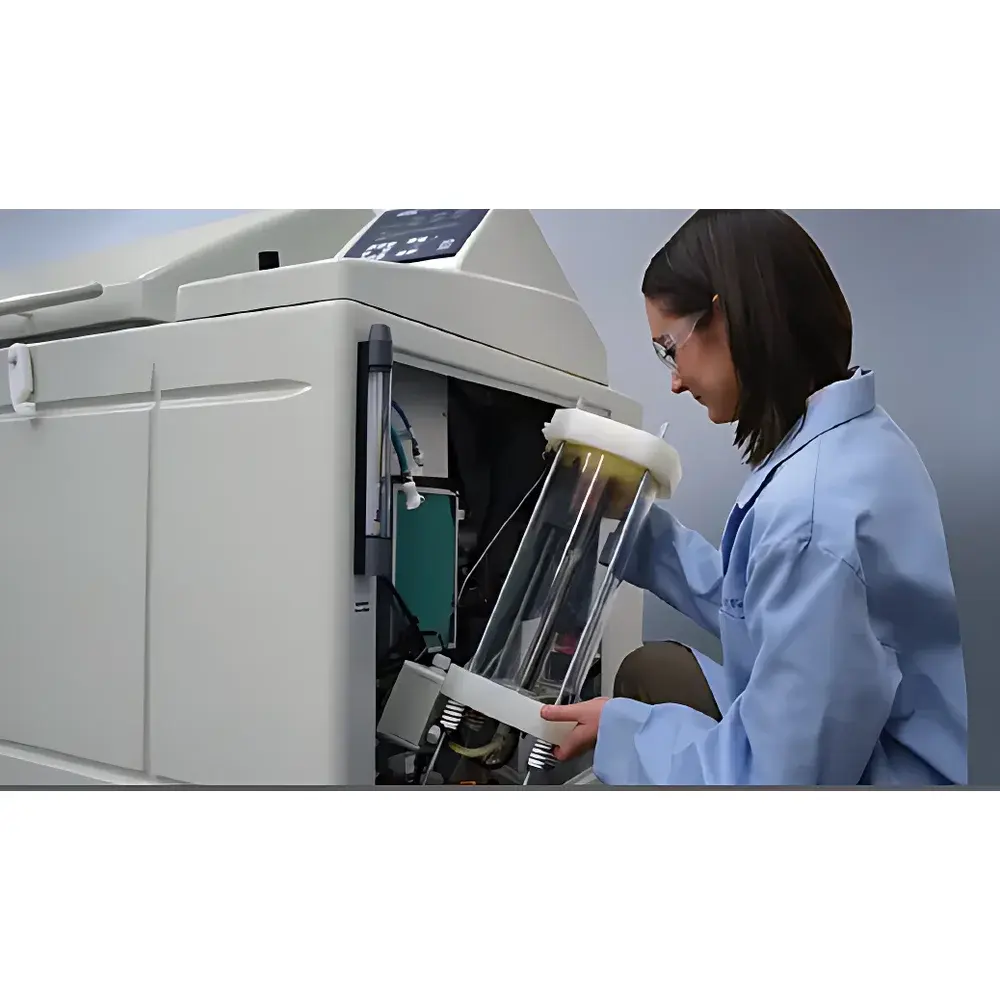
Q-Lab Q-FOG CCT Series Cyclic Corrosion Test Chamber
| Brand | Q-Lab |
|---|---|
| Origin | USA |
| Model | Q-FOG CCT |
| Compliance | ASTM B117, ASTM G85 Annex A5 (Prohesion), ISO 9227, SAE J2334, GMW 14872, Ford CETP 00.00-L-467, Renault D17 2028 |
| Chamber Capacity | 640 L (CCT-600) / 1103 L (CCT-1100) |
| Temperature Range | 10–70 °C (operational range under cyclic conditions) |
| Salt Solution Delivery | Precision-controlled via variable-speed peristaltic pump and regulated compressed air |
| Humidity Control | 100% RH capability (CCT only) |
| Sample Capacity | 160 specimens (75 mm × 150 mm) for CCT-600 |
| Internal Reservoir | 120 L deionized water tank with integrated salt solution filter and low-level alarm |
| Cycle Flexibility | Four-phase cycling — Salt Fog, Dry-off, 100% RH (CCT only), and Ambient Rest |
| Controller | Embedded microprocessor with self-diagnostic firmware, audit-trail-capable logging (FDA 21 CFR Part 11 compliant configuration available), and intuitive touchscreen interface |
Overview
The Q-Lab Q-FOG CCT Series Cyclic Corrosion Test Chamber is an engineered solution for accelerated corrosion testing under dynamically controlled, multi-environmental exposure sequences. Unlike conventional continuous salt spray systems operating strictly at 35 °C per ASTM B117, the CCT model replicates the natural diurnal and seasonal corrosion drivers—wet/dry transitions, humidity fluctuations, and temperature gradients—by executing programmable, repeatable cycles that include salt fog, hot dry-off, 100% relative humidity (RH), and ambient rest phases. This architecture enables high-fidelity correlation between laboratory test results and real-world field performance, particularly for automotive, aerospace, and coated metal components subjected to aggressive atmospheric service conditions.
Key Features
- Four-phase environmental cycling: salt fog (NaCl or synthetic seawater), forced-air drying (with optional auxiliary heater for sub-30% RH), saturated humidity (100% RH, CCT-exclusive), and ambient stabilization—each phase independently controllable in duration, temperature, and transition ramp rate.
- Precision salt fog generation: variable-speed peristaltic pump delivers consistent solution flow to atomizing nozzles; independent compressed air pressure regulation ensures reproducible droplet size distribution and uniform deposition across test specimens (per ISO 9227 fog collection requirements).
- High-efficiency thermal management: direct-heated chamber walls and high-CFM cooling/drying fans enable rapid temperature transitions (e.g., 25 °C → 60 °C in <12 min; 60 °C → 25 °C in <18 min), eliminating thermal lag inherent in water-jacketed designs.
- Integrated 120 L deionized water reservoir with inline salt filtration and level-sensing alarm—supports unattended operation for ≥7 days under typical automotive cycle profiles (e.g., GMW 14872, SAE J2334).
- Intuitive touchscreen controller with preloaded industry-standard test methods, user-defined cycle editor, real-time status monitoring, and comprehensive self-diagnostics—including predictive maintenance alerts and automatic safety shutdown on critical fault detection.
- Ergonomic access design: front-hinged lid with reinforced viewing window, internal LED illumination, and low-profile loading rail system facilitate rapid specimen placement and visual inspection without interrupting ongoing cycles.
Sample Compatibility & Compliance
The Q-FOG CCT accommodates standardized flat-panel specimens (75 mm × 150 mm) up to 160 units (CCT-600) or 240 units (CCT-1100), with adjustable sample racks supporting vertical or angled orientation. It meets or exceeds requirements of major international corrosion standards including ASTM B117 (neutral salt spray), ASTM G85 Annex A5 (Prohesion), ISO 9227 (corrosive saline environments), and OEM-specific protocols such as GMW 14872 (cyclic corrosion test), Ford CETP 00.00-L-467, and Renault D17 2028. When configured with optional data logging and electronic signature modules, the system supports GLP/GMP workflows and satisfies FDA 21 CFR Part 11 requirements for audit trail integrity, user authentication, and record retention.
Software & Data Management
The embedded controller runs Q-Lab’s proprietary CycleControl™ firmware, offering password-protected user roles (operator, engineer, administrator), timestamped cycle execution logs, and exportable CSV reports containing phase start/end times, chamber temperature/RH history, and alarm event records. Optional Q-FOG Connect software enables remote monitoring, centralized fleet management, and integration with LIMS or MES platforms via Ethernet/IP or Modbus TCP. All data are stored internally with non-volatile memory backup, ensuring continuity during power interruption. Firmware updates maintain alignment with evolving regulatory expectations and method revisions.
Applications
- Automotive component validation: electroplated fasteners, painted body panels, brake calipers, and under-hood assemblies per OEM cyclic specifications.
- Coating system qualification: evaluation of primer-surfacer-topcoat systems, powder coatings, and conversion coatings under combined stressors (chloride ingress + humidity + thermal cycling).
- Material screening: comparative assessment of stainless steel grades, aluminum alloys, and zinc-nickel platings for corrosion resistance ranking.
- Quality assurance in manufacturing: routine lot acceptance testing for suppliers subject to IATF 16949 or ISO/TS 22163 compliance programs.
- Research & development: mechanistic studies of pitting initiation, crevice corrosion, and galvanic coupling behavior under time-resolved environmental modulation.
FAQ
What distinguishes the CCT model from the SSP model?
The CCT series adds full 100% RH capability and enhanced thermal control for low-humidity drying—enabling complete implementation of automotive cyclic test standards. The SSP model supports only salt fog and dry-off phases.
Is deionized water mandatory for operation?
Yes. Use of purified water (resistivity ≥5 MΩ·cm) is required to prevent nozzle clogging, scale formation, and inconsistent fog chemistry—critical for method compliance and result reproducibility.
Can the Q-FOG CCT be validated for ISO/IEC 17025 accreditation?
Yes. Q-Lab provides IQ/OQ documentation templates, calibration traceability to NIST standards, and uncertainty budgets for temperature, humidity, and fog deposition rate—supporting third-party laboratory accreditation.
How is fog deposition rate measured and verified?
Per ISO 9227, fog collection is performed using at least two funnels placed within the working volume; average deposition must fall within 1.0–2.0 mL/h per 80 cm², verified quarterly using calibrated volumetric cylinders.
Does the system support automated reporting for regulatory submissions?
When equipped with the Audit Trail Option, the controller generates tamper-evident digital records—including user actions, parameter changes, and cycle deviations—formatted for direct inclusion in FDA, EMA, or notified body technical files.



