
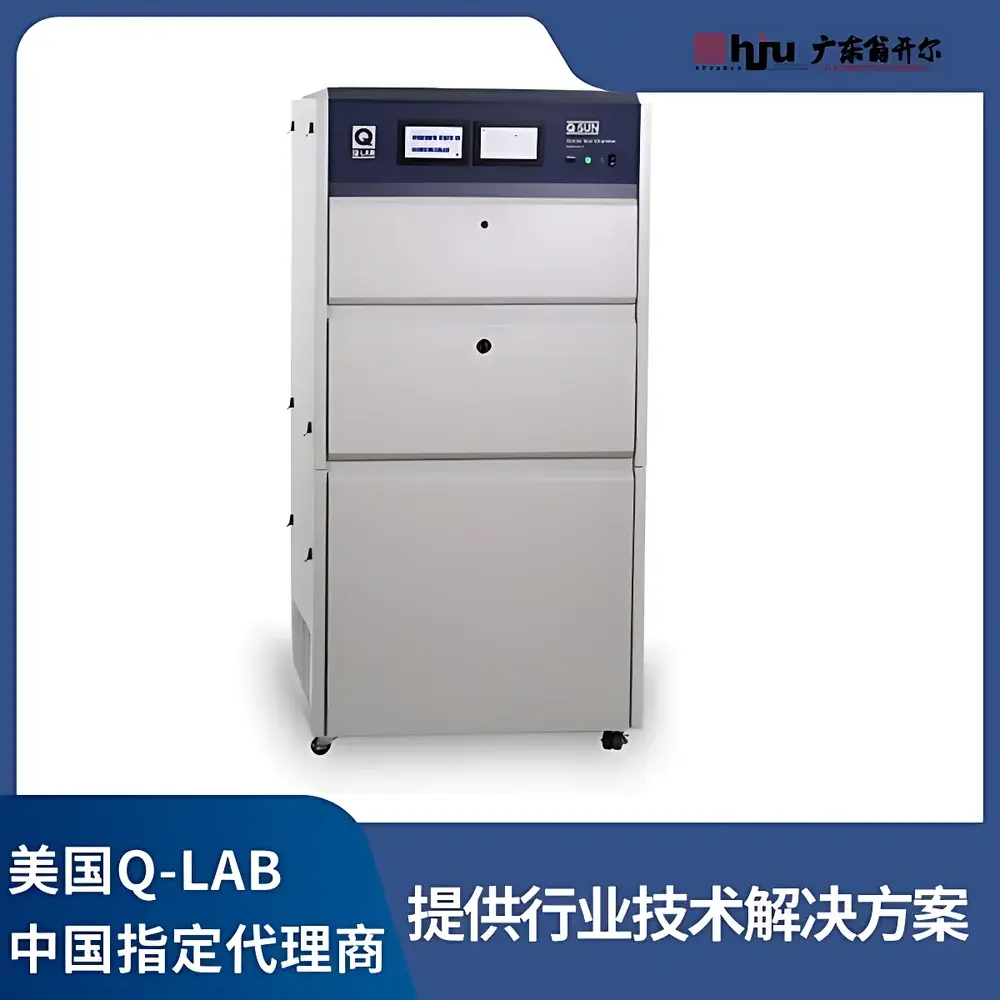
Q-LAB Q-SUN Xe-3-HC Xenon Arc Weathering Test Chamber
| Brand | Q-LAB |
|---|---|
| Origin | USA |
| Model | Q-SUN Xe-3-HC |
| Irradiance | Up to 1.30 W/m²/nm @ 340 nm, 2.40 W/m²/nm @ 420 nm |
| Humidity Control | Yes |
| Temperature Range | Down to 15°C (with refrigeration) |
| Sample Access | Motorized slide-out sample tray |
| Calibration | NIST-traceable via CR-20 Radiometer and AutoCal system |
Overview
The Q-LAB Q-SUN Xe-3-HC Xenon Arc Weathering Test Chamber is an engineered solution for accelerated weathering and light stability evaluation of materials under controlled, reproducible solar-simulated conditions. Utilizing a high-intensity xenon arc lamp with precision optical filtering, the chamber delivers spectral power distribution closely aligned with CIE Standard Illuminant D65 and ISO 105-B02 ID65—enabling correlation with real-world daylight exposure. The system operates on the principle of xenon arc irradiation, where broadband visible and near-UV radiation (290–800 nm) is filtered to replicate terrestrial sunlight while suppressing non-representative UV-C and IR emissions. Integrated refrigeration enables precise control of chamber air temperature down to 15°C, critical for thermally sensitive polymers, pharmaceuticals, and biological packaging. Combined irradiance, temperature, and humidity control allows users to isolate and quantify synergistic degradation mechanisms—photooxidation, hydrolysis, and thermal aging—in a single test environment.
Key Features
- Motorized slide-out sample tray for rapid, ergonomic loading of irregular or multi-dimensional specimens—including bottles, vials, Petri dishes, blister packs, and flexible films—without disturbing ongoing test cycles.
- NIST-traceable irradiance control system featuring the SOLAR EYE® sensor and AutoCal™ calibration protocol, enabling automated transfer of calibration data from the CR-20 radiometer to the controller in under 60 seconds.
- Dual-band irradiance monitoring at 340 nm (1.30 W/m²/nm) and 420 nm (2.40 W/m²/nm), compliant with ASTM G155, ISO 4892-2, and SAE J2527 spectral requirements.
- Refrigerated chamber design maintaining air temperature from 15°C to 80°C, independent of lamp power and ambient conditions.
- Active relative humidity control (10–95% RH, ±3% RH accuracy) synchronized with irradiance and temperature profiles to simulate humid subtropical, arid, or coastal exposure conditions.
- Long-life filter assemblies—including Daylight-Q, Window Glass-Q, and Extended UV filters—engineered to minimize spectral drift over lamp lifetime (typically 1500–2000 hours).
Sample Compatibility & Compliance
The Q-SUN Xe-3-HC accommodates diverse sample geometries and mounting configurations, supporting flat panels (up to 102 × 102 mm), cylindrical containers, and three-dimensional consumer packaging. Its modular tray design permits simultaneous testing of heterogeneous material sets under identical environmental stressors. The system meets essential regulatory and industry standards including ASTM D4329 (plastics), ASTM D4459 (interior automotive), ISO 11341 (paints and varnishes), and ICH Q1B (photostability testing of pharmaceuticals). Data integrity is maintained per FDA 21 CFR Part 11 requirements through electronic audit trails, user access controls, and calibrated parameter logging—all validated under GLP-compliant laboratory practices.
Software & Data Management
Control and monitoring are executed via Q-LAB’s proprietary Q-SUN Software Suite, supporting Windows-based operation with intuitive graphical interface, customizable test profiles, and real-time parameter visualization. All irradiance, temperature, humidity, and time-stamped event data are logged internally and exportable in CSV or XML formats for LIMS integration. The software includes built-in compliance reporting tools for ISO/IEC 17025 laboratories and supports scheduled calibration reminders linked to CR-20 radiometer usage history. Raw sensor outputs and controller setpoints are stored with metadata (operator ID, test ID, version stamp), ensuring full traceability for internal audits or regulatory submissions.
Applications
This chamber is routinely deployed across R&D, QC, and regulatory affairs functions in industries where long-term outdoor durability or shelf-life stability is mission-critical. Key use cases include: photostability qualification of drug product packaging per ICH Q5C; UV resistance validation of automotive interior trim materials (SAE J2412); colorfastness assessment of textile dyes and inks (AATCC TM16); weathering performance of architectural coatings (ASTM D4587); and accelerated aging of polymer-based medical device housings (ISO 10993-12). Its ability to decouple and recombine environmental stressors makes it especially valuable for failure mode analysis and root cause investigation of field failures.
FAQ
What spectral filters are available for the Q-SUN Xe-3-HC?
Standard options include Daylight-Q (D65 simulation), Window Glass-Q (indoor exposure), and Extended UV-Q (enhanced UV-B output). Filter selection is defined during configuration and can be changed manually per test standard requirements.
Is humidity control optional or integrated?
Relative humidity control is fully integrated and standard on the Xe-3-HC model, unlike base Xe-1 variants. It uses a dedicated steam generator and chilled mirror hygrometer for closed-loop regulation.
How often must the xenon lamp be replaced?
Lamp service life is typically 1500–2000 hours depending on operating irradiance level and filter type. The system logs cumulative lamp hours and triggers maintenance alerts prior to end-of-life.
Can test data be exported for regulatory submission?
Yes—raw parameter logs, calibration records, and operator annotations are exportable in secure, timestamped formats compatible with eCTD and FDA electronic submission gateways.
Does the system support remote monitoring?
When connected to a local network, the Q-SUN Software Suite allows secure remote access via authenticated VNC or RDP sessions, subject to site IT policy and firewall configuration.
Related Products



