
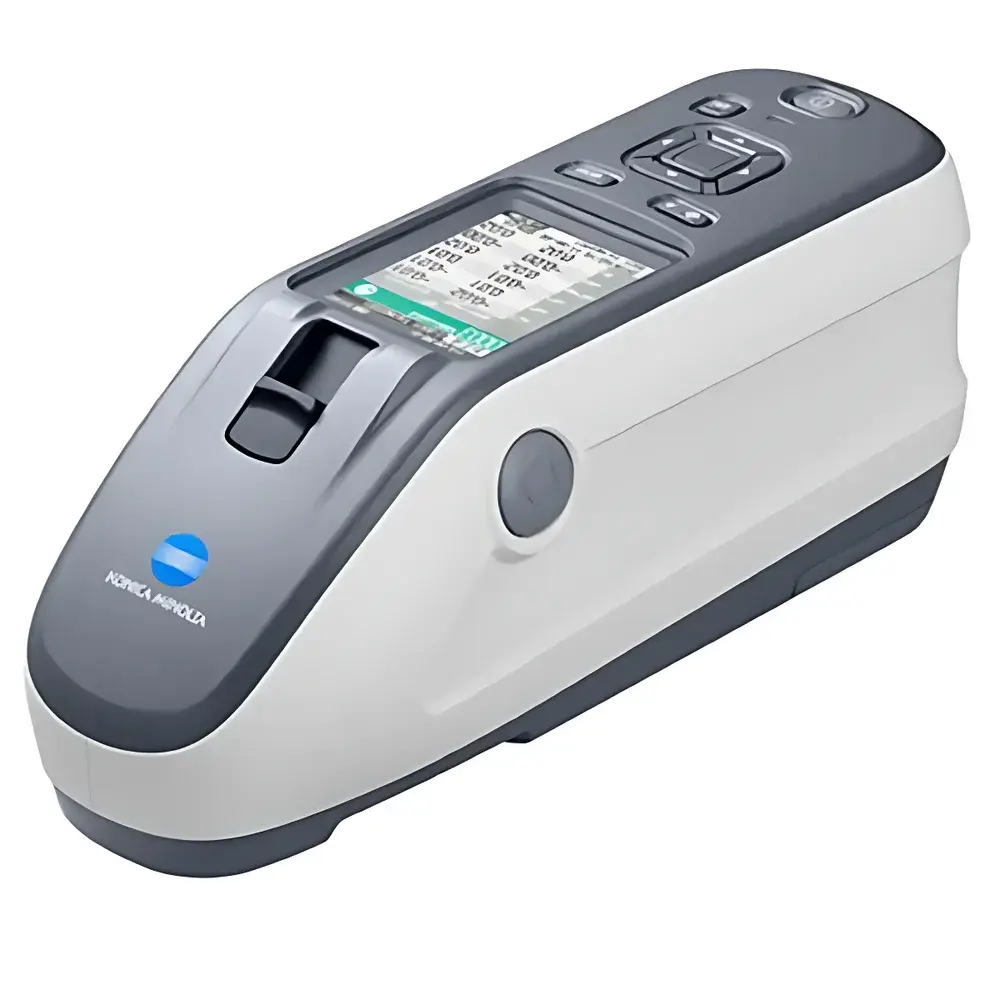
Konica Minolta CM-25cG Color & Gloss Meter
| Brand | Konica Minolta |
|---|---|
| Origin | Japan |
| Model | CM-25cG |
| Instrument Type | Portable |
| Optical Geometry | 45°c:0° (circumferential illumination) |
| Light Source | Pulsed Xenon Lamp |
| Spectral Range | 360 nm – 740 nm |
| Spectral Resolution | 10 nm |
| Repeatability | ΔE*ab ≤ 0.04 (std. dev.) |
| Inter-Instrument Agreement (IIA) | ΔE*ab ≤ 0.15 (BCRA Series II, avg. of 12 tiles) |
| Gloss Measurement | 60° geometry, ISO 2813-compliant embedded sensor |
| Aperture Sizes | MAV (7 mm) and SAV (3 mm) |
| Display | 2.7-inch high-resolution color LCD |
| Weight | < 600 g (incl. batteries) |
| Connectivity | USB + optional Bluetooth® 4.2 |
Overview
The Konica Minolta CM-25cG is a next-generation portable spectrophotometer engineered specifically for high-precision color and gloss measurement in demanding industrial environments—particularly automotive interior component manufacturing, high-visibility textile production (EN 471), and architectural coatings. Unlike conventional 45°/0° or d/8° instruments, the CM-25cG implements a proprietary 45°c:0° optical geometry, where “c” denotes circumferential illumination generated by an integrated integrating sphere and multi-mirror optical path. This configuration delivers near-perfect annular illumination independent of instrument orientation, eliminating directional bias and significantly reducing sensitivity to sample tilt, rotation, or localized surface texture. The system’s spectral engine covers 360–740 nm at 10 nm intervals, enabling full CIE XYZ, L*a*b*, L*C*h, and ΔE*ab calculations with traceable NIST-traceable calibration. Critically, the 45°c:0° geometry excludes specular reflectance—mimicking human visual perception under standardized viewing conditions—making it ideal for evaluating textured plastics, brushed metals, and matte-finished composites where traditional geometries introduce gloss-related metamerism or spatial averaging errors.
Key Features
- True dual-function capability: simultaneous spectral color measurement and ISO 2813-compliant 60° gloss evaluation in a single handheld unit
- 45°c:0° circumferential illumination architecture ensures orientation-invariant measurement repeatability on structured, grainy, or embossed surfaces
- Dual-aperture design supports both MAV (7 mm) and SAV (3 mm) measurement areas—enabling precise assessment of small features, seams, and heterogeneous substrates
- Pulsed xenon lamp provides stable, flash-based illumination across full visible spectrum—eliminating thermal drift and ensuring consistent performance on dark or low-reflectance materials
- Embedded real-time optical preview window allows direct visual alignment prior to measurement—enhancing positional accuracy without reliance on external cameras or software overlays
- Inter-instrument agreement (IIA) ≤ ΔE*ab 0.15 (BCRA Series II, n=12) confirms metrological equivalence across deployed units—essential for multi-site supply chain validation
- Lightweight (<600 g), rugged magnesium alloy housing rated for continuous use in factory-floor and field inspection environments
Sample Compatibility & Compliance
The CM-25cG is validated for use on non-uniform, optically complex surfaces common in Tier-1 automotive interiors—including soft-touch TPO, PU-leather laminates, knitted polyester fabrics, and injection-molded ABS with molded-in textures. Its 45°c:0° geometry inherently suppresses specular contribution, satisfying ASTM D2244, ISO 11664-4, and JIS Z 8722 requirements for color difference evaluation on non-Lambertian surfaces. The integrated 60° gloss sensor conforms to ISO 2813 and ASTM D523, with factory-calibrated reference standards traceable to NPL (UK) and PTB (Germany). Data output supports GLP/GMP audit trails when paired with Konica Minolta’s SpectraMagic NX software, including user authentication, electronic signatures, and 21 CFR Part 11–compliant metadata logging (time stamp, operator ID, instrument serial, calibration status).
Software & Data Management
Measurements are stored internally with timestamp, aperture selection, gloss value, and full spectral data (31-point reflectance curve). Data export via USB or optional Bluetooth® 4.2 supports CSV, XML, and proprietary .qtx formats compatible with SpectraMagic NX v3.6+. The instrument enables hierarchical data organization through user-defined alphanumeric tags—e.g., “Line_A/Trim_Panel/2024Q3”—allowing rapid filtering, batch comparison, and statistical process control (SPC) charting. All measurements retain absolute CIELAB coordinates referenced to D65/10° illuminant/observer, eliminating reliance on physical master standards and enabling true digital color data handover across OEM–supplier networks. Firmware updates maintain compliance with evolving ISO/CIE revisions and support future calibration certificate integration.
Applications
- Automotive: Validation of seat fabrics, door trims, dashboards, and center consoles against OEM color/gloss tolerances (e.g., Ford WSS-M99P1165-A, GMW14872)
- Textiles: EN 471-certified high-visibility garment verification, including retroreflective tape and fluorescent dye consistency
- Coatings & Plastics: Batch-to-batch consistency monitoring for solvent-borne and waterborne topcoats, powder coatings, and extruded profiles
- Quality Assurance: In-line pass/fail decision support using configurable tolerance ellipsoids (CIEDE2000, ΔE*ab, ΔL*ΔC*ΔH*)
- Supplier Collaboration: Secure cloud-enabled data sharing via Konica Minolta’s ColorEdge platform—reducing physical sample shipping and accelerating dispute resolution
FAQ
What distinguishes 45°c:0° from standard 45°/0° geometry?
The “c” denotes circumferential illumination achieved via a multi-mirror optical train within an integrating sphere—producing uniform annular light incidence regardless of instrument rotation or sample angle. This eliminates directional dependency inherent in single-angle 45°/0° systems.
Can the CM-25cG measure metallic or pearlescent finishes?
No—it is not a multi-angle spectrophotometer; its fixed 45°c:0° geometry does not resolve goniochromatic effects. It is optimized for non-iridescent, diffusely scattering surfaces per ISO 18314-2 Annex B.
Is the 60° gloss sensor independently calibrated?
Yes—the sensor is factory-aligned to ISO 2813 reference standards and undergoes concurrent verification during spectral calibration cycles.
How is inter-instrument agreement verified?
Each unit is tested against the BCRA Series II tile set (12 tiles); IIA is reported as mean ΔE*ab across all tiles and must be ≤ 0.15 to ship.
Does the CM-25cG support custom illuminants or observers?
Spectral data is captured raw; post-acquisition calculation supports CIE standard illuminants (A, C, D50, D65, F2, F7, F11) and observers (2°, 10°) via SpectraMagic NX—no onboard firmware limitations.




