
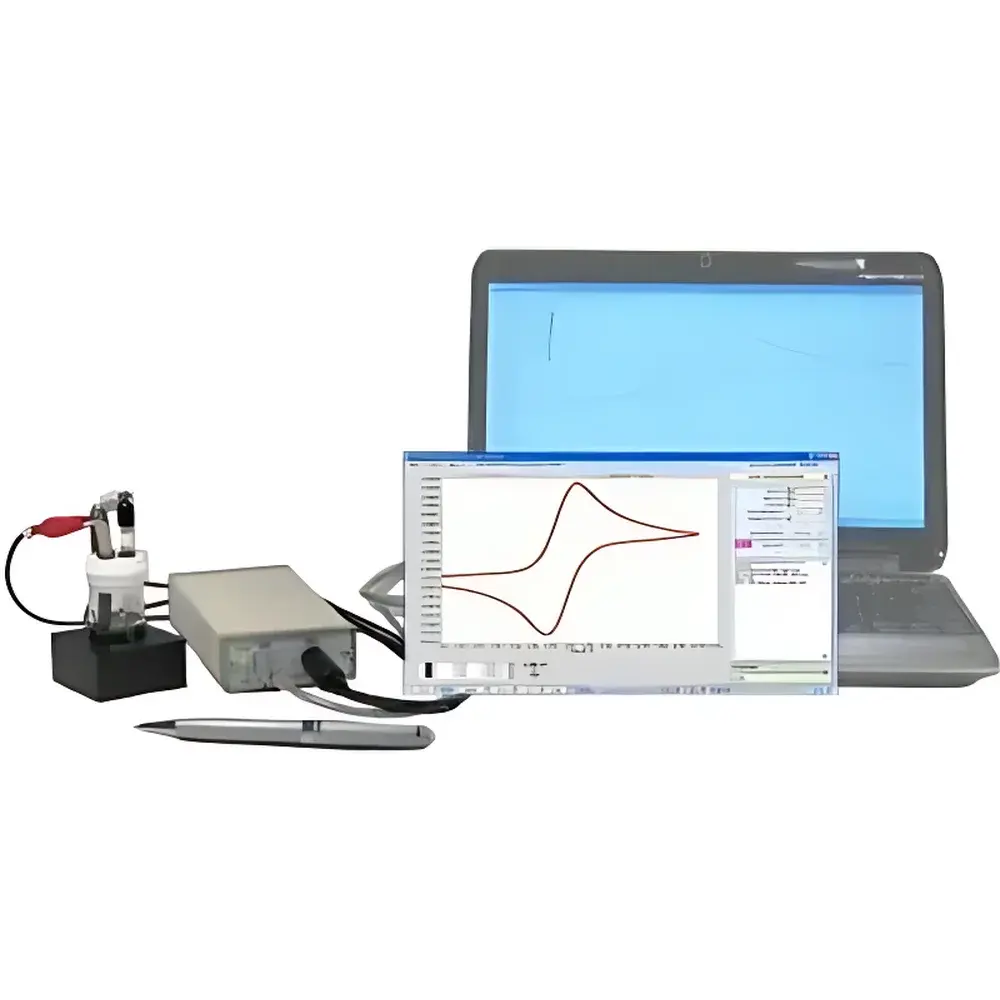
Digi-Ivy DY2116B Portable Potentiostat/Galvanostat
| Brand | Digi-Ivy |
|---|---|
| Origin | USA |
| Model | DY2116B |
| Instrument Type | Portable Electrochemical Workstation |
| Channel Count | Single-Channel |
| Current Range | ±20 nA to ±2 mA (6 full-scale ranges) |
| Potentiostatic Range | ±2.0 V |
| Resolution | 76 µV (potential), 0.002% of full scale (current), down to 0.76 pA minimum measurable current |
| Input Impedance (Reference Electrode) | >10¹² Ω |
| Bandwidth | >100 kHz |
| Sampling Rate | 16-bit ADC, up to 60,000 points/channel |
| Dimensions | 7 × 14 × 3 cm |
| Weight | 250 g |
| Power Supply | USB-powered |
| Filter Options | 4-stage low-pass I/E filter (auto/manual) |
| Operating Systems | Windows 7/Vista/XP |
Overview
The Digi-Ivy DY2116B is a compact, single-channel potentiostat/galvanostat engineered for precision electrochemical measurements in field-deployable, teaching, and benchtop research environments. Based on a high-stability analog front-end architecture and modern mixed-signal integrated circuit design, the instrument implements classic three-electrode electrochemical control (working, counter, and reference electrodes) with digital command execution via USB interface. Its core measurement principle relies on feedback-controlled voltage or current sourcing, coupled with high-fidelity 16-bit DAC (for stimulus generation) and 16-bit ADC (for response acquisition), enabling accurate quantification of faradaic and capacitive currents under controlled potential or current conditions. Designed for low-noise operation without mandatory Faraday cage shielding, the DY2116B achieves sub-picoampere current resolution — critical for corrosion monitoring, sensor characterization, battery electrode screening, and fundamental kinetics studies where signal integrity at ultra-low current levels is essential.
Key Features
- Ultra-compact form factor (7 × 14 × 3 cm, 250 g) optimized for portability and space-constrained labs or classroom demonstrations.
- Low-noise analog signal chain with input bias current 10¹² Ω — supporting high-impedance reference electrodes and minimizing measurement artifacts.
- Wide dynamic current range spanning ±20 nA to ±2 mA across six programmable full-scale ranges, with 0.002% FS resolution and verified minimum detectable current of 0.76 pA.
- Precise 16-bit potentiostatic control over ±2.0 V range, offering 76 µV potential step resolution and >100 kHz bandwidth for fast transient capture.
- Integrated cell on/off switching and configurable low-pass I/E filtering (4 stages, auto/manual selection) to suppress noise while preserving electrochemical response fidelity.
- USB-powered operation eliminates external power supplies and enhances safety in wet-lab or educational settings.
Sample Compatibility & Compliance
The DY2116B supports standard three-electrode electrochemical cells (WE/CE/RE) and is compatible with common aqueous and non-aqueous electrolytes, screen-printed electrodes, microelectrodes, and solid-state battery half-cells. Its analog performance characteristics meet baseline requirements for ASTM G59 (standard practice for conducting potentiodynamic polarization resistance measurements) and ISO 16773-2 (electrochemical impedance spectroscopy for coatings). While not certified for GLP/GMP production environments, its stable calibration traceability, audit-ready data logging, and deterministic timing control make it suitable for method development, QC screening, and academic research workflows requiring reproducible electrochemical data. The device operates within IEC 61010-1 safety limits for laboratory electrical equipment.
Software & Data Management
The included Windows-native software provides a modular, intuitive interface for experiment setup, real-time visualization, and post-acquisition analysis. All supported techniques — including cyclic voltammetry (CV), linear sweep voltammetry (LSV), chronoamperometry (CA), chronopotentiometry (CP), differential pulse voltammetry (DPV), square-wave voltammetry (SWV), open-circuit potential (OCP), and multi-step protocols — are implemented with parameter validation and hardware-enforced limits. Data files are saved in structured binary format with embedded metadata (timestamp, technique, parameters, hardware ID), and export options include CSV and ASCII for third-party analysis (e.g., MATLAB, Origin, Python). Built-in processing tools include digital filtering, baseline correction, smoothing, DC offset removal, arithmetic operations, automatic peak detection (with reporting of Ep, Ip, ΔEp), and batch replay of sequences. The software logs all user actions and parameter changes, supporting basic traceability per FDA 21 CFR Part 11 principles when used in validated environments.
Applications
- Undergraduate and graduate electrochemistry laboratories: CV, DPV, and CA experiments for teaching redox thermodynamics and kinetics.
- Corrosion science: Polarization resistance (Rp), Tafel analysis, and localized corrosion monitoring using microelectrodes.
- Electrochemical sensor development: Amperometric detection limits, sensitivity calibration, and interference testing.
- Battery R&D: Half-cell cycling of cathode/anode materials, SEI formation studies, and charge-transfer resistance estimation.
- Environmental analysis: Heavy metal detection (e.g., Pb²⁺, Cd²⁺) via anodic stripping voltammetry on modified electrodes.
- Materials characterization: Conductivity mapping of conductive polymers, graphene dispersions, and MOF-based catalysts.
FAQ
Is the DY2116B compatible with modern Windows operating systems (e.g., Windows 10 or 11)?
The official software is validated for Windows XP, Vista, and 7. Users on newer OS versions may operate the device via compatibility mode or virtual machine environments; driver-level support for Windows 10/11 is not provided by the manufacturer.
Does the instrument support electrochemical impedance spectroscopy (EIS)?
No — the DY2116B does not implement frequency-domain perturbation or phase-sensitive detection required for EIS. It is optimized for time-domain techniques only.
Can multiple DY2116B units be synchronized for multi-channel measurements?
No — each unit operates independently as a single-channel system. Synchronization across devices is not supported in hardware or software.
What is the maximum sampling rate during chronoamperometric acquisition?
The system supports up to 60,000 data points per channel per run, with minimum sampling intervals down to 10 µs (1e−5 sec), constrained by USB throughput and host PC performance.
Is calibration documentation or NIST-traceable certification available?
Digi-Ivy provides factory calibration reports upon request. However, formal NIST-traceable certification or ISO/IEC 17025 accreditation is not included with standard delivery.






