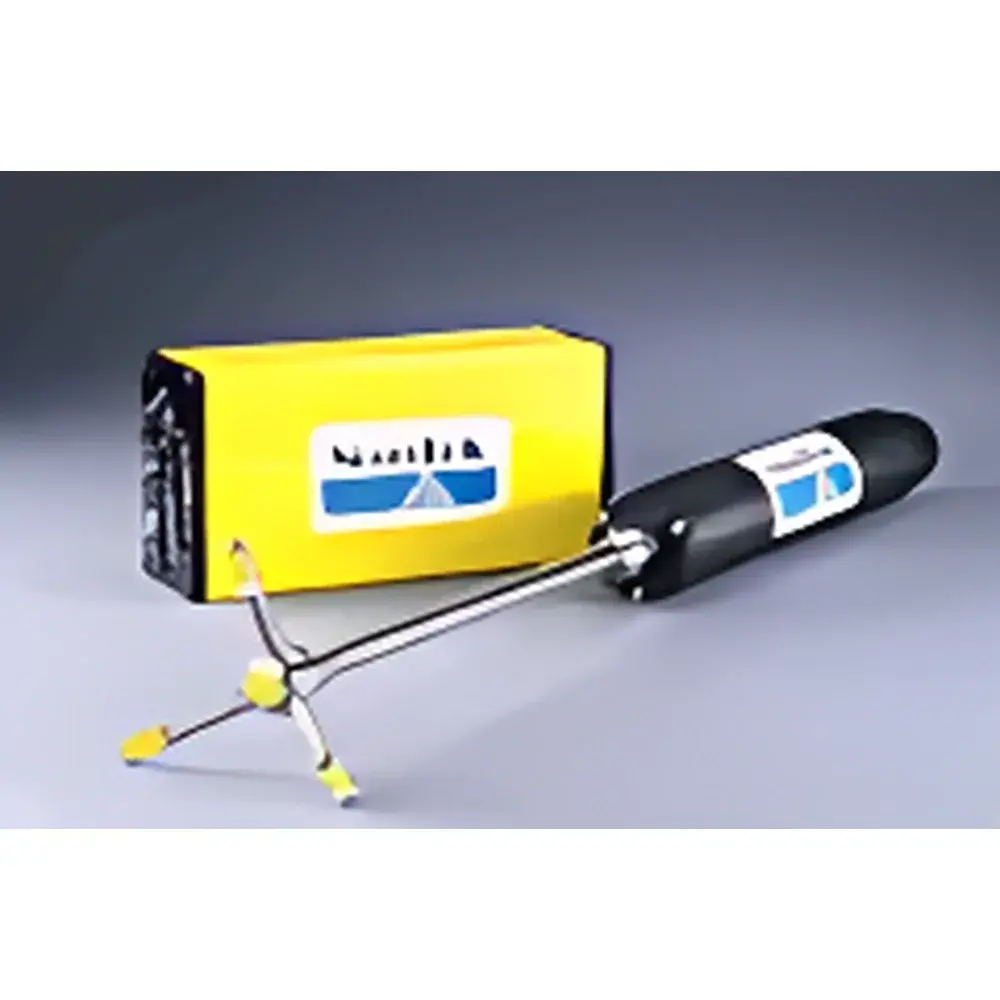
SonTek ADV Acoustic Doppler Velocimeter
| Brand | SonTek |
|---|---|
| Origin | USA |
| Model | ADV |
| Frequency Options | 5 MHz / 10 MHz / 16 MHz |
| Sampling Volume | 0.09–2.0 cm³ |
| Sampling Rate | 0.1–50 Hz |
| Measurement Distance from Transducer | 5–18 cm |
| Velocity Resolution | 0.01 cm/s |
| Velocity Accuracy | ±1% of measured value or ±0.25 cm/s (whichever is greater) |
| Max Operating Depth | 60 m (10/16 MHz), 250 m (5 MHz Delrin), 2000 m (5 MHz Stainless Steel) |
| Power Supply | 12–24 V DC |
| Power Consumption | 2.5–4 W (active), <1 mW (sleep) |
| Probe Configurations | 3D-top-view, 3D-side-view, 3D-upward-view, 2D-side-view |
| Interface | Waterproof connector, splash-proof signal processor |
| Calibration | Factory-performed, stable long-term calibration |
| Compliance | Designed for ASTM D5766, ISO 748, and USGS/USACE hydrodynamic measurement protocols |
Overview
The SonTek ADV Acoustic Doppler Velocimeter is a precision laboratory- and field-grade instrument engineered for non-intrusive, high-resolution measurement of three-dimensional instantaneous water velocity vectors. Based on the physical principle of acoustic Doppler shift, the ADV transmits short pulses of ultrasonic energy into the fluid and analyzes the frequency shift of backscattered signals from suspended particles—serving as natural tracers—to compute velocity components along three orthogonal axes. Unlike mechanical propeller or electromagnetic flowmeters, the ADV operates via remote sensing: the measurement volume (or “sample volume”) is spatially separated from the transducer face by a precisely defined distance (5–18 cm depending on model and frequency), eliminating flow disturbance and enabling boundary-proximal measurements at millimeter-scale standoff. Originally developed in collaboration with the U.S. Army Corps of Engineers Waterways Experiment Station, the ADV has become a de facto standard in hydraulic laboratories, coastal engineering studies, and turbulence research due to its exceptional temporal and spatial resolution, robust noise rejection, and traceable metrological performance.
Key Features
- Three-dimensional velocity vector output with simultaneous acquisition of u, v, and w components at up to 50 Hz (16 MHz MicroADV)
- Ultra-small sampling volumes—from 0.09 cm³ (MicroADV) to 2.0 cm³ (ADV Ocean)—enabling high spatial resolution in laminar, transitional, and turbulent flows
- Multiple probe geometries: 3D-top-view, 3D-side-view, 3D-upward-view, and 2D-side-view configurations support diverse experimental setups—including shallow-water applications down to 2–3 cm depth
- Modular transducer–cable architecture with IP68-rated waterproof connectors and splash-resistant signal processors for operational flexibility and serviceability
- Multi-probe capability: Up to six ADV probes can be synchronized and controlled simultaneously via a single data acquisition workstation
- Factory calibration traceable to NIST standards; no routine recalibration required under normal operating conditions
- Low-power design optimized for long-term deployments: 2.5–4 W active draw, <1 mW sleep mode
- Integrated acoustic backscatter intensity output—calibratable for suspended sediment concentration (SSC) estimation using established empirical or semi-empirical relationships
Sample Compatibility & Compliance
The ADV is validated for use in freshwater, estuarine, and marine environments across a wide range of turbidity levels, provided sufficient acoustic scatterers (e.g., silt, clay, phytoplankton, or seeded particles) are present. Its measurement validity is maintained under low-velocity conditions (<3 cm/s) and high-turbulence regimes (e.g., wave breaking, bottom boundary layers), where traditional methods suffer from mechanical inertia or spatial averaging artifacts. The instrument conforms to internationally recognized hydrometric standards including ASTM D5766 (Standard Test Method for Measuring Velocity of Water Flow in Open Channels Using Acoustic Doppler Velocimeters), ISO 748 (Liquid flow measurement in open channels — Velocity-area method), and supports GLP-compliant data acquisition when integrated with time-stamped, audit-trail-enabled software platforms. All stainless-steel and Delrin-housed variants meet pressure vessel requirements per ASME BPVC Section VIII for submersible operation at rated depths.
Software & Data Management
Data acquisition and real-time visualization are performed using SonTek’s proprietary ADV Software Suite, which supports raw binary data export in ASCII and MATLAB-compatible formats (.mat). The software enables user-defined sampling schemes (burst, continuous, triggered), spectral analysis (FFT-based turbulence spectra), Reynolds stress computation, and coordinate transformation (e.g., streamwise–wall-normal–spanwise). Exported datasets include timestamped velocity components, correlation magnitude, signal-to-noise ratio (SNR), and acoustic intensity—facilitating post-processing in Python, R, or commercial CFD validation tools. For regulated environments, optional FDA 21 CFR Part 11-compliant modules provide electronic signatures, audit trails, and role-based access control. All firmware updates and configuration files are digitally signed to ensure integrity and reproducibility.
Applications
- Laboratory-scale turbulence characterization: Reynolds stress tensor quantification, energy spectra, quadrant analysis, and coherent structure identification in flumes and wave tanks
- Boundary layer studies: Near-wall velocity gradients, roughness element effects, and sediment transport initiation thresholds
- Coastal and estuarine dynamics: Current profiling across tidal cycles, wave–current interaction, and surf zone turbulence dissipation
- Environmental monitoring: Long-term deployment in rivers, reservoirs, and aquaculture systems for flow regime assessment and habitat modeling
- Validation of numerical models: High-fidelity benchmark data for LES, RANS, and SPH simulations requiring point-wise, phase-resolved velocity input
- Suspended sediment dynamics: Coupled velocity–backscatter analysis for SSC inversion and erosion/deposition flux estimation
FAQ
What distinguishes the ADV from an Acoustic Doppler Current Profiler (ADCP)?
The ADV measures velocity at a single, fixed sample volume with ultra-high temporal resolution (up to 50 Hz) and millimeter-scale spatial precision, whereas ADCPs resolve velocity profiles over depth bins (typically ≥10 cm) at lower sampling rates (≤4 Hz). The ADV is optimized for turbulence and boundary-layer research; ADCPs serve large-scale current mapping.
Can the ADV operate in air or non-aqueous fluids?
No—the ADV requires an acoustically scattering medium with sufficient particle concentration and sound speed compatibility (designed for water; not suitable for air, oil, or highly viscous fluids).
Is factory recalibration required after extended deployment?
No—SonTek performs permanent factory calibration using traceable reference flows and temperature-compensated transducer response models. Field verification against static calibration tanks or known flow benches is recommended annually for QA/QC but not mandatory.
How is synchronization achieved across multiple ADV probes?
Probes are triggered via TTL pulse inputs synchronized to a master clock source; all units share common time stamps with microsecond-level alignment, enabling cross-probe turbulence coherence analysis.
Does the ADV support real-time data streaming to SCADA or IoT platforms?
Yes—via optional Ethernet or RS-485 interfaces, raw velocity packets can be streamed in NMEA-0183 or custom JSON format for integration with telemetry gateways, cloud dashboards, or automated control systems.