
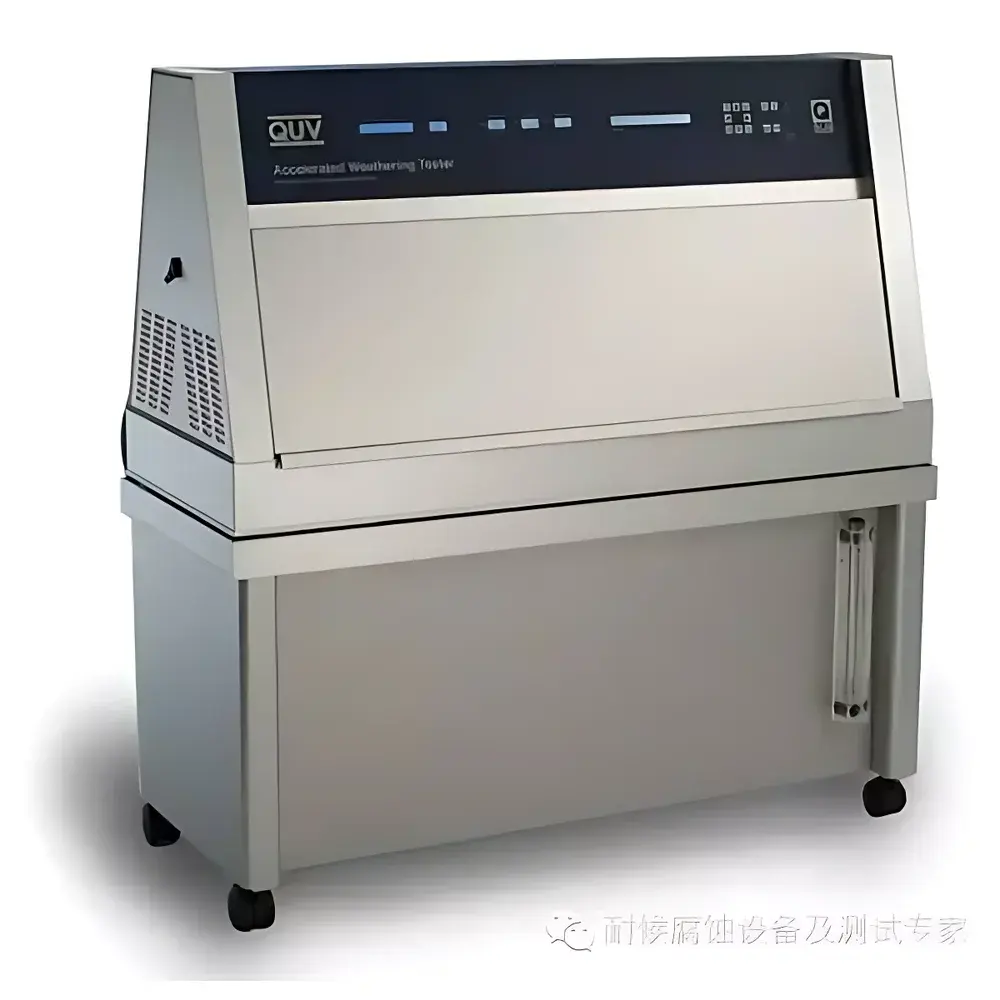
Q-Lab QUV/se UV Aging Test Chamber
| Brand | Q-LAB |
|---|---|
| Origin | USA |
| Model | QUV/se |
| Sample Capacity | 24 pcs (75 mm × 300 mm) or 48 pcs (75 mm × 150 mm) |
| UV Irradiance Control | Yes (Solar Eye® feedback system) |
| Condensation Simulation | Yes |
| Compliance | ASTM G154, ISO 4892-3, JIS K 5600-7-8, SAE J2020, GB/T 14522, and other international standards |
| Chamber Dimensions (L×W×H) | As specified in technical documentation |
| Black Panel Temperature Range | As specified in technical documentation |
| UV Wavelength Range | UVA-340 (315–400 nm) or UVB-313 (280–315 nm), configurable per lamp type |
| Illumination Uniformity | ±15% across specimen plane per ASTM G154 Annex A1 |
Overview
The Q-Lab QUV/se UV Aging Test Chamber is an engineered solution for accelerated weathering evaluation of materials under controlled ultraviolet (UV) radiation, temperature, and condensation cycles. Based on the fundamental principle of photochemical degradation—where UV photons induce bond scission, oxidation, and polymer chain scission—the QUV/se replicates key outdoor exposure stressors in a highly reproducible laboratory environment. Unlike natural outdoor testing, which requires months or years to yield measurable deterioration, the QUV/se delivers quantifiable performance data in days or weeks by intensifying UV irradiance up to five times typical noon summer sunlight (UVA-340 spectrum) while maintaining precise thermal and humidity profiles. Its design adheres to the core requirements of ASTM G154 (Standard Practice for Operating Fluorescent Ultraviolet (UV) Lamp Apparatus for Exposure of Non-Metallic Materials) and ISO 4892-3 (Plastics — Methods of Exposure to Laboratory Light Sources — Part 3: Fluorescent UV Lamps), ensuring regulatory traceability and inter-laboratory comparability.
Key Features
- Solar Eye® Irradiance Control System: A calibrated photodiode sensor continuously monitors UV output and dynamically adjusts lamp power to maintain user-specified irradiance levels (e.g., 0.68 W/m² @ 340 nm), eliminating drift due to lamp aging or voltage fluctuation.
- Condensation Mechanism: Uses elevated chamber temperature and ambient air cooling to generate uniform water condensation on specimen surfaces—mimicking dew formation critical for hydrolytic degradation pathways in coatings, adhesives, and polymers.
- Programmable Test Cycles: Supports multi-step sequences combining UV exposure, condensation, and optional dark periods—enabling simulation of diurnal cycles per ASTM D4587 and ISO 11507.
- High-Uniformity UV Exposure: Optimized reflector geometry and lamp alignment ensure irradiance uniformity within ±15% across the specimen plane (per ASTM G154 Annex A1), minimizing positional bias in comparative studies.
- Robust Construction: Stainless steel interior, corrosion-resistant hardware, and sealed electrical compartments ensure long-term operational integrity in high-humidity UV environments.
- Lamp Compatibility: Accepts both UVA-340 (closest match to solar UV below 365 nm) and UVB-313 (accelerated, short-wavelength UV) fluorescent lamps—allowing method flexibility per material sensitivity and standard requirements.
Sample Compatibility & Compliance
The QUV/se accommodates flat-panel specimens up to 75 mm × 300 mm (24 positions) or 75 mm × 150 mm (48 positions), with standardized mounting fixtures ensuring consistent orientation and airflow. It supports rigid substrates (metal, plastic, ceramic), coated panels, films, and laminates—provided specimens meet dimensional and thermal stability criteria for the test cycle. The system complies with over 50 internationally recognized standards—including ASTM G154, ASTM D4587, ISO 4892-3, JIS K 5600-7-8, SAE J2020, and GB/T 14522—making it suitable for quality control, R&D validation, and regulatory submission dossiers. All irradiance calibrations are traceable to NIST-certified reference standards, and routine verification follows Q-Lab’s documented procedures aligned with ISO/IEC 17025 principles.
Software & Data Management
The QUV/se operates via an intuitive front-panel interface with real-time display of chamber temperature, black panel temperature, UV irradiance, and elapsed time. While the base unit does not include PC connectivity, optional data logging modules enable timestamped recording of all operational parameters at user-defined intervals (e.g., every 1–60 minutes). Exported CSV files support integration into LIMS or statistical analysis platforms (e.g., JMP, Minitab) for trend analysis, SPC charting, and GLP-compliant audit trails. For laboratories requiring full 21 CFR Part 11 compliance, Q-Lab offers validated software upgrades with electronic signatures, role-based access control, and immutable audit logs—supporting FDA-regulated industries including medical device packaging and pharmaceutical excipient stability assessment.
Applications
The QUV/se serves as a primary tool for evaluating UV resistance across diverse sectors: In automotive OEMs, it validates exterior trim durability per GMW14124 and Ford CETP; in coatings R&D, it assesses gloss retention and chalking per ASTM D4587; in packaging, it verifies ink adhesion and film clarity after simulated shelf life; in construction, it tests roofing membrane integrity per ASTM D4799 and ISO 20340. Its reproducibility makes it ideal for supplier qualification, formulation optimization, and failure root-cause analysis—particularly where UV-induced embrittlement, yellowing, or interfacial delamination is suspected. When combined with Q-Lab’s outdoor Florida and Arizona exposure services, the QUV/se enables correlation modeling between accelerated lab data and real-world service life predictions.
FAQ
What UV spectra are supported, and how are they selected?
UVA-340 lamps replicate solar UV down to 295 nm and are recommended for most general weathering applications. UVB-313 lamps emit shorter, more aggressive wavelengths and are used for highly accelerated testing or materials known to degrade primarily below 320 nm. Lamp selection is determined by application standard requirements—not instrument configuration.
Is calibration required, and how often should it be performed?
Yes. Irradiance sensors require annual recalibration using Q-Lab’s NIST-traceable calibration service. Black panel temperature sensors should be verified quarterly against a calibrated reference thermometer per ASTM G151 Annex A2.
Can the QUV/se be used for cyclic corrosion testing?
No. The QUV/se is designed exclusively for UV/condensation cycling. For combined UV/salt spray protocols (e.g., ASTM D7869), Q-Lab recommends the Q-SUN Xe-3-HS or Q-FOG CRH chamber, which integrate xenon arc irradiation with programmable salt fog delivery.
What water quality is required for condensation operation?
Deionized (DI) water with resistivity ≥1 MΩ·cm is mandatory. Tap or distilled water introduces mineral deposits that impair condensate uniformity and accelerate chamber corrosion.
Related Products



