
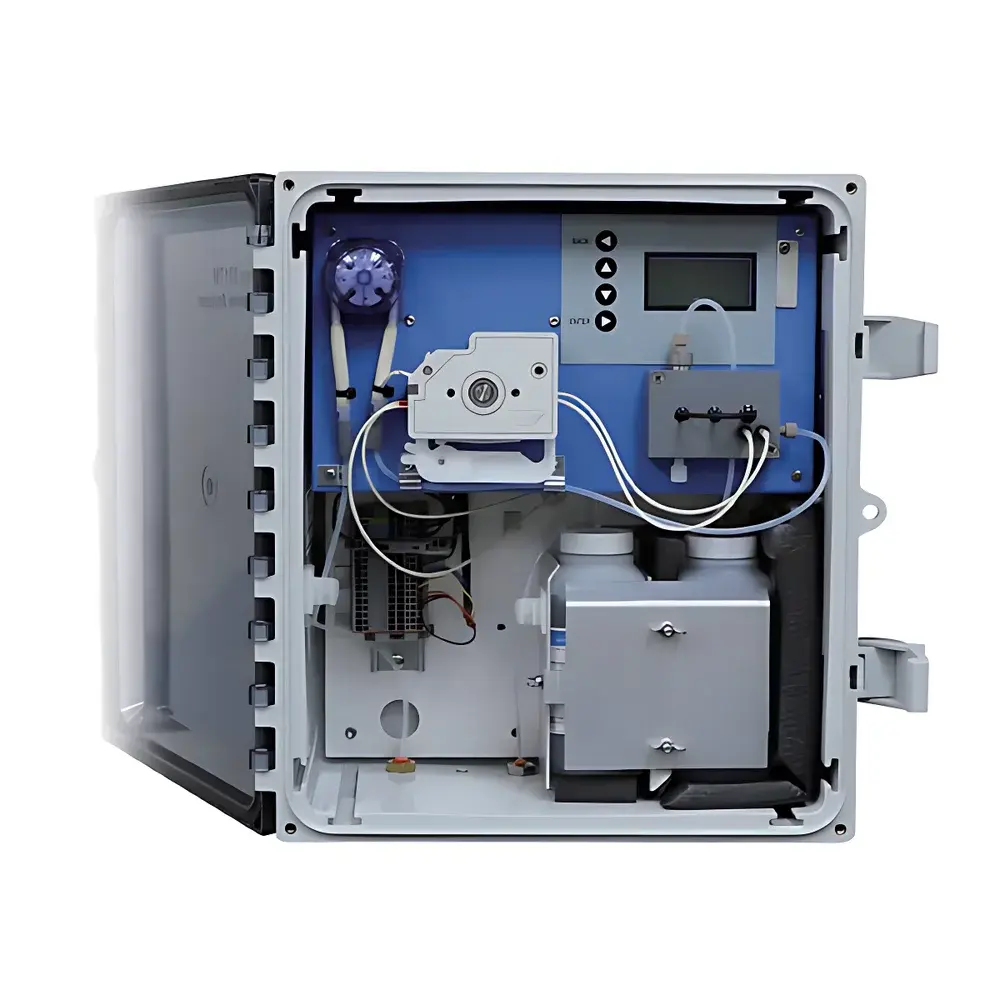
WTW Chlorine 3017M DPD Residual Chlorine and Chlorine Dioxide Analyzer
| Brand | WTW |
|---|---|
| Origin | Germany |
| Model | Chlorine 3017M |
| Instrument Type | Online Analyzer |
| Measurement Principle | DPD Spectrophotometry |
| Measured Parameters | Free Chlorine, Total Chlorine, Chlorine Dioxide (optional reagent configuration) |
| Range | 0–5 mg/L (free or total chlorine, reagent-dependent) |
| Accuracy | ±0.03 mg/L or ±5% (whichever is greater) |
| Resolution | 0.01 mg/L |
| Detection Limit | 0.03 mg/L |
Overview
The WTW Chlorine 3017M is a fully automated, online residual chlorine and chlorine dioxide analyzer engineered for continuous, unattended water quality monitoring in drinking water distribution systems, wastewater effluent streams, cooling water circuits, and sensitive aquatic environments. It operates on the standardized N,N-diethyl-p-phenylenediamine (DPD) spectrophotometric method—recognized by ISO 7393-2, ASTM D1253, and EPA Method 334.1—as the reference analytical technique for free chlorine, total chlorine, and chlorine dioxide quantification in aqueous matrices. The instrument integrates dual-wavelength photometry with temperature-compensated optical detection to minimize interferences from turbidity, color, and oxidant cross-reactivity. Its robust flow-cell design ensures stable hydraulic conditions during measurement cycles, supporting high reproducibility across varying sample matrices without manual intervention.
Key Features
- Fully autonomous operation with >30 days of uninterrupted runtime on a single reagent cartridge set
- Reagent replacement completed in <15 minutes per month—no tools or technician certification required
- Zero-calibration architecture: factory-traceable calibration curves stored in non-volatile memory; no field calibration or standard solutions needed during routine operation
- Backlit graphical LCD display with intuitive menu navigation and real-time trend visualization (concentration, status, maintenance alerts)
- Integrated analog outputs (4–20 mA) and digital communication via Modbus RTU (RS-485) for seamless integration into SCADA or PLC-based control systems
- IP65-rated enclosure suitable for indoor and outdoor mounting in humid or chemically aggressive environments
- Self-diagnostic routines monitor LED stability, fluidic integrity, photometer drift, and reagent depletion—logging events with timestamps for audit readiness
Sample Compatibility & Compliance
The Chlorine 3017M is validated for use with potable water, treated wastewater, recirculating cooling water, and aquaculture influent/effluent streams. It meets the performance criteria specified in DIN EN ISO/IEC 17025 for routine environmental testing laboratories and supports GLP-compliant data handling when deployed with optional IQ Sensor Net infrastructure. Reagent kits are manufactured under ISO 9001 quality management systems and supplied with batch-specific certificate of analysis. The analyzer complies with EU Drinking Water Directive (2020/2184) monitoring requirements for residual disinfectant verification and satisfies US EPA Clean Water Act reporting thresholds for chlorine discharge compliance. All firmware and measurement algorithms adhere to IEC 61508 functional safety principles for process instrumentation.
Software & Data Management
Data acquisition and remote configuration are supported through WTW’s MIQ/IC2 interface module, enabling bidirectional communication with IQ Sensor Net controllers. Historical concentration values, system diagnostics, reagent consumption logs, and alarm events are timestamped and stored locally (up to 30 days) with automatic rollover. Export options include CSV via USB stick or scheduled FTP transfer for LIMS integration. Audit trails record all user-initiated actions—including parameter changes, maintenance entries, and alarm acknowledgments—in accordance with FDA 21 CFR Part 11 requirements when paired with validated IQ Sensor Net software versions. Optional cloud connectivity allows secure web-based access to real-time dashboards and predictive maintenance notifications.
Applications
- Drinking water treatment: Continuous verification of chlorine residual at entry points, booster stations, and distribution endpoints to ensure regulatory compliance and prevent under-/over-dosing
- Wastewater disinfection: Monitoring post-chlorination effluent to meet NPDES permit limits; synchronized with dechlorination control loops using sodium bisulfite or UV reduction
- Cooling water management: Maintaining optimal biocide levels to inhibit Legionella pneumophila growth while minimizing corrosion risk and chemical waste
- Aquaculture & habitat protection: Detecting trace free chlorine carryover from municipal supply lines or accidental dosing events that threaten fish gill function and nitrifying biofilm stability
- Pharmaceutical water systems: Supporting PW and WFI loop surveillance where oxidative residuals must remain below pharmacopeial thresholds (e.g., USP )
FAQ
Does the Chlorine 3017M require daily calibration or standardization?
No. It employs a zero-calibration design with factory-characterized optical and fluidic response profiles. Calibration curves are embedded in firmware and do not degrade under normal operating conditions.
Can it distinguish between free chlorine and chlorine dioxide in the same sample stream?
Yes—via sequential DPD reaction protocols enabled by programmable reagent injection timing and dual-wavelength absorbance differentiation (515 nm and 550 nm), as defined in Standard Methods 4500-Cl G.
Is the analyzer compatible with third-party SCADA platforms?
Yes. Native Modbus RTU (RS-485) support enables direct integration with most industrial automation systems without middleware.
What maintenance intervals are recommended beyond monthly reagent replacement?
Annual verification of photometer linearity and flow-cell cleanliness is advised; full service is recommended every 24 months or after 10,000 measurement cycles.
How does the system handle samples with high turbidity or organic coloration?
The dual-wavelength algorithm automatically corrects for non-specific absorbance contributions, and optional inline filtration (e.g., 5 µm cartridge) can be installed upstream to reduce particulate interference.







