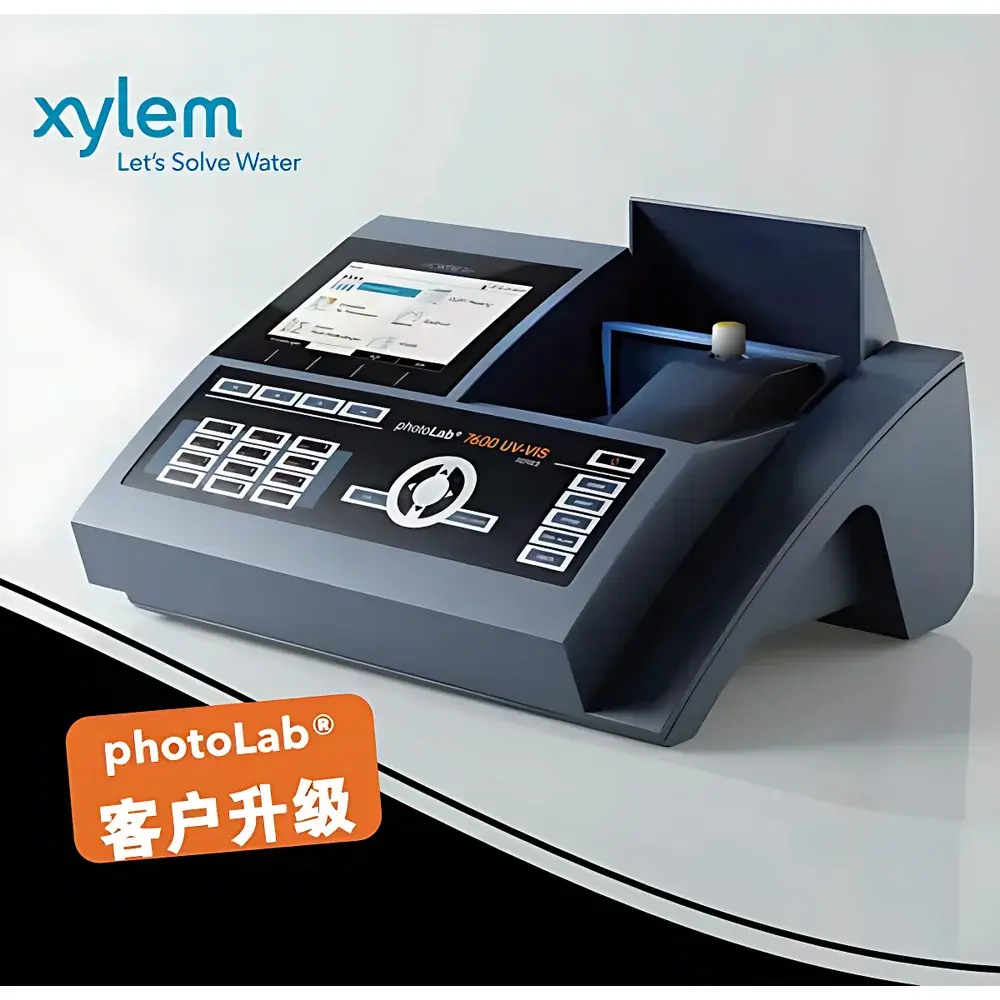
WTW photoLab® 7600 UV-VIS Spectrophotometer
| Brand | WTW |
|---|---|
| Origin | Germany |
| Model | photoLab® 7600 UV-VIS |
| Wavelength Range | 190–1100 nm |
| Optical Technology | Dual-beam reference channel with pulsed xenon lamp |
| Measurement Method | OptRF (Optical Reference-Free) for COD and nitrate/nitrite |
| Connectivity | USB, Ethernet, PDF export |
| Software Compliance | GLP-compliant data logging, LIMS-ready export |
| Regulatory Alignment | Designed for ISO 7027, ASTM D1253, DIN 38405-43, USP <85>, EPA Method 410.4 (COD optical correlation), EN ISO 15681-2 (phosphate), EN ISO 10303-2 (nitrate) |
Overview
The WTW photoLab® 7600 UV-VIS Spectrophotometer is a dual-beam, full-spectrum benchtop instrument engineered for precision photometric analysis across environmental, municipal, and industrial water quality laboratories. Operating from 190 nm to 1100 nm, it employs a high-stability pulsed xenon lamp and integrated reference beam architecture to eliminate drift and ensure reproducible absorbance measurements—critical for compliance-driven workflows. Unlike conventional spectrophotometers requiring chemical reagents and thermal digestion for parameters such as chemical oxygen demand (COD) and nitrate, the photoLab® 7600 implements WTW’s proprietary OptRF (Optical Reference-Free) methodology: a validated, reagent-free optical correlation technique that quantifies COD and NO₂⁻/NO₃⁻ directly in raw wastewater and surface water matrices. This eliminates hazardous reagents—including potassium dichromate and mercury sulfate—reducing both operational cost and regulatory burden associated with chemical handling, waste disposal, and safety documentation.
Key Features
- Dual-beam optical design with real-time reference channel compensation for enhanced baseline stability and measurement repeatability
- Pulsed xenon lamp with >10⁹ flash lifetime—no warm-up time required, enabling immediate analysis and extended service intervals
- High-resolution color touchscreen interface with guided workflow navigation for method selection, calibration, and validation
- OptRF-enabled direct measurement of COD (0–500 mg/L O₂) and nitrate/nitrite (0–100 mg/L NO₃⁻-N) without digestion or reagents
- Full spectral acquisition (1 nm resolution) with peak identification, derivative spectroscopy, and multi-wavelength quantification
- Onboard method library compliant with DIN, ISO, and EPA standard methods—including DIN 38405-43 (COD optical), EN ISO 15681-2 (phosphate), and ASTM D1253 (turbidity)
Sample Compatibility & Compliance
The photoLab® 7600 UV-VIS accepts standard 10 mm, 20 mm, 50 mm, and flow-cell cuvettes, supporting liquid samples ranging from clarified effluent to turbid raw sewage—with built-in scatter correction algorithms minimizing matrix interference. All OptRF calibrations are traceable to certified reference materials and validated per ISO/IEC 17025 requirements. Instrument firmware enforces GLP-compliant operation: automatic timestamping, user authentication, audit trail logging, and electronic signature support for critical steps. Data export formats (CSV, PDF, XML) meet FDA 21 CFR Part 11 requirements when paired with WTW’s optional LabX® Lite software, enabling seamless integration into regulated LIMS environments.
Software & Data Management
The integrated operating system supports secure data storage (≥10,000 measurements), customizable report templates, and one-click export via USB drive or Ethernet to networked PCs. The included DataSpectra™ software package provides spectral visualization, batch processing, calibration curve management, and automated compliance reporting. All measurement metadata—including instrument ID, operator login, cuvette pathlength, wavelength settings, and environmental conditions—is embedded in exported files. Audit trails record every parameter change, calibration event, and result modification—retained for ≥12 months per internal retention policy and aligned with GMP Annex 11 expectations for analytical instrumentation.
Applications
- Routine monitoring of wastewater treatment plants: real-time COD, nitrate, phosphate, ammonia, and total organic carbon (TOC) surrogate estimation
- Surface and groundwater quality assessment: detection of nitrite spikes, humic substance interference, and algal bloom indicators (e.g., chlorophyll-a at 665 nm)
- Drinking water compliance testing: residual chlorine (DPD method), iron, manganese, and fluoride per ISO 9297 and EN 896
- Industrial process control: electroplating bath monitoring (Cu²⁺, Ni²⁺), cooling tower biocide dosing (bromide/bromine), and pharmaceutical excipient purity screening
- Educational and research labs: teaching spectral deconvolution, Beer-Lambert law verification, and multicomponent analysis using least-squares regression
FAQ
Does the photoLab® 7600 UV-VIS require annual lamp replacement?
No—the pulsed xenon lamp is rated for over one billion flashes and typically exceeds five years of routine use without degradation in spectral output or intensity stability.
Can OptRF measurements be validated against standard digestion-based COD methods?
Yes—WTW provides documented correlation studies demonstrating R² > 0.98 against ISO 6060 (dichromate digestion) across municipal influent and secondary effluent matrices; validation reports are available upon request.
Is the instrument compatible with existing photoLab® 6000 series accessories and cuvettes?
Yes—all mechanical, optical, and electrical interfaces are backward-compatible with photoLab® 6000 consumables, including cuvettes, calibration standards, and power adapters.
How does the dual-beam reference channel improve measurement accuracy?
It continuously monitors lamp intensity fluctuations and detector response drift, applying real-time correction to the sample signal—reducing inter-day variability to <0.3% absorbance units under controlled lab conditions.
What cybersecurity features are implemented in the firmware?
Firmware v3.2+ includes TLS 1.2 encrypted Ethernet communication, role-based user access control (admin/operator/technician), and tamper-evident audit log hashing compliant with IEC 62443-3-3 Level 1 requirements.