
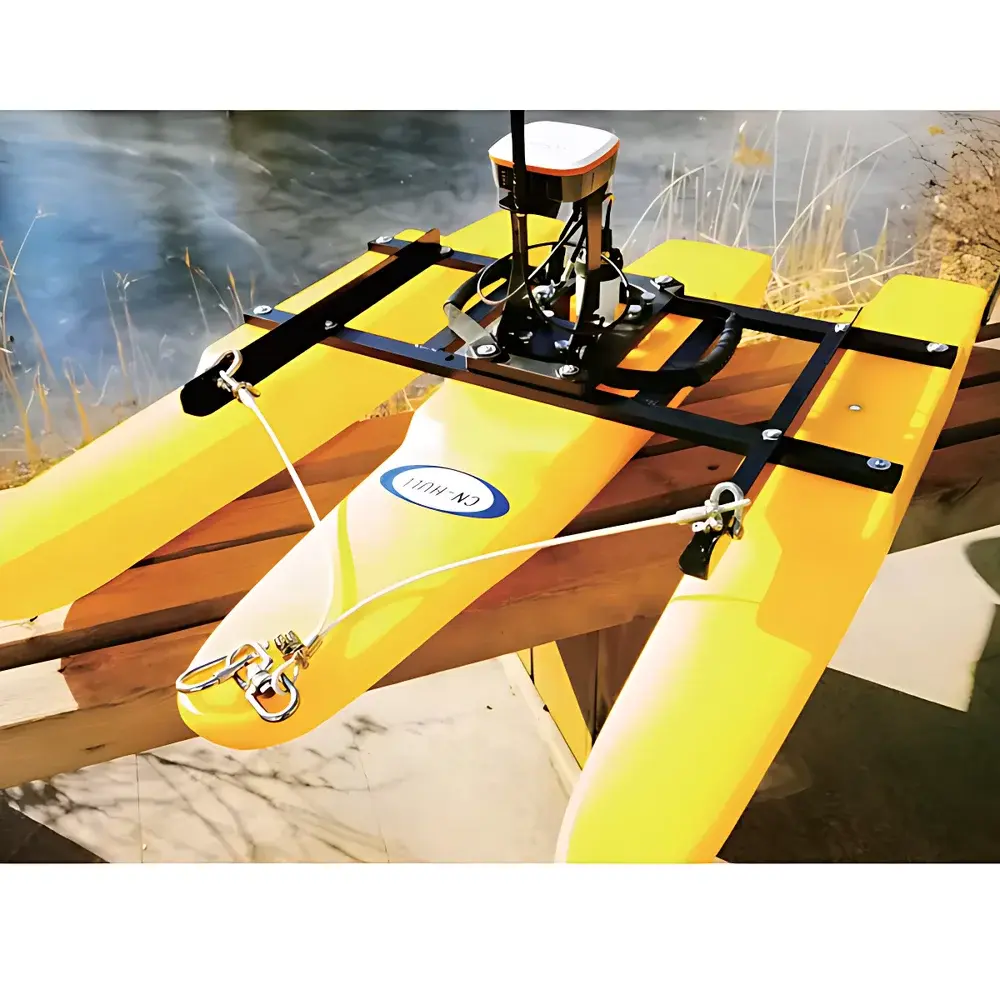
SonTek ST Riverboat Trimaran Platform for Acoustic Doppler Current Profilers
| Brand | SonTek |
|---|---|
| Origin | USA |
| Model | ST Riverboat |
| Application | Field-deployable trimaran hull platform for mounting SonTek RS5 and M9 ADCPs |
| Material | High-density polyethylene (HDPE) |
| Max Flow Velocity Support | 3.6 m/s |
| Weight | Lightweight, single-operator portable |
| Compliance | Designed for ASTM D5030, ISO 748, and USGS/USACE field protocols |
| Mounting Compatibility | Interchangeable instrument plates for SonTek RS5 (via optional STRS5 kit) and M9 ADCPs |
| Wireless Integration | Separated Bluetooth and GPS antenna layout to minimize RF interference |
| Fastening System | Tool-free, captive thumbscrew assembly for field robustness |
Overview
The SonTek ST Riverboat is a purpose-engineered trimaran hull platform designed exclusively for field deployment of high-precision acoustic Doppler current profilers (ADCPs), specifically the SonTek M9 and RS5 systems. Unlike conventional monohull or catamaran platforms, its three-hull configuration leverages hydrodynamic stability principles—minimizing pitch, roll, and yaw under dynamic riverine conditions—to preserve beam geometry integrity and ensure consistent acoustic path alignment. This structural fidelity directly supports velocity profile accuracy, particularly in shallow, turbulent, or high-velocity environments where surface wave distortion and vessel motion introduce significant measurement uncertainty. The ST Riverboat operates as a passive mechanical interface—not an instrument itself—but serves as a critical metrological extension of the ADCP’s transducer array, enabling repeatable, GLP-aligned field measurements across diverse fluvial settings including low-flow channels, flood-stage rivers, tidal estuaries, and regulated canals.
Key Features
- Hydrodynamically Optimized Trimaran Architecture: Three parallel hulls reduce drag coefficient and increase lateral stability, allowing reliable operation at flow velocities up to 3.6 m/s without loss of heading control or sensor submersion.
- Flared Bow Geometry: Prevents bow diving during rapid acceleration or passage through standing waves; mitigates yaw instability in cross-currents and wind-driven surface turbulence.
- High-Density Polyethylene (HDPE) Construction: Chemically inert, UV-stabilized, and impact-resistant—engineered for long-term exposure to abrasive sediments, submerged vegetation, and fluctuating water chemistry without degradation.
- Modular Instrument Interface: Standard aluminum cross-beam and instrument mounting plate pre-configured for SonTek M9; optional STRS5 upgrade kit enables seamless transition to RS5 deployment with no structural modification.
- RF-Isolated Antenna Layout: Dedicated spatial separation between integrated GPS antenna and Bluetooth module minimizes signal coupling, ensuring robust GNSS positioning (sub-meter horizontal accuracy) and stable wireless telemetry during real-time data streaming.
- Captive Fastening System: All thumbscrews are non-removable by design—eliminating hardware loss during frequent field disassembly/reassembly and maintaining mechanical repeatability across deployments.
Sample Compatibility & Compliance
The ST Riverboat is not a standalone analytical instrument but a certified mechanical carrier compliant with SonTek’s OEM integration specifications for M9 and RS5 ADCPs. It meets physical interface requirements defined in SonTek Technical Bulletin TB-2022-01 and aligns with field methodology standards referenced in ASTM D5030 (Standard Test Method for Determining Stream Flow Using Acoustic Doppler Velocimeters), ISO 748:2021 (Liquid flow measurement in open channels — Velocity-area method), and USGS Techniques and Methods Book 3, Chapter A22. Its HDPE hull material conforms to FDA 21 CFR §177.1520 for incidental food-contact polymers—ensuring environmental safety in potable water source monitoring applications. No calibration or traceability is assigned to the hull itself; metrological validity remains governed entirely by the mounted ADCP’s factory calibration certificate and annual verification per ISO/IEC 17025-accredited procedures.
Software & Data Management
The ST Riverboat introduces no software layer or embedded firmware. All data acquisition, processing, and QA/QC workflows occur within SonTek’s RiverSurveyor Live (RSL) v5.5+ or WinRiver II v3.2+ environments. RSL natively recognizes the ST Riverboat’s geometry parameters—including hull draft, beam width, and transducer offset vectors—when the “ST Riverboat” platform profile is selected during survey setup. This enables automatic correction of vessel-induced velocity biases and accurate application of bottom-tracking and water-tracking algorithms. Survey metadata—including deployment date, GPS-derived vessel heading, and ambient water temperature—is logged alongside ADCP velocity bins in standard .rsl or .pd0 formats, supporting audit-ready archiving per FDA 21 CFR Part 11-compliant LIMS integrations when paired with validated electronic signature modules.
Applications
- River discharge monitoring under flood-stage conditions (USGS Stage-Discharge Rating Curve validation)
- Regulatory compliance sampling for NPDES permits requiring continuous velocity profiling
- Sediment transport modeling in braided or meandering channels with variable depth and velocity shear
- Hydropower intake velocity mapping and fish passage corridor assessment
- Post-storm debris flow characterization in mountainous watersheds
- Calibration transfer between fixed-site acoustic sensors and mobile survey platforms
FAQ
Is the ST Riverboat compatible with instruments other than SonTek M9 and RS5?
No. Mechanical, electrical, and software interfaces are proprietary to SonTek ADCPs. Mounting holes, power/data cable routing paths, and RSL platform definitions are not interoperable with Teledyne RD Instruments, Nortek, or Valeport systems.
Does the ST Riverboat require calibration or annual verification?
No. As a passive structural platform, it carries no measurement function. Verification applies solely to the mounted ADCP per ISO/IEC 17025 requirements.
Can the ST Riverboat be used in tidal or saline environments?
Yes. HDPE construction resists galvanic corrosion and biofouling; however, regular freshwater rinsing after saltwater use is recommended to prevent chloride accumulation on aluminum cross-beams.
What is the maximum water depth for reliable operation?
The platform is rated for operation in depths ≥0.4 m with M9 and ≥0.6 m with RS5 to maintain full acoustic beam coverage and avoid near-surface multipath interference.
Is the STRS5 upgrade kit field-installable without tools?
Yes. All fasteners are captive thumbscrews; installation requires only manual tightening—no wrenches, torque drivers, or calibration recalibration needed.
Related Products







