
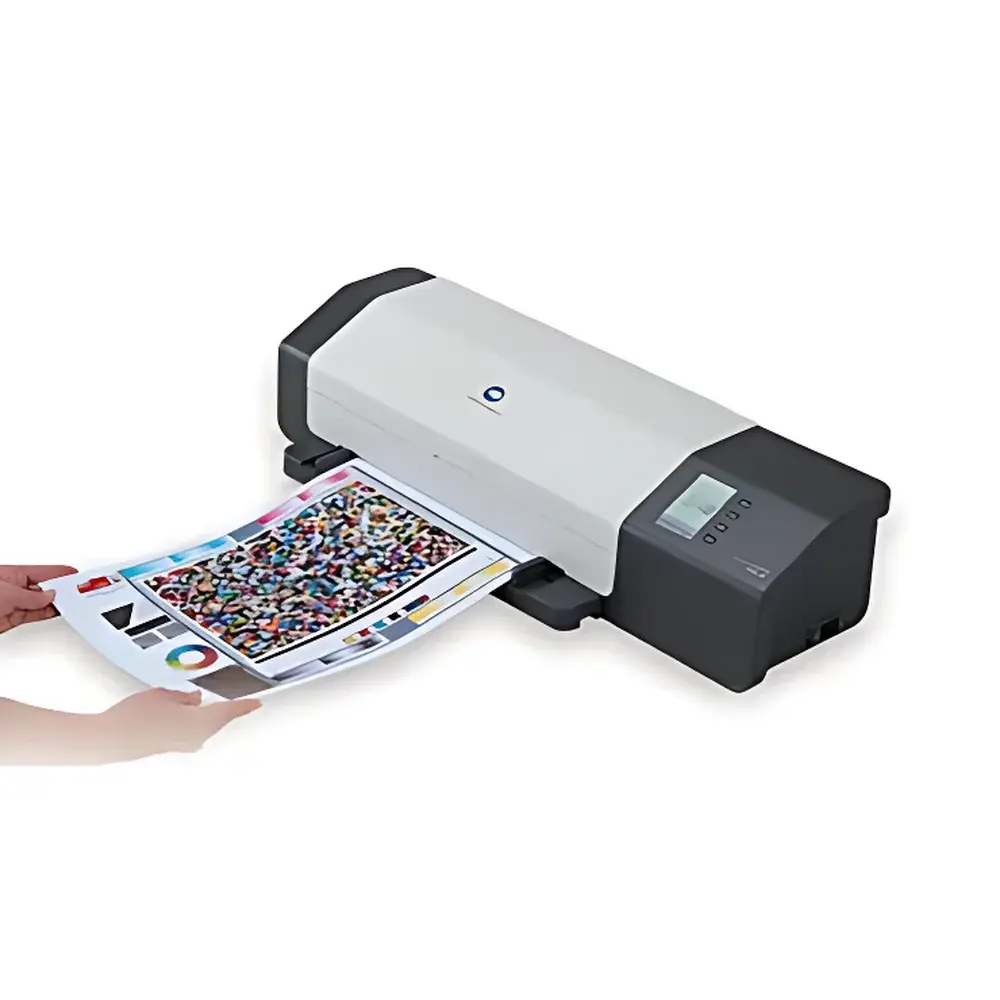
Konica Minolta FD-9 Portable Spectrophotometer
| Brand | Konica Minolta |
|---|---|
| Origin | Japan |
| Model | FD-9 |
| Optical Geometry | 45°a:0° (annular illumination) |
| Wavelength Range | 380–730 nm |
| Wavelength Interval | 10 nm |
| Spectral Bandwidth | ~10 nm |
| Measurement Aperture | ~3 mm |
| Light Source | LED |
| Reflectance Range | 0–150% |
| Repeatability | σΔE₀₀ ≤ 0.05 (after white calibration, 30 measurements at 1 s intervals) |
| Inter-instrument Agreement | ΔE₀₀ ≤ 0.3 (BCRA Series II 12-color tile average) |
| Measurement Time | ~4 minutes for 1500 patches |
| Compliance | CIE No. 15, ISO 7724-1, ISO 13655, DIN 5033 Teil 7, ASTM E1164, JIS Z 8722 |
| Interfaces | USB 2.0, 10/100Base-T Ethernet |
| Power Supply | AC 100–240 V, 50/60 Hz → DC 24 V, 5 A |
| Dimensions (FD-9 only) | 716 × 251 × 159 mm |
| Weight (FD-9 only) | ~10.5 kg |
| Operating Environment | 10–35 °C, 30–85% RH (non-condensing) |
Overview
The Konica Minolta FD-9 Portable Spectrophotometer is a high-precision, automated scanning instrument engineered for color measurement in graphic arts and industrial printing environments. It operates on the principle of diffuse reflectance spectroscopy using a 45°a:0° annular illumination geometry—fully compliant with CIE No. 15, ISO 7724-1, ISO 13655 (M0/M1/M2), ASTM E1164, and JIS Z 8722 standards. Unlike conventional contact or handheld spectrophotometers, the FD-9 integrates an image-based pre-scan capability to detect patch positions autonomously, eliminating dependency on predefined chart definitions or registration marks. Its optical architecture employs a concave grating monochromator with a 10 nm spectral bandwidth across a 380–730 nm range, delivering spectral reflectance data at 10 nm intervals. The system uses stable LED illumination and achieves repeatability of σΔE₀₀ ≤ 0.05 under standardized white calibration conditions—validated via 30 consecutive measurements at 1-second intervals. With inter-instrument agreement of ΔE₀₀ ≤ 0.3 against BCRA Series II reference tiles, the FD-9 ensures traceable, reproducible results across distributed production sites.
Key Features
- Automated patch detection via integrated image sensor: eliminates need for registration marks or pre-defined chart files; supports mixed-content charts containing images, illustrations, and color patches.
- High-speed scanning architecture: completes measurement of up to 1,500 patches in approximately four minutes—including mechanical positioning, dwell stabilization, and spectral acquisition at each point.
- Multi-condition spectral evaluation: simultaneous derivation of M0 (illuminant A), M1 (D50), and M2 (A + UV cutoff) responses from a single scan—reducing operator intervention and measurement variability.
- Flexible chart compatibility: accepts substrates 45–330 mm wide, 170–660 mm long, and 0.05–0.45 mm thick; supports up to 2,928 patches per A3 sheet.
- Network-enabled operation: Ethernet (10/100Base-T) connectivity allows centralized control, remote monitoring, and shared access across lab or pressroom workstations.
- Optional auto-feeder FD-A09: accommodates up to 100 sheets for unattended overnight measurement cycles—critical for production QA/QC scheduling and throughput optimization.
Sample Compatibility & Compliance
The FD-9 is designed for reflective measurement of printed media on white substrates conforming to ISO 13655 requirements. Its 3 mm measurement aperture enables precise evaluation of standard process color patches, spot colors, and fine-detail characterization targets—even on textured or coated papers. The instrument satisfies regulatory and industry-standard measurement protocols including ISO 12647 series (graphic technology), Fogra PSO, IDEAlliance G7, and JapanColor certification frameworks. All spectral data output complies with ISO 17972-1:2015 (CxF3) and ISO 28178:2009 (CGATS) formats—ensuring interoperability with ICC profiling engines, press control systems, and digital workflow platforms. Calibration traceability follows NIST-traceable standards through Konica Minolta’s global service network, supporting GLP/GMP-aligned audit trails where required.
Software & Data Management
The FD-9 ships with FD-S2w measurement software (standard), supporting Windows 7–10 and macOS 10.9–10.10. FD-S2w enables definition-free chart measurement, manual patch exclusion, and arbitrary point placement—including QR code generation for traceable sample identification. Spectral data can be exported in CxF3, CGATS, CSV, or TSV formats. Optional basICColor software (v5.5+) provides full ICC profiling, gamut visualization (2D/3D), ΔE-based pass/fail analysis, TVI (tone value increase) calculation, and automated PDF reporting. Both applications support user-defined illuminants derived from Konica Minolta CL-500A spectroradiometers or FD-7 spectrodensitometers—enabling spectral match validation under non-standard lighting conditions. All software modules maintain full audit trail functionality and support FDA 21 CFR Part 11–compliant electronic signatures when deployed in regulated environments.
Applications
The FD-9 serves as a core metrology tool in prepress quality assurance, press calibration, contract proof verification, and post-production color validation. It is routinely deployed for G7 grayscale calibration, ISO 12647-2 process control, Fogra-certified offset workflows, and brand color consistency audits across multi-site print supply chains. Its ability to measure mixed-content charts without reformatting accelerates legacy chart migration and reduces setup time in hybrid analog-digital workflows. In packaging applications, it supports metallic, fluorescent, and extended-gamut ink evaluation—particularly when paired with M1/M2 condition switching for UV-reactive substrates. The instrument also supports R&D tasks such as substrate influence studies, ink drying behavior analysis, and spectral database construction for AI-driven color prediction models.
FAQ
What measurement geometries does the FD-9 support?
The FD-9 implements 45°a:0° annular illumination geometry, compliant with ISO 7724-1 and CIE No. 15 for diffuse reflectance measurement.
Can the FD-9 measure charts without prior definition files?
Yes—the integrated image sensor performs automatic patch detection during pre-scan, enabling measurement of undefined or mixed-content charts without registration marks.
Is the FD-9 compatible with industry-standard color management ecosystems?
Yes—it outputs CxF3 and CGATS files natively and integrates with basICColor, GMG ColorServer, EFI Fiery, and other ICC-compliant profiling and press control platforms.
Does the FD-9 meet regulatory requirements for documented workflows?
When used with basICColor or validated FD-S2w configurations, the system supports audit-ready logging, electronic signatures, and 21 CFR Part 11–aligned data integrity controls.
What is the maximum number of patches measurable per A3 sheet?
Up to 2,928 patches can be measured on an A3-sized chart (297 × 420 mm), assuming minimum patch size of 6 × 6 mm and standard spacing.
How is instrument calibration maintained across global facilities?
Konica Minolta maintains ISO/IEC 17025-accredited calibration laboratories in the U.S., Germany, Japan, and Singapore—providing on-site or depot recalibration services with NIST-traceable certificates.
Related Products






