
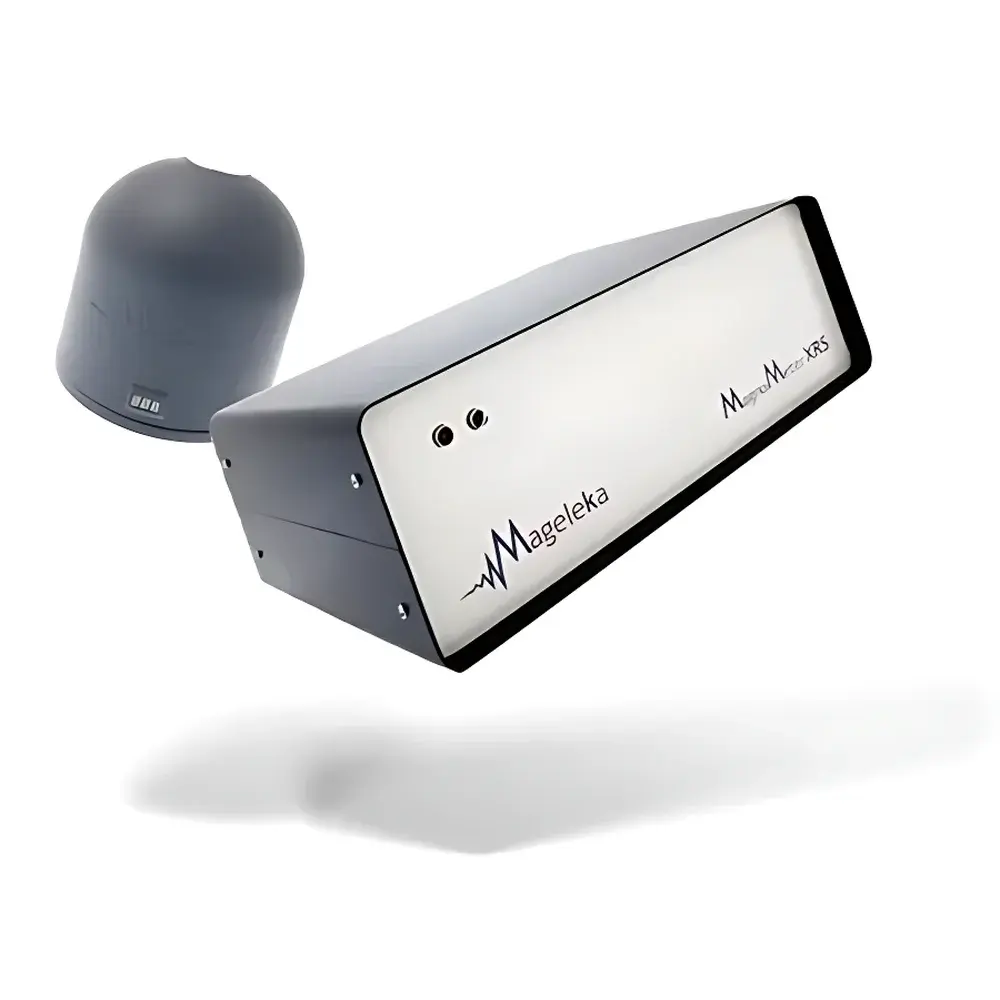
ORONTEC MagnoMeter XRS Nuclear Magnetic Resonance (NMR) Particle Surface Characterization Analyzer
| Brand | ORONTEC |
|---|---|
| Origin | Germany |
| Model | MagnoMeter XRS |
| Instrument Type | Optical Particle Counter (NMR-based surface-sensitive particle analyzer) |
| Category | Particle/Powder Analysis Instruments |
| Compliance | Designed for GLP/GMP-aligned workflows, compatible with ASTM E2457 (for NMR particle analysis methodology), ISO 13320 (laser diffraction) supplementary use case |
Overview
The ORONTEC MagnoMeter XRS is a nuclear magnetic resonance (NMR)-based particle surface characterization analyzer engineered for direct, non-invasive assessment of particle size distribution, shape anisotropy, and surface-specific relaxation behavior in heterogeneous colloidal and suspension systems. Unlike conventional optical or laser-based particle counters—which rely on spherical, homogeneous, and optically uniform particle assumptions—the MagnoMeter XRS measures the transverse relaxation time (T₂) of hydrogen nuclei in the surrounding fluid phase, which is modulated by surface-to-volume ratio, interfacial chemistry, and local magnetic field gradients induced by particle morphology. This physical principle enables quantitative differentiation between particles of identical hydrodynamic diameter but distinct surface roughness, porosity, or chemical functionalization—critical parameters often masked in standard light-scattering or imaging-based methods. The instrument operates without sample dilution, filtration, or drying, preserving native dispersion state and eliminating preparation-induced artifacts.
Key Features
- Direct NMR-based surface sensitivity: Measures T₂ relaxation decay profiles to infer surface-area-to-volume ratio and interfacial interaction strength—not inferred from scattering models.
- No sample preparation required: Supports undiluted, as-received suspensions across concentration ranges from 0.1% to 40% w/v (aqueous and organic media).
- Modular hardware architecture: Integrates interchangeable MagnoPod sensor cartridges with temperature-controlled, electrically isolated probe heads to minimize thermal drift and electromagnetic interference.
- Single-control-module scalability: One central control unit can manage up to four independent MagnoPods—enabling parallel analysis of hazardous, high-viscosity, or regulated samples under containment.
- Rapid acquisition: Full T₂ decay curve acquisition completed in ≤1 second for low-viscosity systems; ≤120 seconds for high-viscosity or paramagnetic-rich formulations.
- Zero moving parts & no optical alignment: Eliminates mechanical wear, calibration drift, and alignment-dependent measurement variability inherent in laser diffraction or dynamic light scattering platforms.
Sample Compatibility & Compliance
The MagnoMeter XRS accommodates standard 5 mm or 10 mm NMR tubes, as well as custom flow-through MagnoPod configurations for inline process monitoring. It supports aqueous, polar organic (e.g., ethanol, acetone), and semi-polar solvent systems—including those containing surfactants, polymers, or ionic species that interfere with electrokinetic or optical techniques. The system is designed to support audit-ready data integrity per FDA 21 CFR Part 11 requirements when paired with ORONTEC’s optional secure software package, including electronic signatures, user role management, and immutable audit trails. Method validation documentation aligns with ICH Q5A (biological product particulates) and ASTM E2457-22 (standard guide for NMR-based particle characterization). It serves as a complementary technique to ISO 13320 (laser diffraction), ISO 13321 (dynamic light scattering), and ISO 9277 (BET surface area), particularly where surface heterogeneity dominates functional performance.
Software & Data Management
ORONTEC’s MagnoSoft XRS v4.2 provides intuitive workflow-driven acquisition, automated T₂ inversion using non-negative least squares (NNLS) algorithms, and multi-parameter deconvolution of relaxation components linked to distinct particle subpopulations. Raw FID data, processed T₂ distributions, and derived metrics—including effective surface relaxivity (ρ₂), mean surface-to-volume ratio (S/V), and shape anisotropy index—are exportable in CSV, HDF5, and XML formats. The software includes built-in reporting templates compliant with GLP documentation standards, version-controlled method storage, and optional integration with LIMS via RESTful API. All data files embed full metadata (temperature, probe ID, pulse sequence parameters, operator ID), ensuring traceability throughout analytical lifecycle.
Applications
- Raw material qualification: Detection of surface oxidation, hydrophobic coating degradation, or agglomeration onset in metal oxides, pigments, and catalysts.
- In-process monitoring: Real-time tracking of particle surface modification during wet-milling, silanization, or polymer grafting reactions.
- Stability assessment: Quantifying changes in interfacial hydration layer integrity during accelerated aging or freeze-thaw cycling.
- Formulation development: Differentiating between physically blended vs. chemically conjugated nanoparticle composites in drug delivery systems.
- Regulatory submission support: Generating orthogonal surface characterization data for ANDA, BLA, or CE-IVD dossiers where BET or zeta potential alone lack discriminatory power.
FAQ
Does the MagnoMeter XRS require calibration with reference standards?
No—NMR signal intensity and relaxation times are intrinsically quantitative and do not require external calibration. System performance verification is performed using standardized water/glycerol mixtures and certified NMR phantoms.
Can it analyze opaque or highly concentrated slurries?
Yes—unlike optical methods, NMR penetration is unaffected by turbidity, color, or high solids loading. The instrument has been validated for titanium dioxide slurries up to 35% w/w and carbon black dispersions at >20% w/v.
Is temperature control available during measurement?
Yes—MagnoPods feature Peltier-based thermostating (±0.1°C stability) with independent thermal isolation from electronics to prevent thermal noise coupling into the RF detection path.
How does it compare to BET surface area analysis?
BET measures total gas-accessible surface area under dry, degassed conditions; MagnoMeter XRS quantifies *wet-state* surface interaction capacity in native dispersion—revealing differences in surface hydration, ligand density, and pore accessibility that BET cannot resolve.
Is method transfer possible between different MagnoMeter XRS units?
Yes—hardware-independent pulse sequences and standardized inversion protocols ensure cross-site reproducibility within ±3% RSD for S/V ratio across multiple instruments when operated under identical experimental conditions.
Related Products



