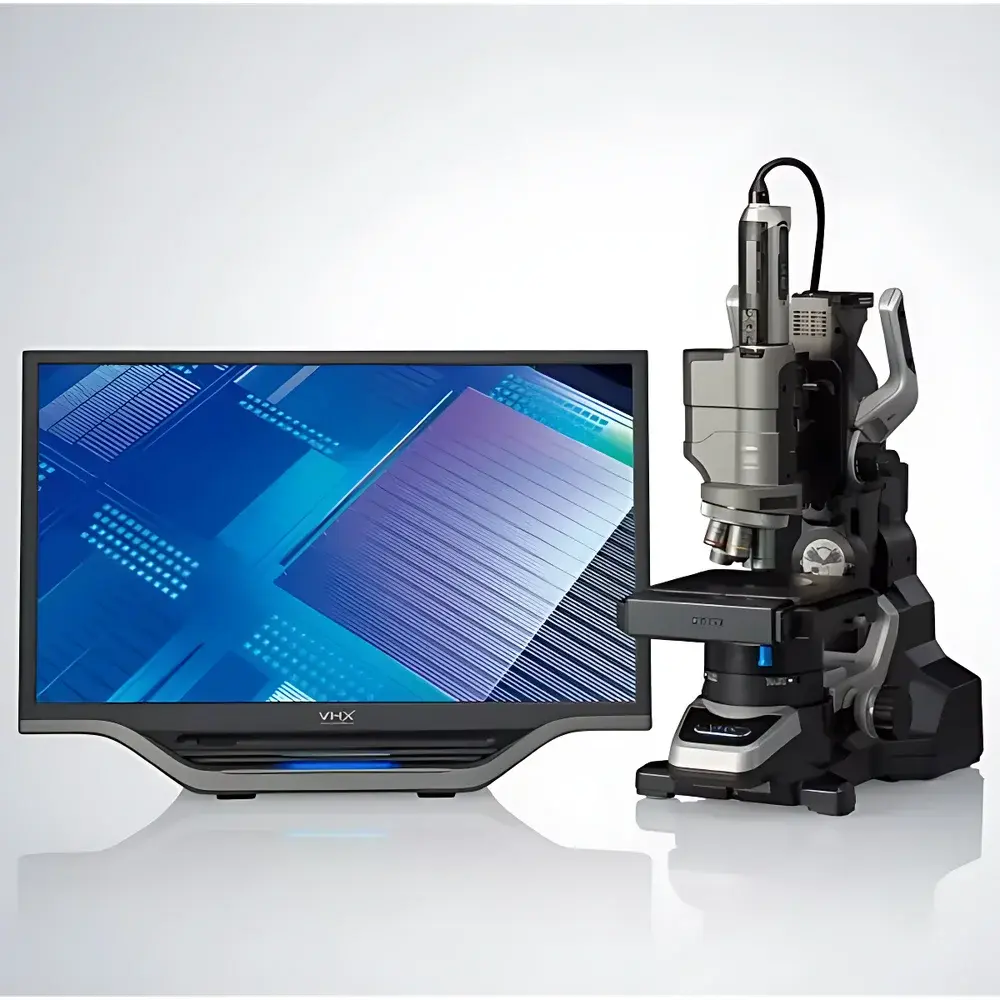
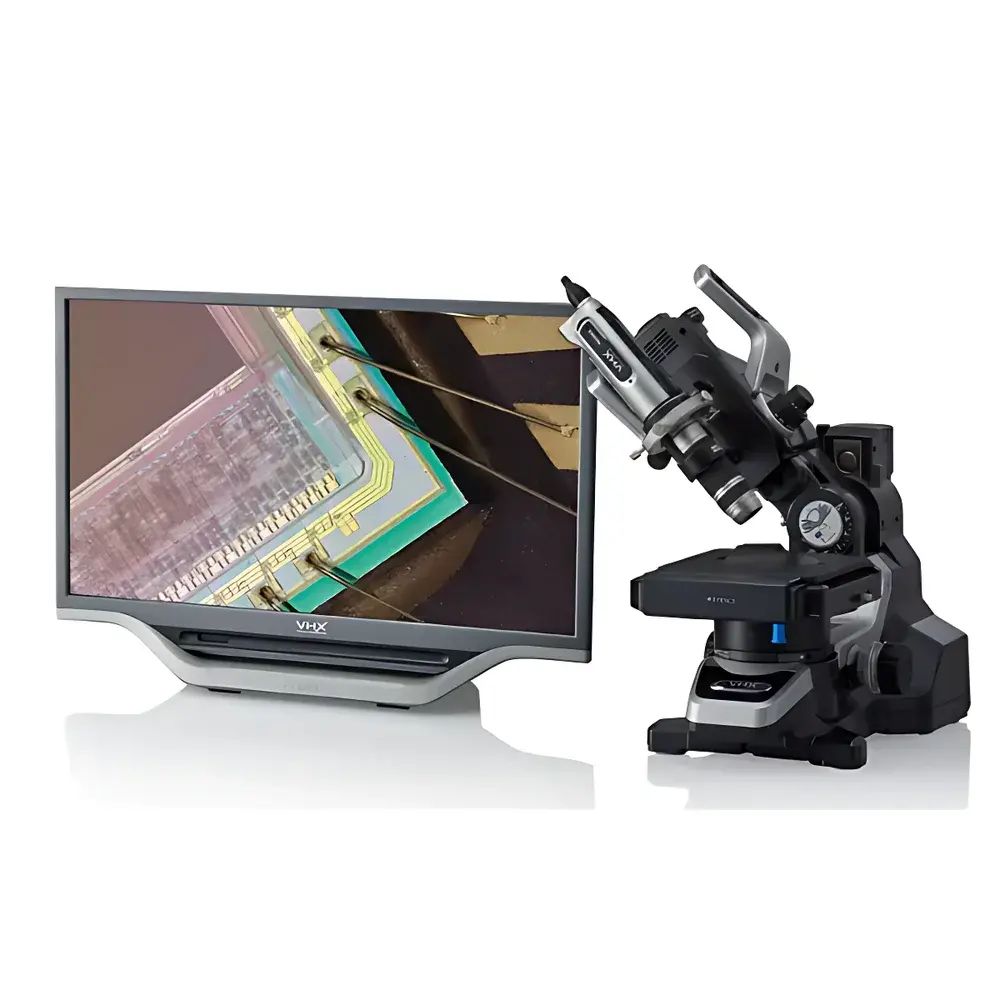
KEYENCE VHX-XF Series Ultra-Deep Depth-of-Field 3D Digital Microscope
| Brand | KEYENCE |
|---|---|
| Origin | Japan |
| Manufacturer Type | Original Equipment Manufacturer (OEM) |
| Product Origin | Imported |
| Model | VHX-XF Series |
| Mounting Type | Upright |
| Integrated Image Analysis System | Yes |
| Total Magnification Range | 0.1× to 6,000× |
Overview
The KEYENCE VHX-XF Series represents the sixth-generation ultra-deep depth-of-field 3D digital microscope system, engineered for precision surface metrology, microstructural analysis, and non-destructive inspection across R&D, quality control, and failure analysis laboratories. Unlike conventional optical microscopes constrained by shallow depth of field at high magnifications, the VHX-XF leverages advanced computational imaging, real-time auto-focus tracking, and multi-angle illumination synthesis to deliver fully focused 2D and topographically resolved 3D images—without mechanical Z-stacking or user intervention. Its core architecture integrates a motorized high-resolution rotating objective lens system with a CMOS image sensor and proprietary image reconstruction algorithms, enabling true optical sectioning and sub-micron vertical resolution in real time. Designed specifically for metallurgical, semiconductor, battery electrode, automotive component, and pharmaceutical packaging inspection, the system complies with foundational requirements for ISO/IEC 17025-compliant measurement workflows and supports traceable dimensional reporting under GLP/GMP-aligned documentation protocols.
Key Features
- Ultra-deep depth-of-field imaging: Achieves full-field focus across complex topographies—from polished metallographic samples to rough fracture surfaces—without Z-scan acquisition.
- Real-time continuous auto-focus tracking: Motorized focus lens dynamically adjusts position during stage movement or tilt, maintaining sharpness at all magnifications (0.1×–6,000×).
- Rotating high-resolution objective system: Supports up to five interchangeable lenses (e.g., VH-Z100R, VH-Z20R), each optimized for specific working distances and numerical apertures; automated lens recognition ensures calibration integrity.
- High-speed panoramic image stitching: Generates seamless composite images up to 100,000 × 100,000 pixels (10 gigapixels) with geometric correction and intensity normalization—enabling macro-to-micro contextual analysis.
- One-touch all-in-focus 3D capture: Acquires registered height maps and color texture data simultaneously; exports XYZ point clouds, cross-section profiles, and surface roughness parameters (Sa, Sq, Sz per ISO 25178).
- Motorized XY stage integration: Enables programmable coordinate-based navigation, automated grid scanning, and repeatable positional recall for comparative analysis and statistical process control (SPC) reporting.
Sample Compatibility & Compliance
The VHX-XF accommodates a broad range of solid, opaque, and reflective specimens without coating or vacuum requirements—including as-polished, etched, or fractured metallic alloys; sintered ceramics; battery cathode/anode foils; solder joints; PCB traces; and medical device polymer components. Its upright configuration supports standard metallurgical sample holders (up to 150 mm × 100 mm) and optional tilting stages for oblique-angle reflectance analysis. The system meets CE marking requirements for electromagnetic compatibility (EMC Directive 2014/30/EU) and low-voltage safety (LVD Directive 2014/35/EU). While not certified as medical device hardware, its measurement traceability framework aligns with ASTM E1558 (Standard Guide for Digital Imaging in Microscopy) and supports audit-ready data logs required for FDA 21 CFR Part 11 compliance when deployed with validated IT infrastructure.
Software & Data Management
The bundled VHX software provides an integrated environment for acquisition, measurement, annotation, and report generation—all within a single GUI. Measurement tools include calibrated 2D length/angle/area, particle counting with threshold-based segmentation, cleanliness assessment per ISO 16232 and VDA 19.1, and phase discrimination via RGB histogram clustering. All operations are logged with timestamped metadata (user ID, instrument serial, lens ID, exposure settings, calibration status), enabling full audit trails. Export formats include TIFF (with embedded scale metadata), CSV (for SPC integration), PDF reports with digital signatures, and STL mesh files for CAD comparison. Optional network deployment allows centralized license management and secure remote access via TLS-encrypted connections.
Applications
- Metallurgy: Grain size analysis (ASTM E112), inclusion rating (ISO 4967), weld penetration depth, heat-affected zone (HAZ) characterization.
- Semiconductors: Bond pad inspection, die attach void detection, wire bond geometry verification.
- Lithium-ion batteries: Electrode coating uniformity, separator pore structure assessment, dendrite morphology quantification.
- Automotive: Surface defect mapping on castings, coating thickness estimation via edge profiling, friction material wear analysis.
- Pharmaceuticals: Tablet coating homogeneity, blister pack seal integrity, particulate contamination screening on vial stoppers.
FAQ
Does the VHX-XF require sample coating for conductive materials?
No—its brightfield/darkfield LED illumination and high-dynamic-range capture eliminate the need for sputter-coating, even on highly reflective metals.
Can measurement data be exported to statistical process control (SPC) platforms?
Yes—CSV exports include measurement values, uncertainty estimates, and operator metadata, compatible with Minitab, JMP, and custom MES integrations.
Is the system compatible with third-party motorized stages or environmental chambers?
It supports RS-232 and Ethernet-based external device control via ASCII command protocol; chamber integration requires custom bracketing and thermal drift compensation validation.
How is calibration maintained across lens changes?
Each objective contains an embedded EEPROM storing factory-calibrated magnification, working distance, and distortion coefficients; software auto-reads and applies corrections upon mounting.
What file formats are supported for 3D surface data export?
STL, OBJ, and XYZ point cloud formats are natively supported; height maps are saved as 16-bit TIFF with embedded scale information for third-party metrology software import.