
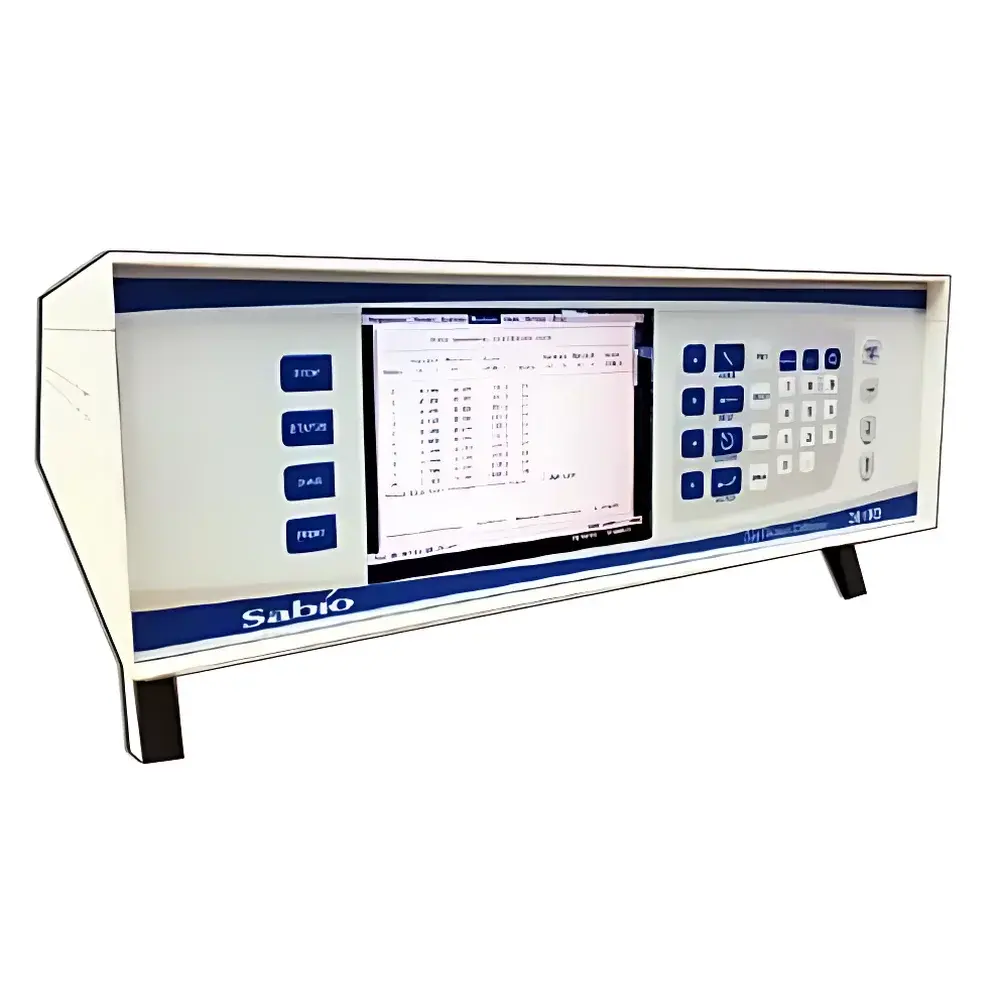
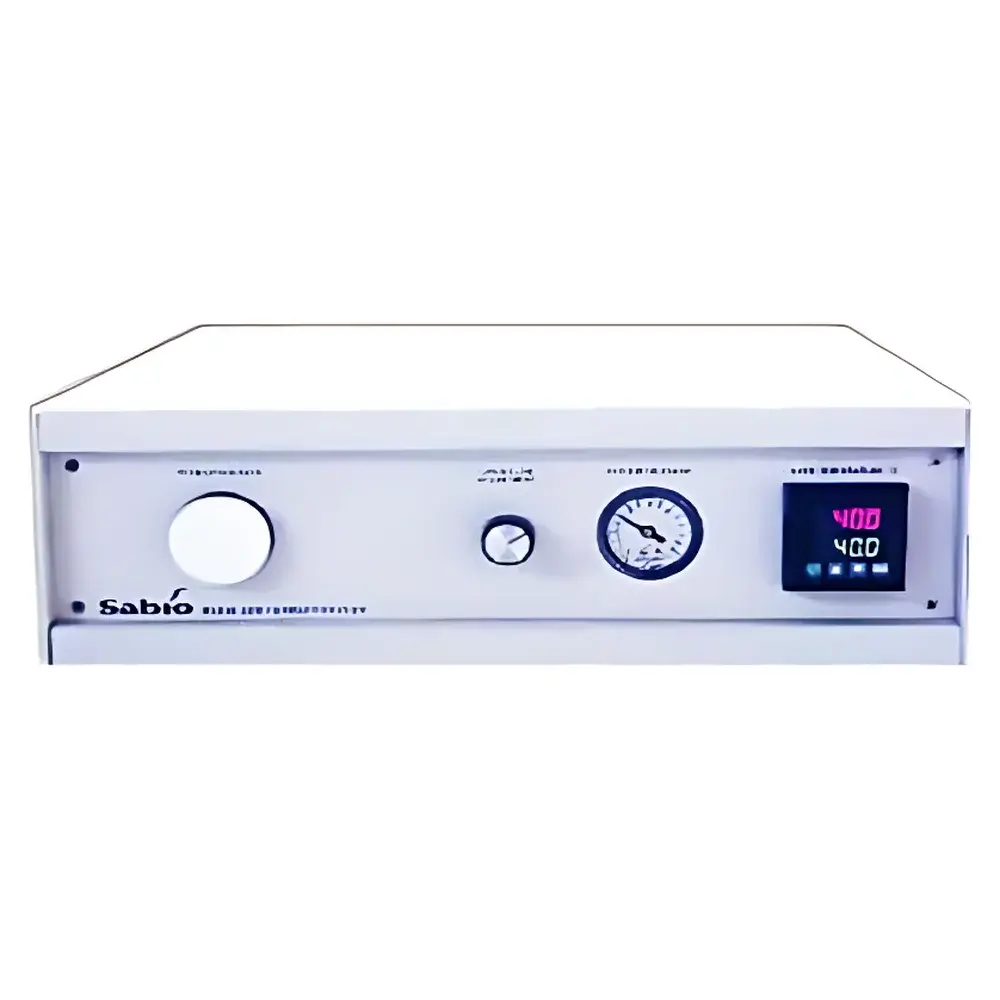
Sabio Model 2010 Gas Dilution Calibrator
| Brand | Sabio |
|---|---|
| Origin | USA |
| Manufacturer Type | Authorized Distributor |
| Origin Category | Imported |
| Model | Model 2010 |
| Pricing | Upon Request |
| Diluent Mass Flow Range | 0–10 SLM (optional up to 20 SLM) |
| Source Gas Mass Flow Range | 0–100 SCCM (optional up to 2 SLM) |
| Flow Accuracy | ≤1% FS |
| Flow Repeatability | ≤±0.15% FS |
| Linearity | ≤±0.5% FS |
| Response Time | <60 s |
| Control Interfaces | Keypad, Keyboard, RS-232 Serial, USB, Ethernet |
| Predefined Calibration Paths | 20 factory-configured flow paths, each supporting up to 20 linear calibration points |
| Supported Calibration Types | Diluent gas, Ozone (O₃), Gas Phase Titration (GPT) |
| Temperature Control System | Microprocessor-based proportional PID controller |
| Temperature Sensor | Platinum RTD (Pt100) |
| Heating Zone Dimensions | Internal Diameter 3.09 cm, Length 12.7 cm |
| Temperature Range | Ambient +2 °C to 65 °C |
| Front Panel Integration | Adjustable pressure regulator, analog pressure gauge, digital temperature controller, Teflon-lined dilution furnace inlet |
Overview
The Sabio Model 2010 Gas Dilution Calibrator is a precision-engineered instrument designed for traceable, gravimetric-grade gas standard generation in environmental monitoring, air quality compliance, and laboratory reference calibration workflows. It operates on the principle of dynamic volumetric dilution—precisely metering a known concentration source gas (e.g., ozone, NO, SO₂, or VOC standards) into a high-purity diluent stream (e.g., zero air or nitrogen) using dual mass flow controllers (MFCs). This enables accurate, repeatable generation of low-concentration calibration standards across six orders of magnitude (ppb to ppm), critical for calibrating ambient air analyzers, continuous emission monitoring systems (CEMS), and portable gas detectors. The system’s architecture complies with fundamental requirements outlined in EPA Method 205, ISO 6145-1 (gas mixtures by dynamic dilution), and ASTM D6166 (calibration of gaseous pollutant analyzers), ensuring metrological integrity in regulatory-grade applications.
Key Features
- Dual high-stability MFCs: Independent control of diluent flow (0–10 SLM, optional 20 SLM) and source gas flow (0–100 SCCM, optional 2 SLM), both certified to ≤1% full-scale accuracy and ≤±0.15% FS repeatability
- Thermally stabilized dilution furnace: Teflon-lined cylindrical chamber (ID 3.09 cm × L 12.7 cm) with microprocessor-driven PID temperature control (ambient +2 °C to 65 °C), minimizing condensation and adsorption losses for reactive gases such as ozone
- Integrated front-panel instrumentation: Analog pressure gauge, calibrated pressure regulator, digital RTD-based temperature display, and tactile keypad—enabling standalone operation without external software
- Multi-interface connectivity: Native support for RS-232 serial, USB virtual COM port, and Ethernet (TCP/IP), facilitating integration into automated calibration stations and LIMS environments
- Configurable calibration logic: 20 preprogrammed flow paths stored in non-volatile memory; each path supports up to 20 user-defined linear calibration points with independent dwell time, flow setpoints, and gas identity tagging
Sample Compatibility & Compliance
The Model 2010 accommodates a wide range of calibration gas matrices—including ozone (O₃), nitrogen dioxide (NO₂), sulfur dioxide (SO₂), carbon monoxide (CO), volatile organic compounds (VOCs), and inert tracer gases—provided they are compatible with Teflon-wetted surfaces and remain stable within the specified thermal operating envelope. All wetted materials meet USP Class VI and FDA 21 CFR Part 11 compatibility requirements for clean gas handling. The instrument satisfies key elements of ISO/IEC 17025:2017 clause 6.4.10 (equipment verification), EPA 40 CFR Part 53 Appendix A (reference method equivalency testing), and EU Directive 2008/50/EC Annex IX (calibration traceability for ambient air monitoring networks). Optional NIST-traceable MFC calibration certificates are available upon request.
Software & Data Management
Sabio’s CaliSoft™ v3.2 desktop application (Windows 10/11 compatible) provides full remote configuration, real-time flow/temperature/pressure logging, and audit-trail-enabled calibration report generation compliant with GLP and GMP documentation standards. Each calibration event records operator ID, timestamp, environmental conditions (temperature, barometric pressure), MFC setpoints, actual measured flows, and pass/fail status against user-defined tolerance bands. Data exports are available in CSV, PDF (with digital signature), and XML formats compatible with ELN systems. Firmware updates preserve all user-defined calibration paths and maintain backward compatibility with legacy .cal files.
Applications
- Primary calibration of UV photometric ozone analyzers per EPA 40 CFR Part 58 Appendix A
- Dynamic preparation of multi-point calibration curves for chemiluminescence NOx analyzers
- Verification of CEMS span and zero drift under field conditions using portable deployment kits
- Validation of permeation tube output rates in controlled-temperature ovens
- Generation of certified reference materials (CRMs) for interlaboratory comparison studies accredited to ISO/IEC 17043
FAQ
What diluent gases are compatible with the Model 2010?
Zero air, nitrogen (≥99.999% purity), and argon are routinely used; all must be oil-free and filtered to ≤0.01 µm to prevent MFC contamination.
Can the instrument generate non-linear calibration sequences?
Yes—each of the 20 programmable paths supports arbitrary point sequencing, including logarithmic, exponential, or custom-defined concentration ramps.
Is the temperature controller validated for ISO 17025 traceability?
The integrated Pt100 RTD sensor is factory-calibrated against NIST-traceable standards; full uncertainty budgets and calibration certificates are available as an optional add-on.
How is leak integrity verified prior to calibration runs?
A built-in pressure decay test function applies 30 kPa to the dilution manifold and monitors pressure loss over 120 seconds; pass threshold is ≤0.1 kPa/min.
Does the Model 2010 support remote diagnostics via Ethernet?
Yes—SNMPv3 and Modbus TCP protocols enable real-time health monitoring, firmware version reporting, and error log retrieval from networked SCADA or building management systems.







