
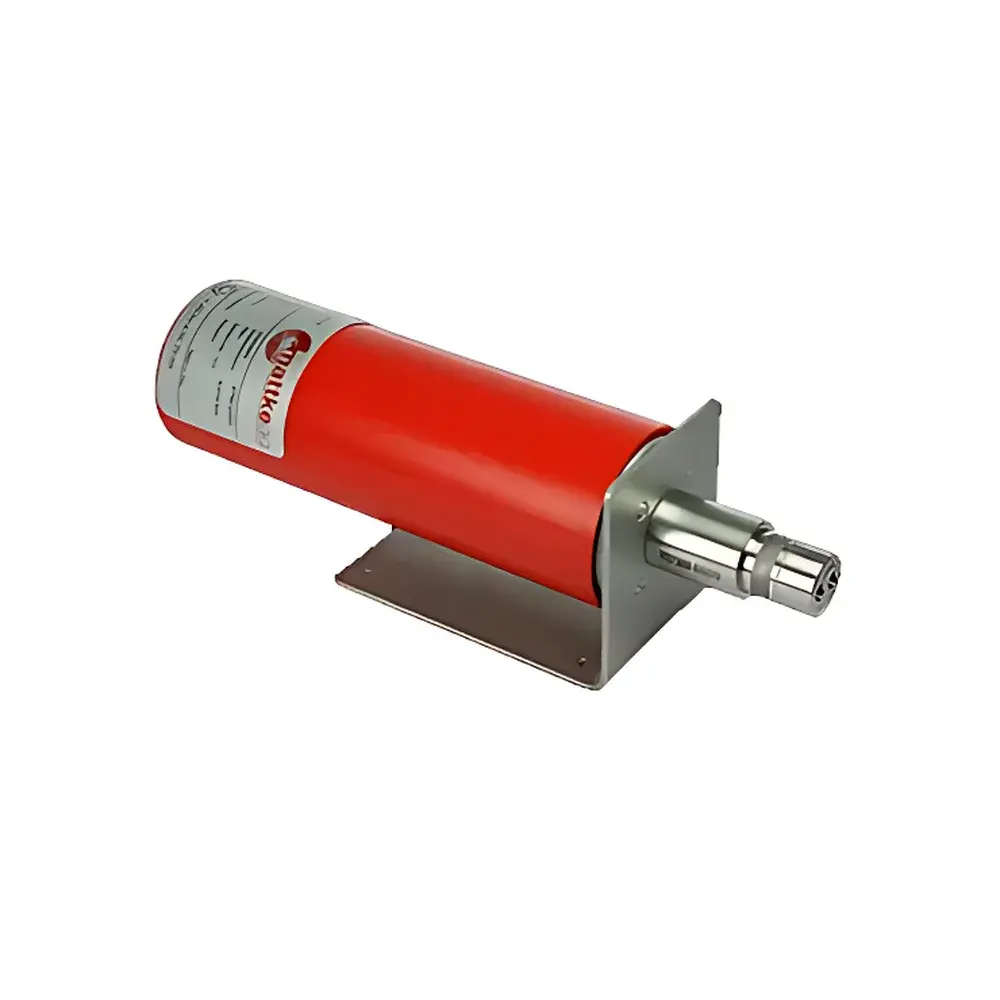
HNPM MZR-4609 Ex Intrinsically Safe Micro-Dosing Peristaltic Pump
| Brand | HNPM |
|---|---|
| Origin | Germany |
| Model | MZR-4609 Ex |
| Flow Rate | 0.012–56 mL/min |
| Speed Range | 1–4700 rpm |
| Viscosity Range | 0.3–5,000 mPa·s |
| Precision (CV) | <1% |
| Max Differential Pressure | 0–10 bar (≥16 mPa·s) |
| Inlet Pressure Max | 5 bar (10 bar with optional fluid seal module) |
| Displacement per Revolution | 12 µL |
| Minimum Dose Volume | 2 µL |
| Motor | 24 V DC, 53 W, encoder resolution 500 pulses/rev |
| Wetted Materials | SS 316L (1.4404/1.4435), tungsten carbide, Ni-based alloys |
| Shaft Seal | graphite-reinforced PTFE + SS 316L |
| Static Seals | FPM (standard), EPDM/FFPM optional |
| Enclosure Rating | ATEX II 2G c T5 X |
| Operating Temperature | −5 to +40 °C |
| Ambient Temperature | 0 to +40 °C |
| Weight | ~2700 g |
| Cable Length | 10 m |
Overview
The HNPM MZR-4609 Ex is an intrinsically safe, high-precision micro-dosing peristaltic pump engineered for continuous and discrete delivery of low- to medium-viscosity fluids in hazardous environments. Unlike conventional peristaltic pumps relying on elastomeric tubing compression, the MZR-4609 Ex employs a patented rotary micro annular gear displacement principle—eliminating pulsation, minimizing shear stress, and ensuring true volumetric accuracy independent of backpressure or fluid rheology. Its certified Ex protection (ATEX II 2G c T5 X) enables deployment in Zone 1 and Zone 2 classified areas per Directive 94/9/EC (now superseded by EU Directive 2014/34/EU), making it suitable for chemical synthesis, solvent handling, catalyst dosing, and process-critical applications where ignition risk must be rigorously mitigated. The pump’s compact footprint (<295 mm length), integrated brushless DC motor (24 V DC, 53 W), and high-resolution optical encoder (500 ppr) support closed-loop speed control and traceable dosing repeatability under dynamic load conditions.
Key Features
- Intrinsically safe design certified to ATEX II 2G c T5 X — compliant with IEC 60079-0, -7, -11, and -31 for gas group IIB and temperature class T5 (surface temp ≤100 °C)
- Volumetric precision with coefficient of variation (CV) <1% across full flow range (0.012–56 mL/min), validated per ISO 5725-2 for reproducibility
- Rotary micro annular gear mechanism eliminates tubing fatigue, pulsation, and particle generation — ideal for shear-sensitive formulations and sterile processes
- Wetted path constructed from corrosion-resistant materials: AISI 316L stainless steel (1.4404 / 1.4435), tungsten carbide, and nickel-based alloys; static seals in FPM (standard), with EPDM or FFPM available for aggressive solvents
- Extended viscosity capability: stable operation from 0.3 mPa·s (e.g., water, methanol) up to 5,000 mPa·s (e.g., adhesives, gels, lubricating oils)
- High-resolution encoder feedback (500 pulses/rev) enables precise speed regulation and audit-ready motion logging for GLP/GMP-aligned workflows
- Modular architecture supports optional fluid seal modules for elevated inlet pressure (up to 10 bar) and custom calibration protocols for non-Newtonian fluids
Sample Compatibility & Compliance
The MZR-4609 Ex is compatible with aqueous solutions, organic solvents (e.g., acetone, THF, DMF), mineral and synthetic oils, UV-curable resins, epoxy precursors, and non-aqueous gels. Its wetted material set meets ASTM F2136 for biocompatibility testing and complies with FDA 21 CFR Part 11 requirements when integrated with validated SCADA or LIMS systems. All electrical interfaces adhere to EN 61326-1 (EMC) and EN 61000-6-2/-4. Mechanical safety conforms to EN ISO 12100 and EN 60204-1. For pharmaceutical applications, the pump supports 21 CFR Part 11-compliant electronic signatures and audit trails when paired with HNPM’s optional DOSIS-Link software suite.
Software & Data Management
The pump operates standalone via front-panel keypad or integrates seamlessly into automated platforms via RS-485 (Modbus RTU), analog 0–10 V / 4–20 mA, or TTL pulse input. Optional DOSIS-Link software provides real-time flow monitoring, dose history export (CSV/Excel), calibration certificate generation, and firmware version tracking. All operational parameters—including speed, total volume dispensed, runtime, and fault logs—are timestamped and stored with tamper-evident hashing. Audit trail functionality satisfies GLP and GMP data integrity requirements per ALCOA+ principles (Attributable, Legible, Contemporaneous, Original, Accurate, Complete, Consistent, Enduring, Available).
Applications
- Continuous reagent addition in catalytic hydrogenation, nitration, and polymerization reactors
- Precision metering of UV-curable inks, coatings, and encapsulants in vacuum-deposition and spray-coating lines
- Dosing of high-value APIs, excipients, or solvents in lab-scale formulation development (ICH Q5C, Q7)
- Controlled delivery of lubricants and sealants in micro-assembly stations
- Automated sampling and dilution in online process analytical technology (PAT) systems
- Low-shear transfer of shear-thinning hydrogels and nanoparticle suspensions in R&D labs
- Calibration fluid delivery for inline viscometers and density meters in hazardous-area installations
FAQ
What ATEX zone classifications does the MZR-4609 Ex support?
It is certified for Zone 1 and Zone 2 (gas atmospheres), Group IIB, T5 temperature class (max surface temperature ≤100 °C).
Can the pump handle abrasive slurries or particulate-laden fluids?
No — the MZR-4609 Ex is designed for homogeneous liquids only; suspended solids >5 µm may accelerate wear of ceramic components and void warranty.
Is 21 CFR Part 11 compliance built-in or dependent on external software?
The pump itself provides secure, time-stamped event logging; full Part 11 compliance requires integration with validated DOSIS-Link software and documented system validation protocols.
What is the recommended recalibration interval under continuous operation?
HNPM recommends annual calibration verification using gravimetric or syringe-pump reference standards traceable to NIST or PTB.
Does the pump support bidirectional flow or variable stroke volume?
No — it operates unidirectionally only; volumetric displacement is fixed per revolution (12 µL/rev); discrete dosing is achieved via controlled motor rotation count.



