
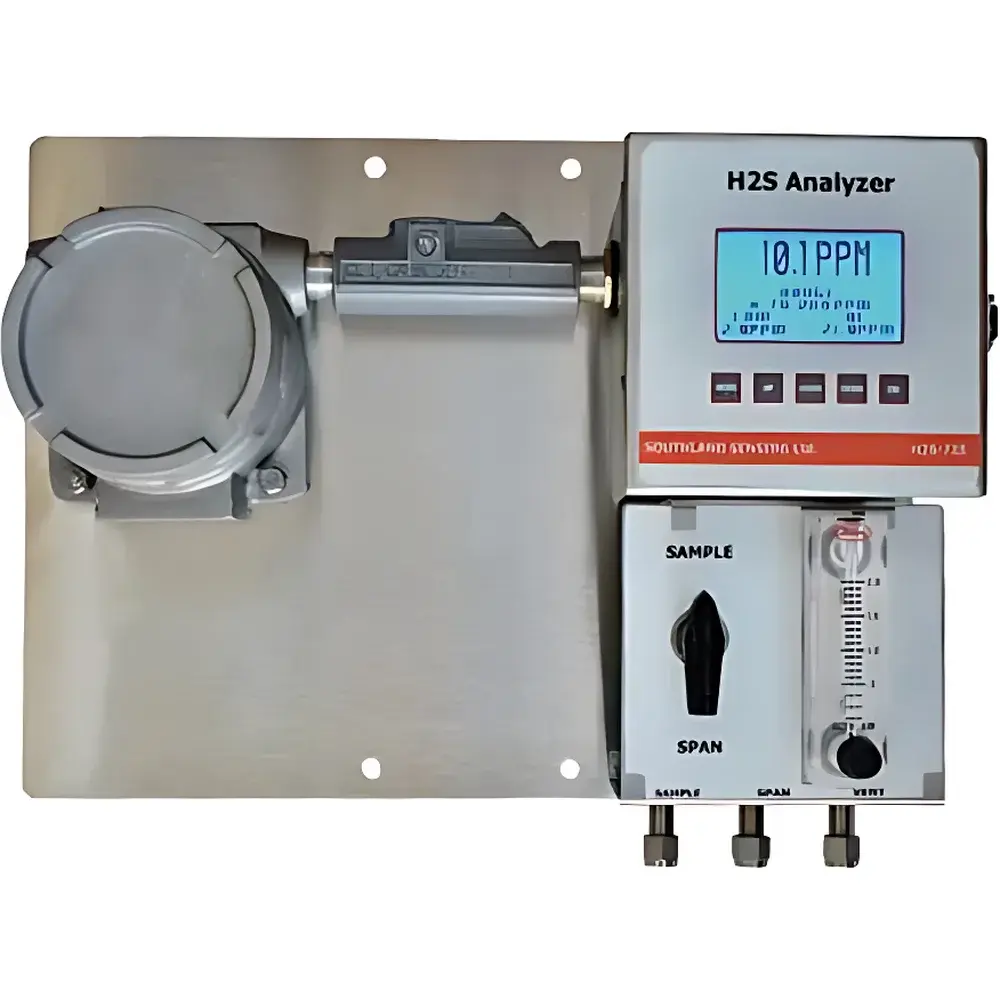
Southland M725 H2S Analyzer
| Brand | Southland |
|---|---|
| Origin | USA |
| Model | H2S-725 |
| Explosion Protection | Class 1, Div 1, Groups B, C, D |
| Measurement Range | 0–200 ppm or 0–2000 ppm H₂S |
| Accuracy | ±2% FS |
| Output | 4–20 mA |
| Power Supply | 12–24 V DC |
| Current Draw | 50 mA |
| Response Time (T90) | <60 s |
| Sample Flow Rate | 0.25–5.0 SCFH |
| Inlet Pressure | 0.1–50 PSIG |
| Operating Temperature | 0–50 °C |
| Enclosure Dimensions | 15.25" × 12.5" × 5.25" |
| Weight | 18.5 lb |
| Sensor Type | Electrochemical fuel cell (current-based) |
| Calibration Interval | Recommended every 1–3 months |
| Warranty | 12 months (sensor and electronics) |
| Gas Connection | 1/4" Swagelok |
| Interference Response | Methyl mercaptan (40%), SO₂ (18%) |
| Optional Features | Heated enclosure, custom range configuration, sampling system integration, bidirectional RS485 communication |
Overview
The Southland M725 H2S Analyzer is a field-deployable, intrinsically safe electrochemical gas analyzer engineered for continuous, real-time detection of hydrogen sulfide (H₂S) in industrial process and safety-critical environments. It operates on the principle of amperometric detection—where H₂S diffuses through a selective membrane into an aqueous electrolyte, undergoes oxidation at the working electrode, and generates a current proportional to gas concentration. This electrochemical fuel cell architecture delivers high specificity, long-term baseline stability, and minimal drift—making it suitable for unattended operation in demanding upstream and midstream natural gas infrastructure. Designed explicitly for compliance with hazardous area classification requirements, the M725 meets Class 1, Division 1, Groups B, C, and D per NEC/UL standards, enabling direct installation in Zone 1 equivalent locations without external barriers. Its compact, ruggedized chassis supports permanent mounting in skids, compressor stations, wellheads, biogas upgrading facilities, and pipeline metering stations.
Key Features
- Intrinsically safe design certified to Class 1, Div 1, Groups B, C, D—no additional explosion-proof enclosures required.
- Galvanically isolated analog output (4–20 mA) and power input to eliminate ground-loop interference and ensure signal integrity in electrically noisy environments.
- Modular electrochemical sensor platform with two calibrated ranges: H2S-1x (0–200 ppm) and H2S-2x (0–2000 ppm), both utilizing proprietary low-maintenance fuel cells with no liquid electrolyte replenishment or electrode cleaning.
- Integrated sampling interface with standard 1/4″ Swagelok fittings; compatible with optional full sampling systems including flow control valves, needle valves, rotameters, and particulate filtration.
- Fast T90 response time (<60 seconds) across full scale, supporting timely alarm activation and process feedback control.
- Wide operating pressure range (0.1–50 PSIG inlet) and ambient temperature tolerance (0–50 °C) enable deployment in variable field conditions.
- Configurable relay outputs for local alarm signaling, shutdown interlocks, or data logging triggers—programmable via front-panel interface or remote command.
Sample Compatibility & Compliance
The M725 is optimized for use in hydrocarbon-rich gas streams, including raw natural gas, sweetened pipeline gas, landfill biogas, and anaerobic digester off-gas. Its electrochemical sensor exhibits defined cross-sensitivity profiles—e.g., 40% relative response to methyl mercaptan and 18% to sulfur dioxide—enabling informed correction or application-specific validation per ASTM D5504 or ISO 8573-6. The analyzer complies with applicable sections of API RP 14C, ISA-TR84.00.02, and OSHA 1910.120 for fixed gas detection in process safety management (PSM) programs. All units are supplied with factory calibration certificates traceable to NIST standards, and sensor performance is validated against ISO 17025-accredited reference gas mixtures prior to shipment.
Software & Data Management
While the M725 operates as a stand-alone analog transmitter, its optional bidirectional RS485 interface supports Modbus RTU protocol for integration into distributed control systems (DCS), SCADA platforms, or centralized gas monitoring networks. Configuration, zero/span calibration, alarm setpoint adjustment, and diagnostic status retrieval can be performed remotely using industry-standard Modbus function codes. Internal non-volatile memory retains calibration history, uptime logs, and fault timestamps—supporting audit readiness under GLP/GMP and EPA Method 21 compliance frameworks. Firmware updates are delivered via secure serial interface and require no hardware modification.
Applications
- Natural gas production: Real-time H₂S monitoring at wellhead separators, glycol dehydrators, and amine treaters.
- Gas transmission: Continuous leak detection and quality assurance at compressor stations and custody transfer points.
- Biogas upgrading: Feedstock and product stream analysis in anaerobic digestion and membrane separation plants.
- Refinery sour water stripping units: Effluent gas monitoring for environmental reporting and regulatory compliance.
- Landfill gas collection systems: Safety monitoring of blower discharge and flare feed lines.
- Chemical manufacturing: Process vent and scrubber outlet verification per EPA 40 CFR Part 63 Subpart HH.
FAQ
What is the recommended calibration frequency for the M725 H2S sensor?
Calibration is recommended every 1–3 months depending on exposure profile, ambient conditions, and regulatory requirements. More frequent calibration may be necessary in high-H₂S or high-humidity environments.
Can the M725 operate in pressurized sample lines?
Yes—the analyzer accepts inlet pressures from 0.1 to 50 PSIG and includes internal pressure regulation; no external pressure-reducing valves are required for typical pipeline applications.
Is the sensor affected by common interferents such as CO or CH₄?
The electrochemical cell is highly selective for H₂S; carbon monoxide and methane exhibit negligible cross-sensitivity (<0.5% FS response), ensuring reliable measurement in natural gas matrices.
Does the M725 support heated sample conditioning?
An optional heated enclosure kit is available to maintain sensor temperature above dew point in cold or high-humidity installations—critical for preventing condensation-induced drift.
What documentation accompanies each unit for regulatory audits?
Each analyzer ships with a Certificate of Conformance, factory calibration report (including span gas lot numbers and uncertainty values), explosion-proof certification summary, and UL listing documentation—all retained digitally for 10 years post-shipment.






