
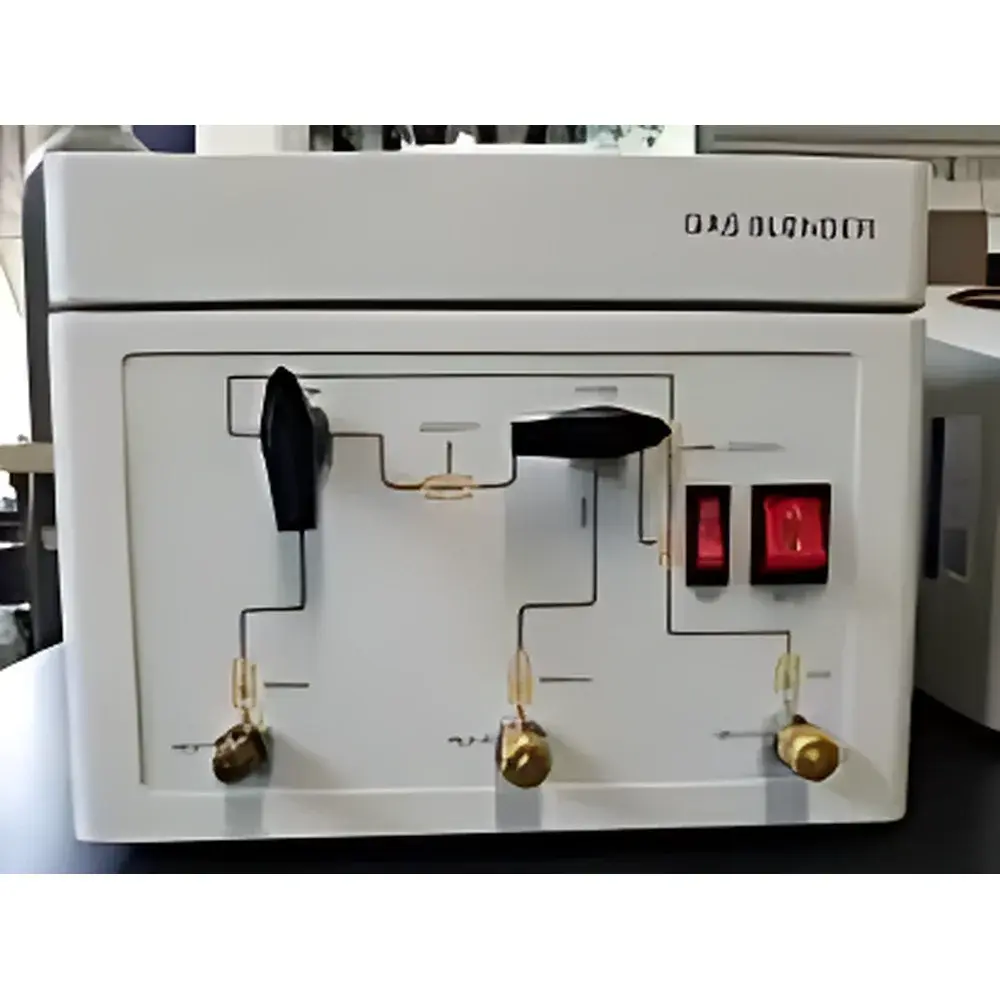
MNK MDL100 Laboratory Gas Dilution System
| Brand | MNK |
|---|---|
| Origin | Beijing, China |
| Model | MDL100 |
| Dilution Ratio Range | 10–1000× |
| Output Flow Rate | 0.5–5 L/min |
| Dilution Modes | Binary and Multi-component |
| Flow Control Principle | Thermal Mass Flow Control |
| Flow Accuracy | ±0.5% of reading |
| Repeatability | <0.2% RSD |
| Linearity (R²) | >0.9999 |
| Overall Dilution Uncertainty | <1% |
| Control Interface | Integrated Touchscreen PC with Customizable Software |
Overview
The MNK MDL100 Laboratory Gas Dilution System is a precision-engineered instrument designed for traceable, gravimetrically referenced gas mixture preparation in analytical, calibration, and environmental testing laboratories. It operates on the thermal mass flow control principle—fully compliant with ISO 6145-1:2015 (Gas analysis — Preparation of calibration gas mixtures using dynamic volumetric methods — Part 1: Gravimetric method) and aligned with the metrological traceability framework established by the National Institute of Metrology (NIM), China. Unlike pressure-based or orifice-driven dilution systems, the MDL100 employs calibrated thermal mass flow controllers (MFCs) to independently regulate primary (stock) and diluent gas streams in real time, enabling dynamic, continuous generation of stable, low-concentration gas standards across a 10× to 1000× dilution range. Its architecture supports both binary (one analyte + one diluent) and multi-component configurations—making it suitable for preparing complex calibration blends used in GC, FTIR, CRDS, and ambient air monitoring applications.
Key Features
- Thermal mass flow controllers sourced from internationally certified suppliers, factory-calibrated against NIM-traceable primary standards
- Dual-channel high-stability flow control with real-time feedback loop and automatic zero-drift compensation
- Integrated touchscreen PC running embedded Linux-based control software with intuitive graphical workflow interface
- Programmable dilution sequences—including stepwise concentration ramps, fixed-ratio blends, and timed multi-gas switching
- Onboard diagnostics including MFC health monitoring, flow deviation alerts, and calibration expiration tracking
- Modular gas path design with electropolished 316L stainless-steel tubing, VCR fittings, and optional heated sample lines (up to 80 °C)
- Compliance-ready audit trail: full timestamped log of all setpoints, actual flows, operator IDs, and system events
Sample Compatibility & Compliance
The MDL100 accommodates a wide range of non-corrosive, non-condensing gases—including N₂, O₂, Ar, He, CO₂, CH₄, NO, SO₂, NH₃ (with optional chemically resistant MFCs), and volatile organic compounds (VOCs) at sub-ppm levels. All wetted materials meet ASTM F519 and USP Class VI requirements. The system’s metrological performance has been validated per ISO/IEC 17025:2017 clause 5.10 (traceability of measurements) and supports GLP/GMP environments through configurable electronic signatures and 21 CFR Part 11–compliant data integrity features—including immutable audit logs, role-based access control, and electronic record retention. Certificate of Conformance includes NIM-accredited calibration reports for each installed MFC, traceable to SI units via national primary standards.
Software & Data Management
The MDL100 is controlled via a dedicated touchscreen HMI running proprietary firmware with dual-mode operation: manual mode for rapid prototyping and automated sequence mode for unattended calibration runs. All configuration files, method templates, and historical run data are stored locally in encrypted SQLite databases with optional network backup to secure FTP/SFTP servers. Export formats include CSV (for LIMS integration), PDF (for QA documentation), and XML (for instrument interoperation with Agilent OpenLab, Thermo Fisher Chromeleon, or Shimadzu LabSolutions). Software updates are delivered via signed firmware packages with SHA-256 verification. Remote diagnostics and parameter adjustment are supported over TLS-secured Ethernet connections—enabling centralized fleet management without compromising data sovereignty.
Applications
- Preparation of certified reference materials (CRMs) for EPA Method TO-14A, TO-15, and EU EN 14662 compliance testing
- Dynamic calibration of continuous emission monitoring systems (CEMS) and portable gas analyzers (e.g., UV-DOAS, TDLAS, electrochemical sensors)
- Method validation and uncertainty budgeting per ISO/IEC 17025 and ISO 17034
- Trace-level stability studies of reactive gas standards (e.g., ozone, ClOₓ, HONO)
- Multi-gas interference testing in sensor development labs
- Supporting ISO 8573-1 compressed air purity certification through precise moisture and hydrocarbon dilution
FAQ
What international standards does the MDL100 comply with?
The system adheres to ISO 6145-1:2015 for dynamic gas dilution methodology and incorporates metrological traceability aligned with ISO/IEC 17025:2017 and NIM certification protocols.
Can the MDL100 be integrated into an existing LIMS or SCADA infrastructure?
Yes—via standard TCP/IP Modbus TCP or OPC UA interfaces; custom API wrappers (REST/JSON) are available upon request for enterprise-level integration.
Is validation documentation provided for GxP-regulated environments?
Yes—DQ/IQ/OQ documentation packages, including risk assessments (ICH Q9), test scripts, and raw calibration data, are supplied as part of the optional Validation Support Service.
What maintenance intervals are recommended for long-term accuracy?
Annual recalibration of MFCs against NIM-traceable standards is recommended; internal diagnostics monitor drift trends and notify users 30 days prior to scheduled recalibration.
Does the system support humidified or heated gas streams?
Optional heated gas modules (0–80 °C) and Nafion™-based humidity control accessories are available for applications requiring dew point stabilization or condensation prevention.
Related Products







