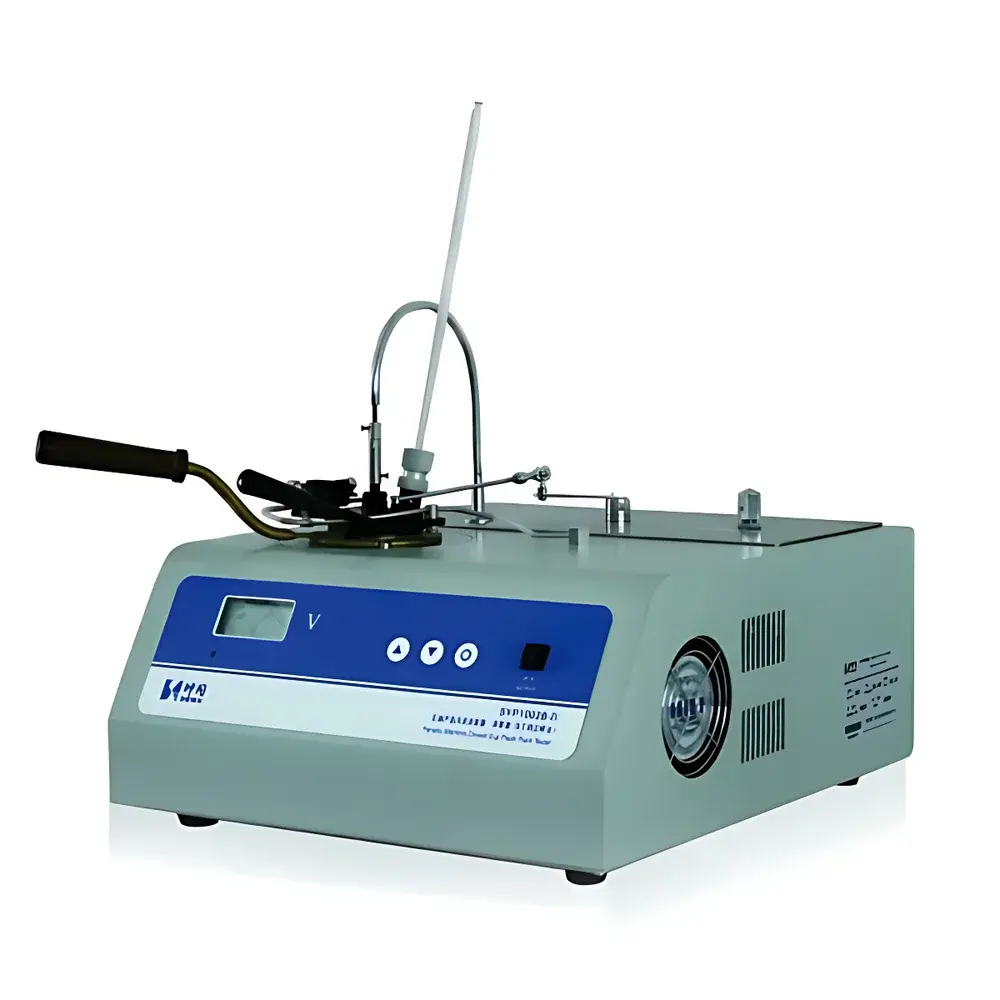
Shenkai SYP1002B-IV Pensky-Martens Closed-Cup Flash Point Tester
| Brand | Shenkai |
|---|---|
| Origin | Shanghai, China |
| Model | SYP1002B-IV |
| Test Method | Closed-Cup (Pensky-Martens) |
| Standards Compliance | GB/T 261, ISO 2719, ASTM D93, IP 34 |
| Heating Power | 500 W |
| Temperature Range | −5°C to 370°C (with three calibrated thermometer ranges) |
| Stirring Speeds | 90–120 rpm and 250 ±10 rpm |
| Ignition Motor Speed | 24 rpm |
| Cooling Rate | 12–14 °C/min |
| Cup Type | Standard Pensky-Martens closed cup (GB/T 261 compliant) |
| Ignition Orifice Diameter | 0.7 mm |
| Voltage Control Range | 0–220 V (digitally set, 3½-digit LCD display) |
| Flame Adjustment | Via adjustable gas flow valve for butane, propane, or town gas |
Overview
The Shenkai SYP1002B-IV Pensky-Martens Closed-Cup Flash Point Tester is a precision-engineered instrument designed for the accurate determination of flash point temperatures in petroleum products and related combustible liquids, in strict accordance with internationally recognized test standards including GB/T 261, ISO 2719, ASTM D93, and IP 34. It operates on the principle of the Pensky-Martens closed-cup method, wherein a sample is heated under controlled conditions inside a sealed test cup while an ignition source is periodically introduced through a defined orifice. The flash point is recorded as the lowest temperature at which vapors above the liquid surface ignite momentarily when exposed to the flame—under standardized atmospheric pressure and stirring conditions. This method is widely adopted for safety classification, transportation regulation (e.g., UN TDG, IMDG Code), and quality control in refineries, lubricant manufacturing, and petrochemical R&D laboratories.
Key Features
- Two independently selectable mechanical stirring speeds: low-speed mode (90–120 rpm) for initial heating and high-speed mode (250 ±10 rpm) during final approach to flash point—ensuring consistent vapor generation and thermal homogeneity per standard requirements.
- Semi-automatic ignition system driven by a dedicated AC motor (24 rpm), eliminating manual flame positioning errors and improving repeatability across operators and shifts.
- Digitally controlled variable-voltage heating circuit (0–220 V range), enabling precise manual adjustment of heating rate between 1–12 °C/min—critical for compliance with ramping profiles specified in ASTM D93 Annex A1 and ISO 2719 Clause 8.
- Integrated gas manifold with universal compatibility for butane, propane, or natural gas; flame size is continuously adjustable via a calibrated needle valve, ensuring reproducible ignition energy delivery.
- Dedicated cooling subsystem for the electric heating mantle, achieving a verified cooling rate of 12–14 °C/min—reducing turnaround time between consecutive tests without compromising thermal stability or cup integrity.
- Three-range certified mercury-in-glass thermometers included: −5–110 °C (0.5 °C division), 20–150 °C (1 °C division), and 90–370 °C (2 °C division), all conforming to GB/T 261 dimensional and calibration specifications.
- Onboard voltage compensation circuitry maintains stable heating output despite line voltage fluctuations, supporting robust operation in industrial environments where power quality may vary.
Sample Compatibility & Compliance
The SYP1002B-IV is validated for use with a broad spectrum of petroleum-derived and synthetic fluids—including gasoline, diesel fuel, kerosene, lubricating oils, biodiesel blends, solvent-based coatings, and suspensions containing particulates or film-forming additives. Its design accommodates samples exhibiting non-Newtonian behavior or surface-film formation during heating, provided they remain pumpable and do not decompose below their flash point. Instrument qualification documentation supports audit readiness for GLP and GMP-regulated environments. All mechanical, thermal, and ignition parameters are traceable to national metrological standards and align with the physical construction requirements outlined in Clause 5 of ISO 2719 and Section 6 of ASTM D93.
Software & Data Management
This model is a benchtop standalone instrument with no embedded microprocessor or digital data logging capability. All operational parameters—including voltage setpoint, stirring speed selection, and observed flash point—are manually recorded by the operator. However, its modular architecture and standardized analog interfaces allow integration into laboratory-wide LIMS or ELN systems via optional third-party analog-to-digital converters and relay modules. For regulated environments requiring electronic records, users may pair the instrument with external certified data acquisition hardware compliant with FDA 21 CFR Part 11 (electronic signatures, audit trails, and data integrity controls), provided such systems are validated per organizational SOPs.
Applications
- Flash point verification of finished fuels prior to shipment (ASTM D93 Category I/II)
- Quality assurance testing of base oils and formulated lubricants per ISO 2909
- Regulatory compliance screening for hazardous material classification under CLP/GHS Annex VI
- In-process monitoring of distillation fractions in refinery fractionation units
- Research evaluation of thermal stability and volatility profiles in alternative fuel formulations
- Failure analysis of contaminated or degraded hydrocarbon samples exhibiting anomalous flash behavior
FAQ
What standards does the SYP1002B-IV fully comply with?
It meets the mechanical, thermal, and procedural requirements of GB/T 261, ISO 2719, ASTM D93 (Method A), and IP 34—including cup geometry, stirrer dimensions, thermometer placement, and ignition timing tolerances.
Can this instrument be used for samples with suspended solids?
Yes—its robust stirring mechanism and wide cup aperture support homogeneous heating of suspensions, provided particles do not obstruct the thermometer well or ignition orifice.
Is external cooling water required?
No—the integrated air-cooled heating mantle eliminates dependency on external chillers or tap water, enhancing portability and reducing infrastructure demands.
What gas supply pressure is recommended for optimal ignition performance?
A regulated supply of 15–30 kPa (0.15–0.3 bar) is advised; higher pressures risk flame instability, while lower pressures may yield inconsistent ignition.
How often must the standard thermometer be recalibrated?
Per ISO/IEC 17025 and internal QA protocols, thermometers should be verified against a NIST-traceable reference before each test series or at least daily in continuous operation.