
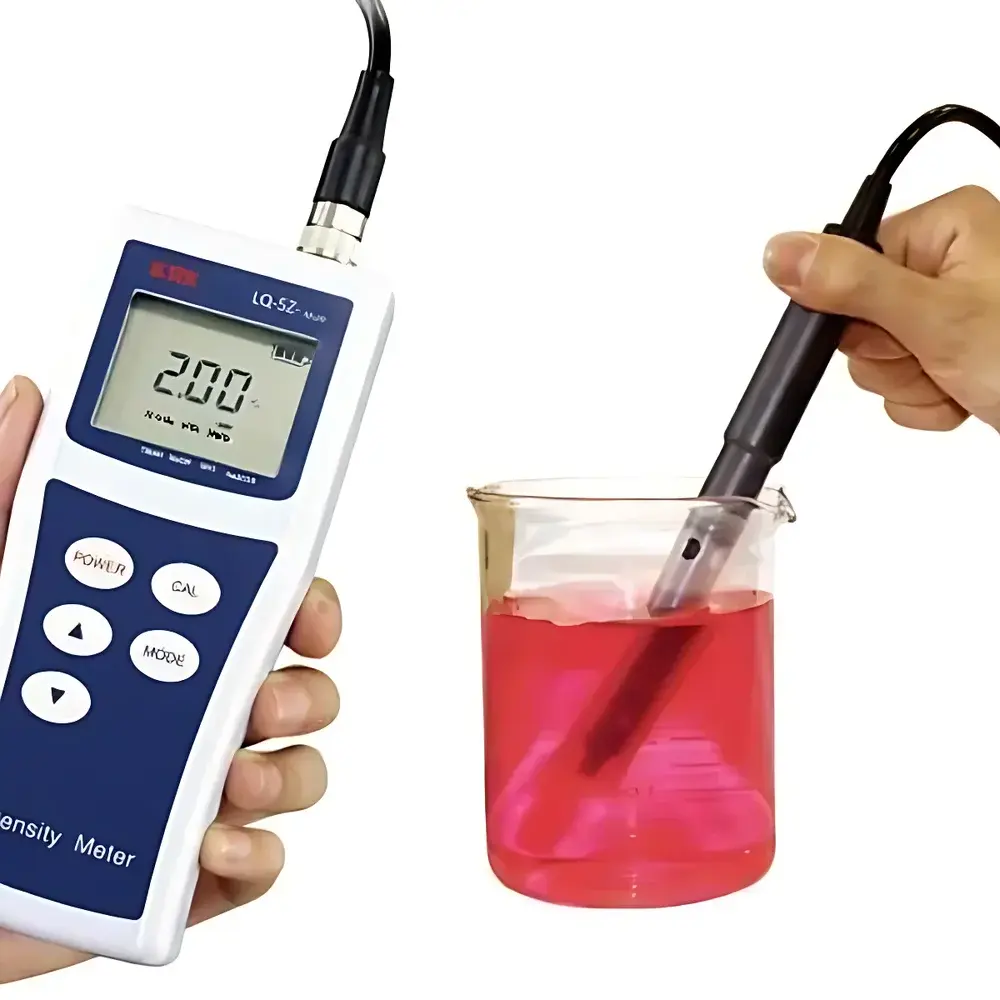
KRK LQ-5Z Single-Component Aqueous Chemical Concentration Meter for NH₃, NaOH, KOH, H₂SO₄, HCl, HNO₃ and TMAH
| Brand | KRK |
|---|---|
| Origin | Japan |
| Model | LQ-5Z |
| Measurement Principle | Potentiometric Electrode Method (Ion-Selective) |
| Measurands | NH₃ (aq), NaOH, KOH, H₂SO₄, HCl, HNO₃, TMAH |
| Sample Type | Single-component aqueous solutions only (no mixtures) |
| Concentration Ranges | NH₃: 0.00–2.00% w/w |
| NaOH | 0.00–3.00% w/w |
| KOH | 0.00–3.00% w/w |
| H₂SO₄ | 0.00–2.00% w/w |
| HNO₃ | 0.00–2.00% w/w |
| TMAH | 0.00–5.00% w/w |
| HCl | range not specified in source data |
| Temperature Range | 0.0–40.0 °C |
| Temperature Compensation | Automatic (NTC-based) |
| Calibration | Zero & span calibration per analyte |
| Enclosure Rating | IP66 |
| Power | 3× LR03 (AAA) alkaline batteries with auto-off |
| Electrode Type | 4-electrode conductometric/potentiometric sensor (model-specific), 1 m cable |
| Instrument Dimensions | 38(H) × 75(W) × 180(D) mm |
| Electrode Dimensions | Ø17 × 180 mm |
| Weight | Instrument ≈ 300 g |
Overview
The KRK LQ-5Z is a portable, single-parameter concentration meter engineered for precise, on-site quantification of individual strong electrolytes and weak bases in aqueous industrial process streams. Unlike generic conductivity meters, the LQ-5Z employs analyte-specific electrode configurations—each calibrated to respond selectively to a defined chemical species via potentiometric or conductometric principles. For ammonia (NH₃), measurement relies on a gas-permeable membrane electrode that detects dissolved NH₃ through pH shift in an internal buffer solution, enabling direct % w/w determination without interference from ammonium salts under controlled pH conditions. For strong acids (H₂SO₄, HNO₃, HCl) and strong bases (NaOH, KOH, TMAH), the instrument utilizes temperature-compensated multi-electrode arrays optimized for ionic strength and dissociation behavior unique to each solute. Designed explicitly for non-mixed solutions, the LQ-5Z eliminates cross-sensitivity artifacts common in multi-analyte platforms, ensuring traceable accuracy in semiconductor wet benches, electroplating baths, and wastewater pretreatment lines where reagent purity and stoichiometric control are critical.
Key Features
- Analyte-dedicated firmware modes: Selectable calibration profiles for NH₃, NaOH, KOH, H₂SO₄, HNO₃, HCl, and TMAH—each with preloaded temperature-response curves and linearization algorithms.
- Automatic temperature compensation (ATC) using integrated NTC thermistor (±0.1 °C resolution), compliant with ISO 7888 and ASTM D1125 guidelines for aqueous solution measurements.
- IP66-rated enclosure: Dust-tight and protected against powerful water jets—validated for continuous operation in humid cleanrooms, plating facilities, and outdoor monitoring stations.
- Zero-and-span calibration protocol: Enables field verification and adjustment using certified standard solutions traceable to NIST SRMs (e.g., NIST SRM 3194 for NH₃).
- Low-power architecture: Operates up to 200 hours on three LR03 alkaline cells with programmable auto-shutdown (15/30/60 min options) and low-battery warning.
- Compact handheld form factor: Ergonomic design (38 × 75 × 180 mm) with rubberized grip and high-contrast LCD—optimized for glove-compatible operation in Class 1000 cleanrooms.
Sample Compatibility & Compliance
The LQ-5Z accepts only single-component aqueous solutions within defined concentration and temperature limits (0.0–40.0 °C). It is incompatible with mixed acids/bases, suspensions, organic solvents, or solutions containing >50 ppm chloride (for TMAH mode) or >100 ppm phosphate (for NH₃ mode), which may foul the ion-selective membrane. All factory calibrations adhere to JIS K 0107 (Japanese Industrial Standard for chemical analysis) and support GLP documentation requirements—including operator ID logging, calibration timestamping, and result export via optional IR interface (not included). The device meets IEC 61000-6-2 (EMC immunity) and IEC 61010-1 (safety for electrical equipment for measurement) standards.
Software & Data Management
While the LQ-5Z operates as a standalone meter with no embedded Bluetooth or USB, its analog output (0–1 V DC proportional to concentration) supports integration into SCADA systems via 4–20 mA transmitters (external converter required). Calibration history and measurement logs are retained in non-volatile memory (100 entries) with time/date stamping. Optional PC software (KRK DataLink v2.1, sold separately) enables CSV export, trend charting, and audit-trail generation compliant with FDA 21 CFR Part 11 when used with validated Windows environments and electronic signatures.
Applications
- Semiconductor manufacturing: Real-time monitoring of TMAH photoresist strip baths and dilute ammonia cleaning solutions (SC1 formulations).
- Electroplating: Control of NaOH/KOH concentrations in zinc and nickel passivation baths; H₂SO₄ titration in copper sulfate electrolytes.
- Wastewater treatment: Pre-discharge verification of residual ammonia in effluent streams prior to nitrification stages.
- Chemical distribution centers: Field verification of bulk tank concentrations for quality release per ISO 9001 clause 8.6.
- Research laboratories: Rapid screening of reagent stock solutions prior to ICP-MS or HPLC sample prep.
FAQ
Can the LQ-5Z measure ammonia in seawater or wastewater with high ionic strength?
No. High chloride or carbonate content causes significant deviation due to liquid-junction potential drift. Use only in purified water matrices or low-TDS process streams.
Is electrode replacement required between different analytes (e.g., switching from NH₃ to H₂SO₄)?
Yes. Each analyte requires a dedicated electrode assembly (LQ-5Z-NH₃, LQ-5Z-H₂SO₄, etc.)—cross-use invalidates calibration and risks membrane damage.
Does the instrument comply with EPA Method 350.1 for ammonia analysis?
No. The LQ-5Z is not a substitute for laboratory-grade colorimetric or distillation methods required for regulatory reporting; it serves as a rapid operational control tool.
What is the typical electrode lifetime under daily use?
Approximately 12–18 months when stored in manufacturer-recommended storage solution and rinsed with deionized water after each use.
Can calibration be performed with user-prepared standards?
Yes—provided standards are prepared gravimetrically using certified reference materials and verified by independent titration or IC analysis.







