
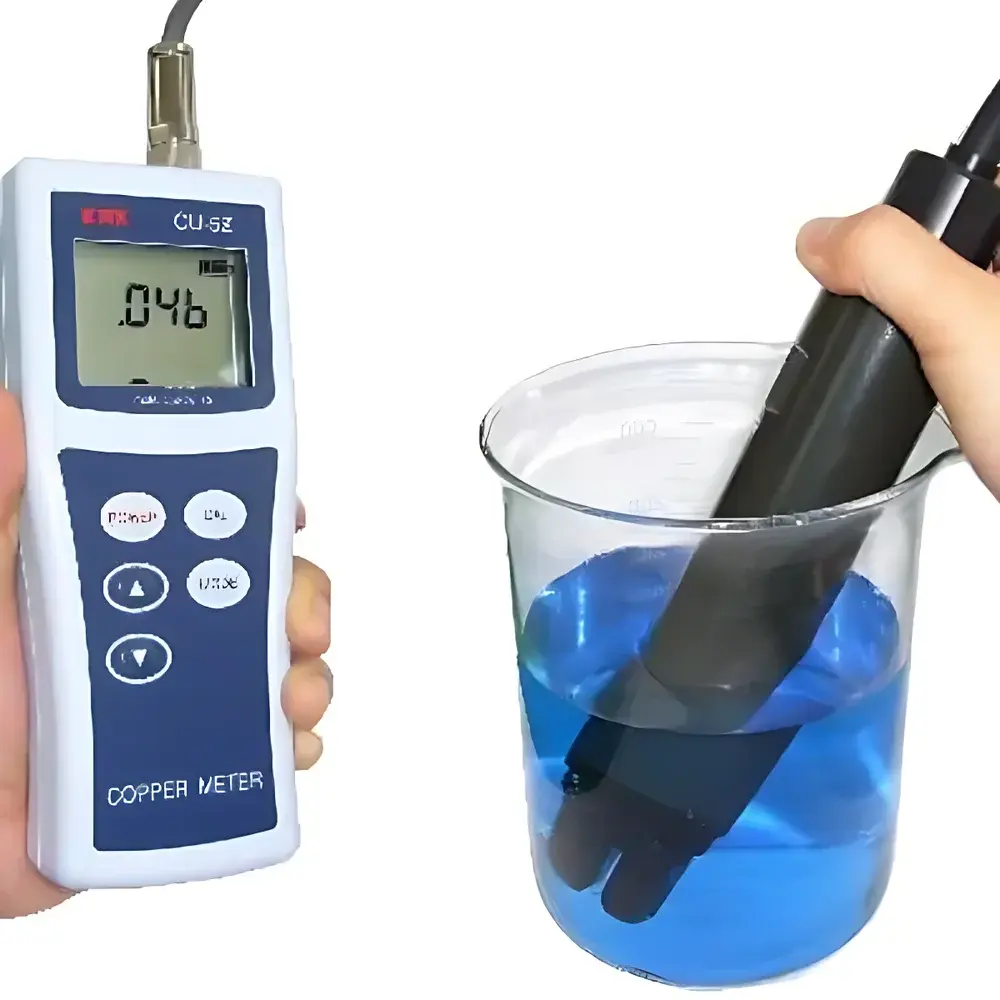
Copper Ion Analyzer CU-5ZL – Portable Photometric Analyzer for Electroplating Bath Monitoring
| Brand | Rikorika |
|---|---|
| Origin | Japan |
| Model | CU-5ZL |
| Instrument Type | Portable |
| Measurement Range | 0–76.3 g/L Cu²⁺ |
| Detection Limit | 1 g/L |
| Operating Temperature | −5°C to +45°C |
| Accuracy | ±2% of theoretical value (under specified conditions) |
| Calibration | Span calibration using certified Cu standard solution |
| Power Supply | 3× AAA alkaline batteries (LR03), auto-off after 30 min |
| Dimensions | 38 mm (H) × 75 mm (W) × 180 mm (D) |
| Weight | ~300 g |
| Display | 3½-digit LCD |
| Measurement Modes | Cu²⁺ (g/L), Cu molarity (mol/L), CuSO₄ (g/L) |
| Optical System | LED light source with reference beam and automatic intensity compensation |
| Sensor Material | Chemically resistant alloy optimized for acidic electroplating baths (H₂SO₄, H₂O₂ tolerant) |
| Temperature Compensation | Built-in thermistor with real-time correction algorithm |
Overview
The Rikorika CU-5ZL is a portable, field-deployable photometric copper ion analyzer engineered specifically for routine monitoring of copper concentration in industrial electroplating electrolytes. It operates on the principle of visible-light absorbance spectroscopy—measuring the characteristic absorption band of Cu²⁺ ions in acidic sulfate-based solutions at wavelengths centered near 810 nm. Unlike generic ISE or colorimetric test kits, the CU-5ZL integrates a dual-beam optical architecture: a measurement path through the sample and a simultaneous reference path that dynamically compensates for LED intensity drift, cuvette fouling, and ambient light interference. This design ensures high reproducibility across shifts and operators, critical for bath control in PCB manufacturing, decorative plating, and semiconductor interconnect processes. Its robust sensor head is constructed from corrosion-resistant alloys compatible with typical plating chemistries—including sulfuric acid concentrations up to 200 g/L and low-level hydrogen peroxide additives—eliminating cross-sensitivity and electrode poisoning issues common in potentiometric sensors.
Key Features
- Triple-parameter quantification: Simultaneous display of Cu²⁺ concentration (0.0–76.3 g/L), molar concentration (0.000–1.200 mol/L), and CuSO₄ equivalent (0.0–300 g/L)
- Dual-beam photometric engine with integrated reference photodiode for real-time LED brightness stabilization
- Automatic temperature compensation via embedded thermistor; validated performance from −5°C to +45°C
- Chemically inert sensor interface resistant to H₂SO₄, H₂O₂, chloride, and organic brighteners commonly present in acid copper baths
- 3½-digit LCD with backlight; intuitive single-button operation and menu navigation
- Battery-powered (3× AAA) with intelligent power management—auto-shutdown after 30 minutes of inactivity
- Compact form factor (38 × 75 × 180 mm) and lightweight design (~300 g) optimized for handheld use in production lines and lab benches
Sample Compatibility & Compliance
The CU-5ZL is validated for direct analysis of clarified, non-turbid aqueous samples with pH < 2.0—typical of acid copper sulfate plating baths (e.g., 180–220 g/L H₂SO₄, 20–250 g/L CuSO₄·5H₂O). It is not intended for untreated wastewater, suspended solids, or highly complexing matrices (e.g., EDTA-containing strike baths). While not certified to ISO/IEC 17025, its measurement traceability aligns with ASTM D1688 (Standard Test Methods for Copper in Water) for photometric determination. The instrument supports GLP-compliant documentation when paired with external logbooks; however, it does not include electronic audit trail or 21 CFR Part 11 functionality. Routine verification is performed using NIST-traceable Cu standard solutions (e.g., 100 mg/L and 500 mg/L Cu²⁺ in 0.1 M H₂SO₄).
Software & Data Management
The CU-5ZL operates as a standalone analyzer without onboard data logging or USB/Bluetooth connectivity. All measurements are displayed in real time and must be manually recorded. For laboratory integration, users may pair the device with external digital loggers or LIMS platforms via manual entry. Calibration is performed using a single-point span adjustment with a certified Cu standard solution; no zero-point calibration is required due to the differential optical architecture. The instrument’s firmware includes self-diagnostic routines for LED output stability and battery voltage monitoring, indicated by dedicated icons on the LCD.
Applications
- Real-time monitoring of Cu²⁺ concentration in acid sulfate plating baths during replenishment cycles
- Verification of bath composition prior to rack loading in PCB through-hole plating lines
- QC checks of incoming CuSO₄·5H₂O raw material solutions
- Troubleshooting abnormal deposit morphology (e.g., burning, nodulation) linked to Cu²⁺ deviation
- Supporting maintenance of bath conductivity and throwing power within specification limits (per IPC-4552A)
- Field validation of online analyzers during commissioning or periodic verification
FAQ
Can the CU-5ZL measure copper in cyanide-based or alkaline baths?
No. The optical method relies on the d-d transition of hydrated Cu²⁺ in strongly acidic media. Cyanide complexes (e.g., [Cu(CN)₃]²⁻) and Cu⁺ species in alkaline environments exhibit different absorption profiles and are outside the calibrated range.
Is cleaning required between measurements?
Yes. Rinse the sensor tip thoroughly with deionized water after each sample to prevent carryover, especially when measuring high-concentration baths (>50 g/L Cu²⁺). A soft lint-free wipe is recommended—do not use abrasive materials.
What is the shelf life of the calibration standard?
Certified Cu standards in 0.1 M H₂SO₄ are stable for ≥12 months when sealed and stored at 15–25°C. Avoid repeated opening or exposure to ambient air to prevent oxidation or contamination.
Does temperature compensation correct for viscosity effects?
No. The built-in thermistor compensates only for the temperature-dependent absorbance coefficient of Cu²⁺. Viscosity-related flow dynamics are irrelevant in static cuvette-based measurement; however, ensure samples are equilibrated to ambient temperature before analysis.
Can the instrument be recalibrated by the end user?
Yes. Span calibration is user-accessible via the front-panel menu using a single certified standard. No special tools or service technician intervention are required.







