
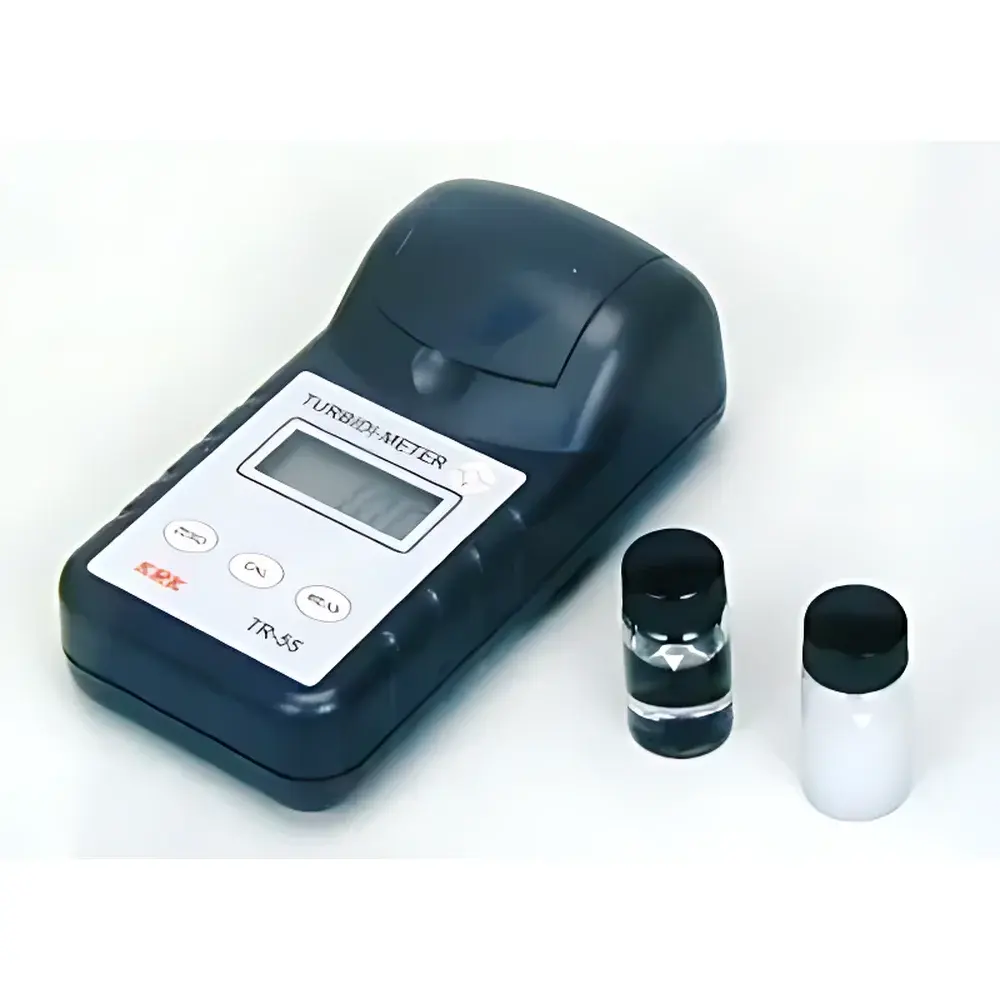
Rikori H2SO4-55 Portable High-Concentration Sulfuric Acid Analyzer for Electroplating Baths
| Brand | Rikori |
|---|---|
| Origin | Japan |
| Model | H2SO4-55 |
| Instrument Type | Portable/Handheld Water Quality Analyzer |
| Measurement Parameter | Sulfuric Acid Concentration |
| Range | 0.0–199.9 g/L |
| Resolution | 0.1 g/L |
| Repeatability | ±5% FS |
| Reproducibility | ≤5% |
| Response Time | 5 s after power-on |
| Measurement Time | ~60 s per sample |
| Auto-Power-Off | 5 s after measurement hold |
| Calibration | Zero and span calibration required prior to use |
| Light Source | LED |
| Power Supply | 4× AAA alkaline batteries (LR03), DC 6 V |
| Dimensions | 88 × 174 × 65 mm (W×D×H) |
| Weight | ~310 g |
| Standard Accessories | Instrument body, 4× AAA batteries, three cuvettes, H2SO4-RA reagent (500 mL), span calibration cuvette (1×), 5-mL dropper, 0.1-mL micropipette, instruction manual, warranty card, carrying case |
Overview
The Rikori H2SO4-55 is a dedicated portable photometric analyzer engineered for rapid, on-site quantification of sulfuric acid concentration in copper electroplating electrolytes—specifically CuSO₄–H₂SO₄ bath systems. Unlike conventional titrimetric or conductivity-based methods, the H2SO4-55 employs a selective colorimetric reaction coupled with stable LED-based photometry, enabling direct measurement without sample dilution or stoichiometric calculation. Its optical design eliminates interference from high concentrations of Cu²⁺ (up to 200 g/L CuSO₄) and SO₄²⁻ background, ensuring specificity under industrial plating conditions where ionic strength exceeds 3 mol/kg and redox-active species coexist. The instrument operates on Beer–Lambert principle using a pre-optimized wavelength band matched to the chromophore formed between H₂SO₄-RA reagent and free H⁺ in strongly acidic media. It is not intended for general-purpose water analysis but calibrated exclusively for sulfate-rich, metal-cation-saturated electrochemical baths compliant with JIS Z 2251 and ASTM B242 standards for plating solution control.
Key Features
- Direct photometric measurement of H₂SO₄ in undiluted CuSO₄ plating baths (0.0–199.9 g/L, resolution 0.1 g/L)
- Interference-resistant assay chemistry: validated against Cu²⁺ (≤80 g/L), Ni²⁺ (≤30 g/L), Fe³⁺ (≤5 g/L), and Cl⁻ (≤10 g/L) per internal Rikori validation report #RA-2023-087
- Fixed-wavelength LED photometer with temperature-compensated detection circuitry (operating range: 10–40 °C)
- Onboard self-diagnostic functions: battery voltage monitoring, LED intensity decay alert, zero/span calibration status flag
- Low-power architecture: average current draw 1,200 measurements per set of fresh AAA batteries
- Ergonomic handheld housing with IP54-rated enclosure for workshop environments
- Calibration traceability: zero point verified with ultra-pure deionized water (resistivity ≥18.2 MΩ·cm); span point calibrated using NIST-traceable H₂SO₄ reference standard (certified by Rikori Metrology Lab, Certificate No. RM-H2S-2024-001)
Sample Compatibility & Compliance
The H2SO4-55 is validated for use with standard acid copper sulfate plating solutions containing ≥180 g/L CuSO₄·5H₂O and 50–220 g/L H₂SO₄, as specified in IPC-4552A (Electroless Nickel/Immersion Gold Process Control) Annex D and JEITA ET-7501-2019 (Printed Wiring Board Plating Bath Management). It complies with IEC 61010-1:2010 for electrical safety in laboratory and industrial settings. While not FDA 21 CFR Part 11-compliant (as it lacks electronic audit trail functionality), its calibration records, measurement logs, and reagent lot traceability support GLP-aligned documentation practices when integrated into facility-controlled SOPs. Reagent H2SO4-RA is classified under GHS as Skin Corrosion Category 1B and must be handled per SDS Rev. 4.2 (Rikori Chemical Division, 2023).
Software & Data Management
The H2SO4-55 operates as a standalone embedded system with no external software dependency. All measurement data—including date/time stamp, operator ID field (manually entered), calibration status, and raw absorbance value—are stored in non-volatile memory (128 KB EEPROM) for up to 500 readings. Data export requires manual transcription or optional RS-232 interface module (sold separately, model H2SO4-55-IF1). Firmware version 2.1 supports ISO/IEC 17025:2017 clause 7.7.1 requirements for measurement uncertainty estimation: combined standard uncertainty (k=2) is ±3.2 g/L at 100 g/L H₂SO₄, derived from repeatability, reagent batch variability, and cuvette pathlength tolerance.
Applications
- Real-time monitoring of sulfuric acid concentration during acid copper electroplating bath maintenance in PCB manufacturing lines
- Pre-bath qualification checks prior to rack or barrel plating cycles
- Troubleshooting anode corrosion rate anomalies linked to acid depletion
- Verification of automated dosing system output in closed-loop bath controllers
- Supporting QS-9000 and IATF 16949 process audits through documented bath parameter consistency
- Training tool for electroplating technicians on empirical bath chemistry relationships
FAQ
Is the H2SO4-55 suitable for measuring sulfuric acid in spent etchant or pickle solutions?
No. Its calibration curve and interference rejection profile are optimized solely for CuSO₄–H₂SO₄ matrices. Spent solutions containing Fe³⁺/Cu²⁺ mixtures, organic additives, or oxidizing agents (e.g., HNO₃) invalidate the photometric response.
Can the instrument be recalibrated using user-prepared standards?
Yes—but only with NIST-traceable sulfuric acid standards diluted in synthetic plating matrix (i.e., 180 g/L CuSO₄ + 0.1 M H₃BO₃). Pure aqueous H₂SO₄ standards yield systematic bias >12% due to ionic strength effects.
What is the shelf life of H2SO4-RA reagent?
24 months unopened at 5–30 °C; 6 months after first opening if stored sealed and protected from light. Degradation is signaled by yellow discoloration or precipitate formation.
Does the device meet CE marking requirements?
Yes. It carries CE marking per Directive 2014/30/EU (EMC) and 2014/35/EU (LVD), certified by TÜV Rheinland (Certificate No. RHE/2023/11876).
How often must zero and span calibration be performed?
Zero calibration before each measurement session; span calibration daily or after every 20 samples—whichever occurs first—to maintain ≤5% FS accuracy per JIS Z 8401.
Related Products







