
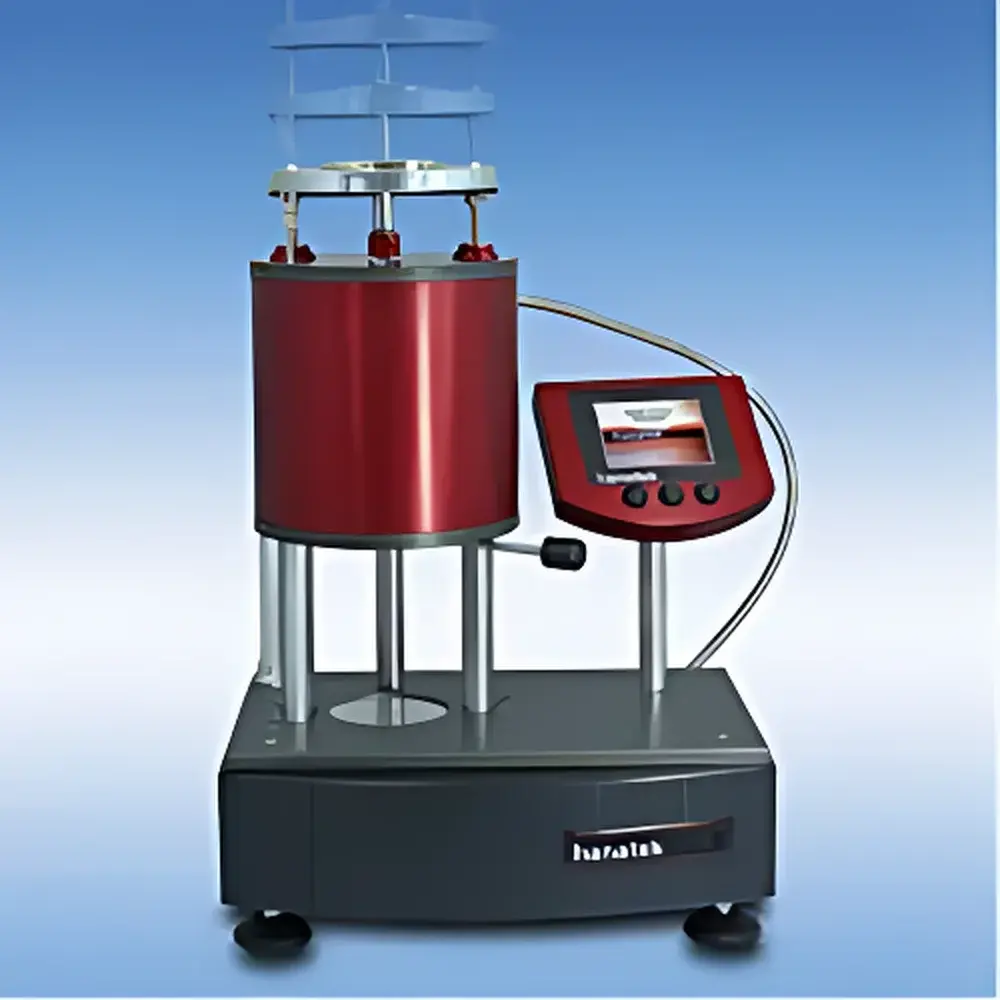
Hanatek MFI Series Melt Flow Indexer
| Origin | UK |
|---|---|
| Manufacturer Type | Authorized Distributor |
| Origin Category | Imported Instrument |
| Model | Hanatek MFI |
| Price | Upon Request |
Overview
The Hanatek MFI Series Melt Flow Indexer is a precision-engineered instrument designed for the quantitative determination of melt mass-flow rate (MFR), melt volume-flow rate (MVR), and related rheological parameters of thermoplastic polymers under standardized load and temperature conditions. Operating on the principle of extrusion plastometry—where molten polymer is forced through a calibrated die under controlled temperature and dead-weight loading—the system delivers traceable, repeatable measurements essential for quality control, material specification compliance, and process validation in polymer manufacturing and compounding facilities. Its design adheres strictly to the physical requirements defined in ISO 1133-1 & -2, ASTM D1238 (Parts A, B, and C), BS 2782, and ASTM D3364, ensuring global regulatory acceptability across R&D, QC, and production environments.
Key Features
- Triple-zone barrel heating system with independent PID control per zone, maintaining axial thermal uniformity ≤ ±0.2°C across the full 40–400°C operating range—critical for minimizing inter-laboratory variability and eliminating common sources of deviation observed in legacy MFI instruments.
- Real-time barrel temperature monitoring via embedded Pt100 sensors, coupled with automatic micro-adjustment feedback loops that dynamically correct thermal drift during test execution.
- Integrated piston displacement sensor with 0.01 mm resolution, enabling continuous volumetric flow tracking and precise calculation of MFR, MVR, melt density, shear rate, tensile stress, and apparent melt viscosity.
- Pneumatically actuated weight deployment system eliminates manual handling of standard masses (1.2 kg to 21.6 kg), reducing operator exposure to thermal hazards and mechanical strain while ensuring consistent load application timing and force repeatability.
- Touchscreen HMI with preloaded test methods compliant with ISO 1133 Annexes and ASTM D1238 Procedure A/B/C, supporting one-touch initiation, real-time parameter visualization, and auto-generated test reports.
- User-performed annual calibration using UKAS-accredited reference standards and traceable calibration kits—fully satisfying ISO/IEC 17025 requirements without necessitating instrument return or third-party onsite service.
- Field-replaceable barrel assembly, designed to ISO 1133 dimensional tolerances, allowing rapid maintenance without downtime or reliance on manufacturer depot repair cycles.
- Automated post-test barrel cleaning sequence utilizing controlled nitrogen purge and thermal soak, minimizing carbonization residue buildup and extending die/barrel service life.
Sample Compatibility & Compliance
The Hanatek MFI accommodates standard cylindrical polymer specimens (typically 4–5 g) across major thermoplastic families including polyethylene (PE), polypropylene (PP), polycarbonate (PC), ABS, PET, and engineering thermoplastics. It supports both single-point (Method A) and multi-point (Method B/C) flow index determinations, as well as melt density derivation via gravimetric collection. All hardware—including die geometry (2.095 mm diameter × 8.000 mm length), barrel internal diameter (9.550 mm), and piston specifications—conforms precisely to ISO 1133 Annex A and ASTM D1238 Figure 1 requirements. The instrument’s metrological traceability is maintained through factory calibration against NPL-traceable temperature and mass standards, and its operational software architecture supports audit-ready data integrity per FDA 21 CFR Part 11 when configured with optional electronic signature modules.
Software & Data Management
Embedded firmware enables local storage of ≥1,000 test records with full metadata (operator ID, sample ID, method version, environmental timestamp, raw displacement vs. time arrays). Export formats include CSV and PDF with configurable templates aligned to internal QA documentation protocols. Optional PC-based Hanatek DataLink software provides advanced statistical analysis (X-bar/R charts, trend detection), LIMS integration via ASTM E1384-compliant XML export, and GLP-compliant electronic audit trails—including user action logging, parameter change history, and calibration event archiving. All data fields are immutable post-generation unless authorized via role-based access control.
Applications
- Raw material acceptance testing for incoming resin lots against supplier specifications (e.g., PE HD/LD grades, PP homopolymer/copolymer variants).
- In-process monitoring of extrusion and injection molding feedstocks to detect thermal degradation or molecular weight shifts.
- Batch-to-batch consistency verification during masterbatch production and compound formulation development.
- Supporting regulatory submissions requiring documented flow behavior under standardized test conditions (e.g., medical-grade polymer certification per ISO 10993-12).
- Research applications involving structure–property relationships, such as correlating MFR with GPC-derived Mw/Mn ratios or rheological master curves.
FAQ
What international standards does the Hanatek MFI fully comply with?
ISO 1133-1:2011, ISO 1133-2:2011, ASTM D1238-13 (Procedures A, B, and C), BS 2782-1:1992, and ASTM D3364-04.
Can the instrument perform both MFR and MVR measurements simultaneously?
Yes—real-time piston displacement data allows concurrent calculation of both melt mass-flow rate (g/10 min) and melt volume-flow rate (cm³/10 min), along with derived melt density (g/cm³).
Is UKAS traceable calibration possible without sending the unit to a service center?
Yes—users can execute full thermal and mechanical calibration annually using Hanatek-supplied UKAS-accredited reference tools, preserving ISO/IEC 17025 accreditation status in-house.
How does the triple-zone heating improve measurement accuracy compared to single-zone systems?
It eliminates axial thermal gradients known to exceed ±15°C in conventional units, thereby preventing premature polymer degradation at the top zone or insufficient melt homogenization near the die—both leading causes of non-repeatable flow readings.
What safety mechanisms prevent operator exposure to high-temperature components?
The system incorporates automated pneumatic weight handling, post-test nitrogen-assisted barrel cooling, and a programmable “cool-down lockout” that disables access until barrel surface temperature falls below 60°C.





