
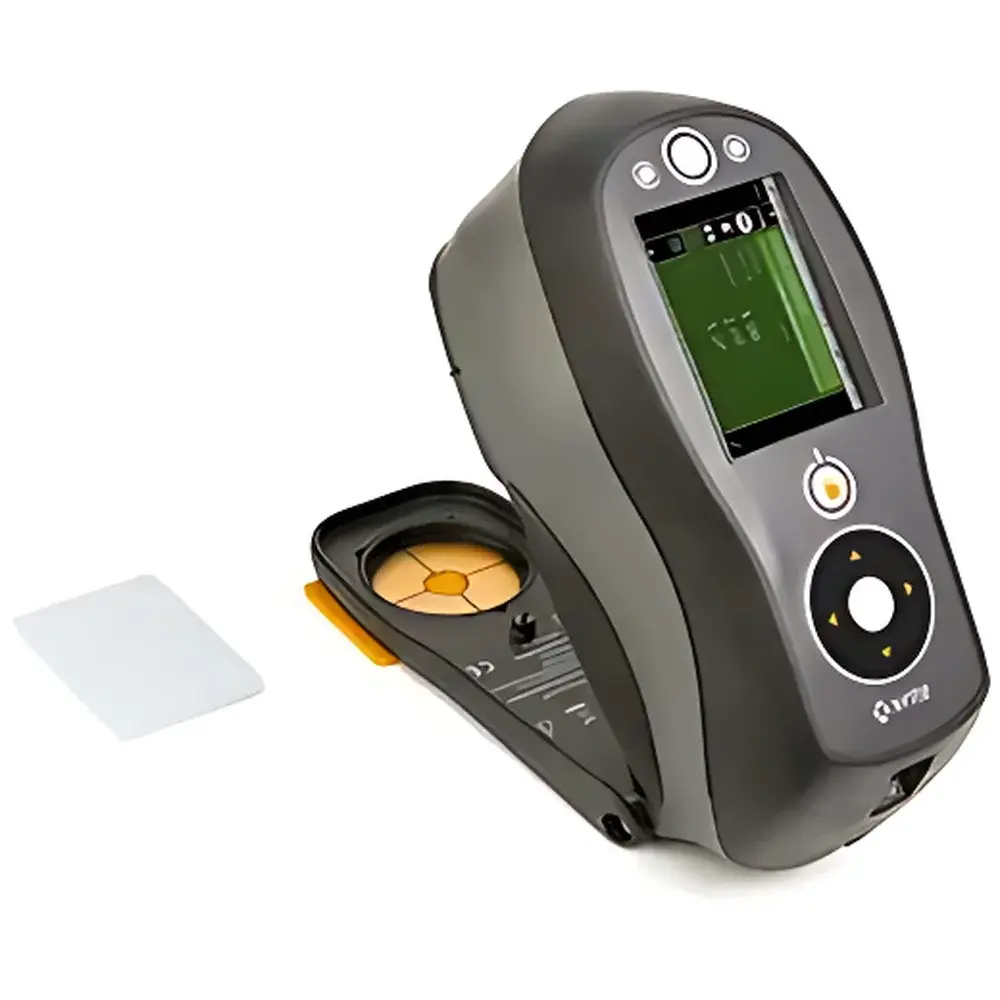
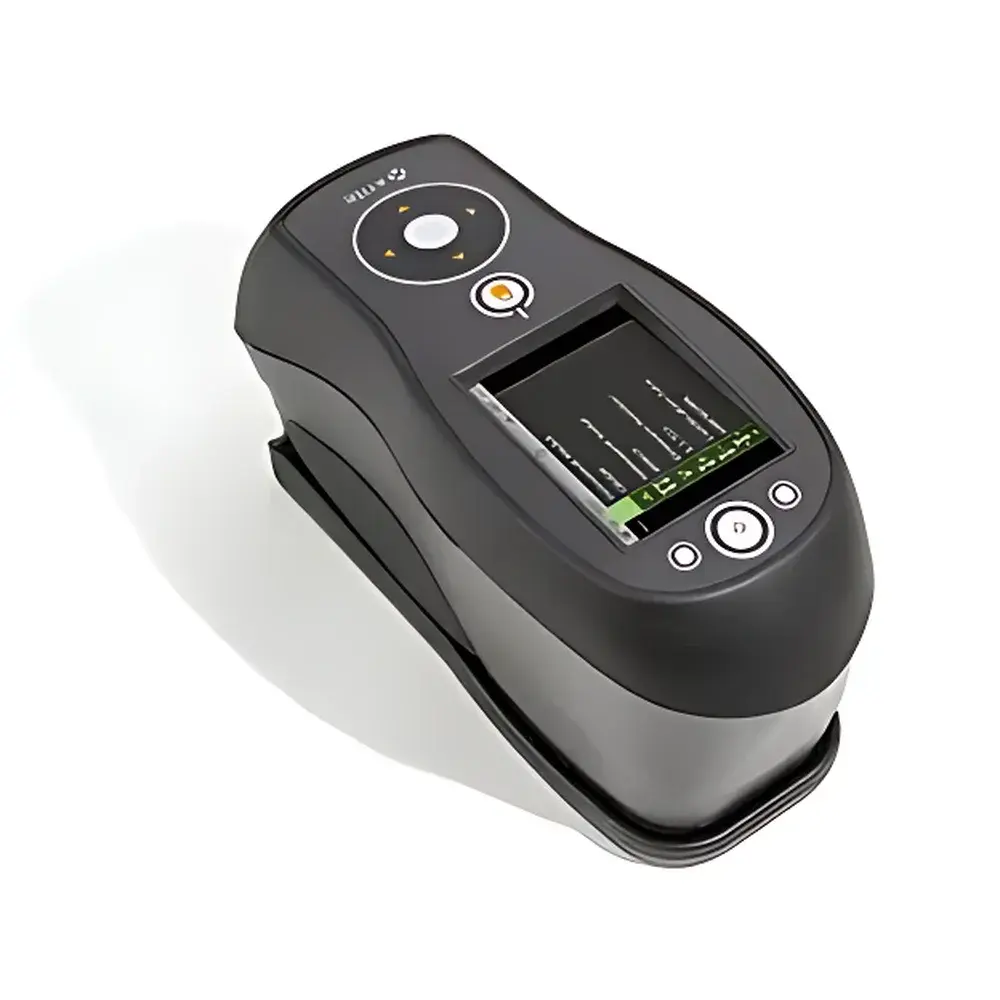
X-Rite Ci64 Portable Spectrophotometer
| Brand | X-Rite |
|---|---|
| Origin | USA |
| Product Type | Spectrophotometer |
| Instrument Type | Portable |
| Optical Geometry | d/8° integrating sphere |
| Light Source | Tungsten halogen lamp |
| Spectral Range | 400–700 nm |
| Repeatability | ΔE* < 0.04 (white tile, 10 readings) |
| Aperture Options | 4 mm, 8 mm, 14 mm (Ci64L variant) |
| On-device Storage | Up to 4,000 measurements |
| Connectivity | Optional Bluetooth (CE, US, CA, CN, IN, JP, KR, TW) |
| Software Integration | NetProfiler 3.0, PantoneLIVE™ cloud access, eXact™ compatibility |
| Compliance | ASTM E308, ISO/CIE 15, ISO 13655, DIN 5033, GB/T 3978–2008 |
| Backward Compatibility | Full SP-series legacy support with embedded spectral data conversion |
Overview
The X-Rite Ci64 is a high-precision portable spectrophotometer engineered for industrial color measurement in dynamic production and quality control environments. Utilizing d/8° integrating sphere optics with a tungsten halogen light source, the Ci64 delivers stable, repeatable spectral reflectance data across the visible spectrum (400–700 nm). Its optical architecture is specifically optimized for measuring complex surfaces—including metallic inks, laminated foils, embossed packaging, anodized metals, and textured substrates—where directional gloss, surface topography, and specular reflectance significantly influence perceived color. Unlike 0/45° geometry instruments designed for flat matte prints, the Ci64’s diffuse illumination minimizes angular dependency and ensures metrological consistency across heterogeneous materials. This makes it indispensable for brand-critical applications where visual color match must be decoupled from geometric appearance effects—enabling users to distinguish whether a measured ΔE shift arises from chromatic deviation or changes in surface finish.
Key Features
- Triple-aperture capability (4 mm, 8 mm, and optional 14 mm) for flexible spot-size selection—ideal for small graphics, large-area packaging, and legacy specification alignment.
- Integrated color display with intuitive graphical UI and flip-over design for ergonomic operation on vertical, overhead, or recessed surfaces.
- Dedicated lock key prevents accidental parameter changes during routine QC checks, ensuring procedural integrity in regulated workflows.
- On-device storage of up to 4,000 spectral measurements with timestamp, operator ID, and metadata tagging—eliminating real-time PC dependency.
- Hot-swap battery system: operate continuously while charging a second battery via optional AC adapter—maximizing instrument uptime in shift-based manufacturing.
- PantoneLIVE™-enabled: authenticated access to cloud-hosted PANTONE® spectral libraries and brand-specific digital color standards, supporting global supply chain harmonization under ISO 12647-2 and G7 calibration frameworks.
Sample Compatibility & Compliance
The Ci64 meets rigorous international standards for colorimetric accuracy and inter-instrument agreement. It complies with ASTM E308 (standard practice for computing CIE colors), ISO/CIE 15 (colorimetry), ISO 13655 (spectral measurement of printed samples), and DIN 5033 (photometric and colorimetric standards). Its d/8° geometry conforms to CIE Publication No. 15:2018 and supports both SCI (Specular Component Included) and SCE (Specular Component Excluded) modes via software configuration—essential for evaluating metamerism in multi-source lighting environments. The device is validated for use in GLP/GMP-aligned labs and supports FDA 21 CFR Part 11-compliant audit trails when integrated with NetProfiler 3.0 and enterprise-quality management systems.
Software & Data Management
NetProfiler 3.0 serves as the central performance validation and calibration platform for the Ci64. It enables remote verification, drift monitoring, and spectral recalibration without requiring physical lab intervention. Each measurement generates a unique, time-stamped ID linked to instrument firmware version, aperture setting, illumination condition, and operator credentials—ensuring full traceability per ISO/IEC 17025 requirements. Embedded spectral data conversion algorithms maintain backward compatibility with legacy X-Rite SP series instruments and improve inter-instrument agreement across mixed fleets. When paired with eXact™ or Color iQC software, the Ci64 feeds into automated SPC dashboards, tolerance alerts, and cross-site color deviation reporting—facilitating closed-loop corrective action in Tier-1 supplier networks.
Applications
- Brand-critical packaging: bottle caps, aluminum cans, metallized films, and flexographic labels where gloss and texture dominate visual perception.
- Commercial printing: verification of PANTONE® metallics, pearlescent inks, and extended-gamut process colors under variable lighting conditions.
- Automotive trim & interiors: measurement of injection-molded plastics, brushed aluminum, and leather with high surface variability.
- Consumer electronics: color matching of anodized housings, glass panels, and coated displays requiring consistent hue and chroma across production batches.
- Regulated industries: pharmaceutical blister packaging, medical device labeling, and food-grade cartons where color fidelity impacts regulatory compliance and consumer trust.
FAQ
What distinguishes the Ci64 from the Ci62 or Ci60?
The Ci64 includes all standard apertures (4 mm, 8 mm, and 14 mm via Ci64L), enhanced Bluetooth certification across 8 global regulatory zones, and full NetProfiler 3.0 feature parity—including remote spectral optimization and PantoneLIVE™ synchronization. The Ci62 omits the 14 mm aperture and certain regional Bluetooth certifications; the Ci60 lacks Bluetooth and advanced software integration capabilities.
Can the Ci64 measure fluorescent or UV-reactive materials?
The standard Ci64 does not include UV excitation. For fluorescent substrates, the Ci64 UV variant integrates a UV-filtered tungsten source and dedicated UV calibration—required for ISO 13655 M1/M2 mode compliance in security printing and specialty coatings.
How does the Ci64 ensure long-term measurement stability?
It employs thermally stabilized optics, factory-calibrated ceramic white reference tiles, and real-time sensor drift compensation algorithms. Annual verification with X-Rite-certified calibration services maintains traceability to NIST-traceable standards.
Is spectral data export supported in industry-standard formats?
Yes—measurements export as .cie, .txt, and .csv files containing full 10-nm interval spectral reflectance data (31 points), CIE XYZ, L*a*b*, ΔE00, and custom tolerances—compatible with MATLAB, Python (via xrite-py), and major QC platforms including Qualisys and SPC XL.





