
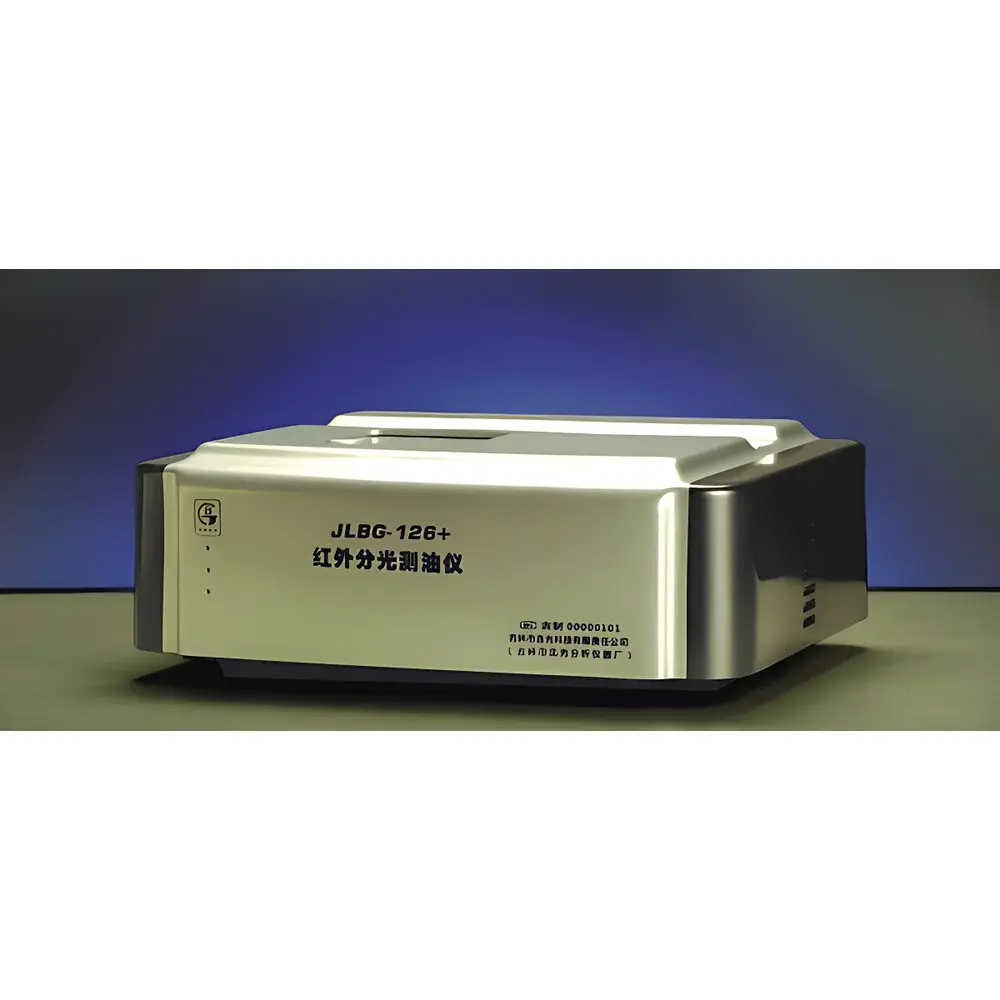
Beiguang JLBG-126+ Infrared Spectrophotometric Oil Content Analyzer
| Brand | Beiguang |
|---|---|
| Origin | Jilin, China |
| Model | JLBG-126+ |
| Instrument Type | Laboratory |
| Measurement Principle | Infrared Spectrophotometry |
| Measurement Range | 0 mg/L – 100% oil (w/w or v/v, matrix-dependent) |
| Detection Limit | 0.2 mg/L (as petroleum hydrocarbons in water) |
| Accuracy | ±10% (relative error vs. certified reference materials) |
| Resolution | 0.1 ppm |
| Measurement Cycle Time | 75 seconds per sample |
| Compliance | Designed to meet HJ 637–2012 (China Environmental Protection Standard) |
Overview
The Beiguang JLBG-126+ Infrared Spectrophotometric Oil Content Analyzer is a laboratory-grade instrument engineered for precise, regulatory-compliant quantification of total petroleum hydrocarbons (TPH) and aromatic hydrocarbon fractions in aqueous environmental matrices. It operates on the fundamental principle of mid-infrared (MIR) absorption spectroscopy—specifically targeting C–H stretching vibrations in aliphatic and aromatic hydrocarbons at wave numbers 2930 cm⁻¹ (CH₂ asymmetric), 2960 cm⁻¹ (CH₃ asymmetric), and 3030 cm⁻¹ (aromatic C–H). Unlike non-dispersive infrared (NDIR) instruments, the JLBG-126+ performs full-spectrum scanning across 4000–500 cm⁻¹ with high optical resolution, enabling spectral fingerprinting, interference identification, and quantitative multi-component analysis without reliance on empirical calibration curves.
Key Features
- True Dispersive Infrared Spectrophotometry: Equipped with a precision Czerny–Turner monochromator and thermoelectrically cooled DTGS detector, the system acquires continuous absorbance spectra—not discrete point measurements—allowing unambiguous discrimination between petroleum hydrocarbons and common interferents such as alcohols, ketones, and esters.
- Dual Solvent Compatibility: Supports both carbon tetrachloride (CCl₄) and tetrachloroethylene (C₂Cl₄) as extraction solvents, facilitating seamless transition from legacy methods to environmentally compliant workflows aligned with Montreal Protocol Phase-Out schedules and updated Chinese EPA guidance (e.g., revised HJ 637 implementation documents).
- Regulatory Algorithm Implementation: Implements the exact calculation protocol specified in HJ 637–2012 Section 9.1: ρ = X·A₂₉₃₀ + Y·A₂₉₆₀ + Z·(A₃₀₃₀ − A₃₀₃₀/F), eliminating curve-fitting artifacts and ensuring traceability to national standard methodology.
- Verified Instrument Detection Limit: Demonstrates reliable detection of 0.4 mg/L petroleum hydrocarbon standard solutions under standardized extraction conditions (1000 mL sample volume, 25 mL C₂Cl₄ extract, 10 mm pathlength cell), satisfying the instrumental sensitivity requirement derived from the method’s stated 0.01 mg/L reporting limit.
- Aromatic Hydrocarbon-Specific Quantification: Capable of resolving and quantifying aromatic C–H absorption at 3030 cm⁻¹ with validated response to benzene and toluene standards per HJ 637–2012 Section 8.1.1—critical for assessing toxicity-relevant fractions in industrial effluents from petrochemical, steelmaking, and coking facilities.
- Enhanced Optical Stability: Utilizes a worm-gear-driven grating drive mechanism in the monochromator, reducing mechanical backlash and thermal drift versus traditional gear-train systems—improving long-term wavelength reproducibility and baseline stability over extended operational cycles.
Sample Compatibility & Compliance
The JLBG-126+ is validated for use with liquid-phase extracts prepared from surface water, groundwater, wastewater, and leachate samples following standard EPA Method 1664 or HJ 637–2012 protocols. It supports both manual and automated liquid handling integration for routine QC/QA workflows. Instrument design and data processing logic conform to the technical requirements of China’s Ministry of Ecology and Environment (MEE) for TPH analysis. While not inherently 21 CFR Part 11–compliant out-of-the-box, its raw spectral data export (CSV, ASCII) enables integration into validated LIMS environments supporting audit trails, electronic signatures, and data integrity controls required under GLP and ISO/IEC 17025 frameworks.
Software & Data Management
The embedded firmware provides real-time spectral visualization, peak annotation, baseline correction, and automatic absorbance integration at user-defined wave number intervals. All raw interferograms and processed spectra are stored with metadata including date/time stamp, operator ID, solvent type, cell pathlength, and extraction parameters. Export formats include CSV (for third-party chemometric analysis) and PDF reports containing full spectral overlays, calculation logs, and compliance flags against HJ 637–2012 pass/fail criteria. Optional PC-based software extends functionality with batch processing, statistical trend analysis, and customizable report templates suitable for regulatory submission.
Applications
- Regulatory monitoring of petroleum hydrocarbons in municipal and industrial wastewater discharges (per GB 8978–1996 and local discharge permits)
- Groundwater remediation site assessment and long-term plume tracking
- Environmental impact assessments for oil storage facilities, refineries, and transportation corridors
- Quality control of treated effluent in zero-liquid-discharge (ZLD) systems
- Research-grade characterization of hydrocarbon biodegradation kinetics and sorption behavior
- Validation of solid-phase extraction (SPE) and liquid–liquid extraction (LLE) efficiency in method development labs
FAQ
Does the JLBG-126+ support ASTM D7066 or ISO 9377-2 compliance?
The instrument implements core infrared measurement principles consistent with ISO 9377-2 (petroleum hydrocarbons in water), but formal conformance requires lab-specific validation per that standard’s precision and recovery requirements.
Can it quantify individual hydrocarbon classes (e.g., aliphatics vs. aromatics)?
Yes—by applying the three-band algorithm with appropriate calibration coefficients (X, Y, Z, F), it differentiates aliphatic CH₂/CH₃ contributions from aromatic C–H absorption, enabling semi-quantitative class separation.
Is method validation documentation provided?
Beiguang supplies instrument-specific verification reports covering wavelength accuracy, photometric linearity, repeatability, and detection limit verification per HJ 637–2012 Annex B protocols.
What maintenance is required for long-term spectral fidelity?
Annual wavelength calibration using NIST-traceable polystyrene film and quarterly DTGS detector performance checks are recommended; no consumable optical components require replacement under normal operation.
How is data integrity ensured during regulatory audits?
All raw spectra and calculation parameters are immutable upon acquisition; revision history and operator log entries are retained in non-erasable memory, supporting retrospective audit trail reconstruction.
Related Products







