
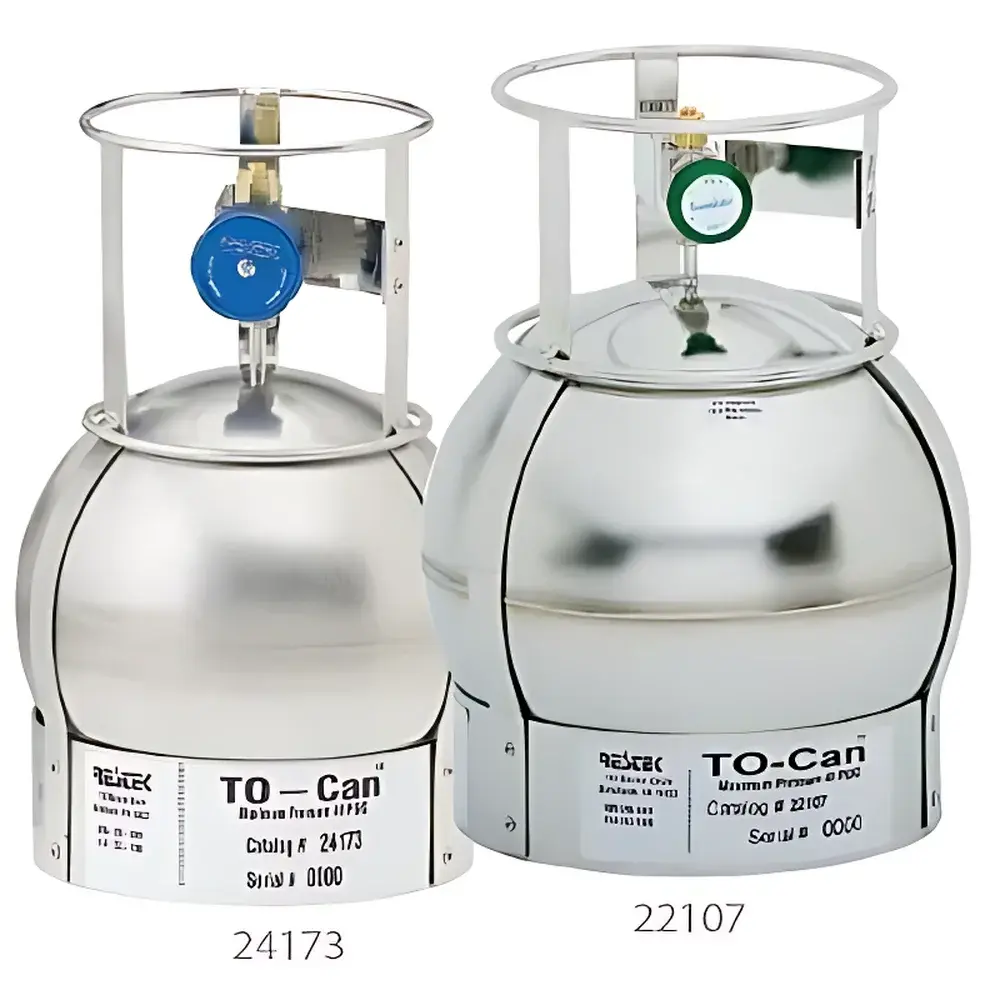
Restek TO-Can EPA-Compliant Air Sampling Canisters
| Key | Brand: Restek |
|---|---|
| Origin | USA |
| Material | Electropolished Stainless Steel (316L) |
| Valve Type | Parker Hannifin Metal-to-Metal Sealed Diaphragm Valve (2/3-turn) |
| Volume Options | 1 L, 3 L, 6 L, 15 L |
| Operating Temperature | Up to 250 °C |
| Internal Surface Treatment | Electropolishing + Ultrasonic Cleaning + Passivation |
| Leak Integrity | Helium-leak tested (<1×10⁻⁹ atm·mL/s) |
| Pressure Rating | 60 psig / Vacuum Range: –30" Hg |
| Compliance | EPA TO-14A, TO-15A, ASTM D5466, USP <661> |
Overview
The Restek TO-Can EPA-Compliant Air Sampling Canisters are precision-engineered passive sampling vessels designed for the quantitative collection, transport, and storage of volatile organic compounds (VOCs) and semi-volatile organic compounds (SVOCs) in ambient, workplace, and stack emission air matrices. Based on the Couette flow principle of inert gas-phase containment, the TO-Can utilizes ultra-clean electropolished 316L stainless steel construction with metal-to-metal sealed diaphragm valves to eliminate adsorptive losses, catalytic degradation, and surface-mediated reactivity during extended holding periods. Its design directly fulfills the stringent material compatibility, surface inertness, and leak integrity requirements specified in U.S. Environmental Protection Agency Methods TO-14A and TO-15A, as well as ASTM D5466–22 for whole-air sampling. Each canister undergoes a validated multi-stage surface conditioning protocol—including electrochemical polishing, high-frequency ultrasonic cleaning in ultra-pure solvents, and nitric acid passivation—to form a stable, chromium-rich oxide layer that suppresses analyte interaction over storage durations up to 30 days at ambient temperature.
Key Features
- Electropolished 316L stainless steel body with seamless spherical geometry—eliminates weld seams and micro-crevices that act as reactive nucleation sites
- Parker Hannifin-certified metal-to-metal sealed diaphragm valve (2/3-turn actuation) rated for continuous service at 250 °C; provides unambiguous open/closed tactile feedback and zero elastomer contact
- Helium leak-tested to <1×10⁻⁹ atm·mL/s prior to nitrogen purging and vacuum sealing—ensures trace-level integrity for sub-part-per-trillion (pptv) VOC quantitation
- Modular pressure/vacuum gauge options: standard dual-range gauge (–30″ Hg to +60 psig) available with calibrated suffixes –651 (–30″ Hg / +15 psi) or –652 (–30″ Hg / +30 psi)
- Four volumetric configurations (1 L, 3 L, 6 L, 15 L) optimized for field deployment logistics, analytical sensitivity requirements, and regulatory sample volume mandates
- Optional Swagelok SS4H bellows valve variant for applications requiring ultra-high-cycle durability and minimal dead volume
Sample Compatibility & Compliance
The TO-Can is validated for use with target analytes defined in EPA TO-14A (purge-and-trap GC–MS) and TO-15A (cryogenic preconcentration GC–MS), including C₂–C₁₂ hydrocarbons, halogenated VOCs (e.g., chloromethanes, vinyl chloride), oxygenates (e.g., MTBE, acetone), and sulfur-containing compounds (e.g., carbonyl sulfide). Its surface chemistry meets ISO 17025-accredited laboratory validation criteria for recovery (>95% for >90% of TO-15 target compounds after 14-day storage at 25 °C), breakthrough, and blank performance. The canister’s construction and treatment process align with FDA 21 CFR Part 11 data integrity expectations when used within GLP-compliant environmental monitoring programs. All units are supplied with NIST-traceable certificate of conformance documenting leak test results, internal pressure verification, and surface passivation validation.
Software & Data Management
While the TO-Can is a passive hardware component without embedded firmware, its integration into regulated workflows is supported through Restek’s CanisterLog™ digital tracking module (optional add-on). This cloud-based platform enables chain-of-custody documentation, pressure decay trending, calibration gas lot traceability, and audit-ready reporting aligned with ISO/IEC 17025 clause 7.7 and EPA Contract Lab Program (CLP) data submission standards. Instrument control software from major GC–MS vendors (e.g., Thermo Fisher Chromeleon, Agilent MassHunter, Waters Empower) includes native TO-Can metadata fields for sample ID, collection time/date, ambient T/P, and canister serial number—facilitating automated report generation compliant with EPA Form 2000–1 and ASTM D5466 Annex A3.
Applications
- Ambient air quality monitoring networks (e.g., EPA Photochemical Assessment Monitoring Stations—PAMS)
- Workplace exposure assessment per OSHA Method 05 and NIOSH Method 1501
- Industrial fugitive emission detection using tracer gas dilution techniques
- Indoor air quality investigations in commercial buildings and schools
- Stack testing for compliance with NSPS and MACT standards
- Method development and reference material preparation for VOC calibration standards
FAQ
What surface treatment process does Restek apply to ensure TO-14/TO-15 compliance?
Restek employs a proprietary three-step protocol: electrochemical polishing to achieve Ra < 0.2 µm surface roughness, multi-bath ultrasonic cleaning in semiconductor-grade solvents, and nitric acid passivation per ASTM A967 to stabilize the Cr₂O₃ layer.
Can TO-Can canisters be reused, and if so, what is the recommended cleaning protocol?
Yes—Restek provides validated regeneration procedures including bake-out at 250 °C under dynamic vacuum, followed by helium purge and re-validation via certified blank analysis per EPA TO-15A Section 8.4.
Is the Parker diaphragm valve compatible with automated sampling manifolds?
Yes—the 2/3-turn actuation torque and repeatable end-stop positioning enable reliable integration with pneumatic or stepper-motor-driven manifold controllers meeting IEC 61508 SIL-2 functional safety requirements.
How is leak integrity verified prior to shipment?
Each unit undergoes helium mass spectrometry leak testing per ASTM E499–21, with acceptance criteria set at ≤1×10⁻⁹ atm·mL/s at 60 psig differential pressure.
Do TO-Can canisters require certification for ISO/IEC 17025 accreditation?
While the canister itself is not accredited, Restek supplies full metrological documentation—including uncertainty budgets for pressure measurement, surface area characterization, and recovery validation data—that laboratories may incorporate into their scope of accreditation per ISO/IEC 17025:2017 clause 6.4.10.







