
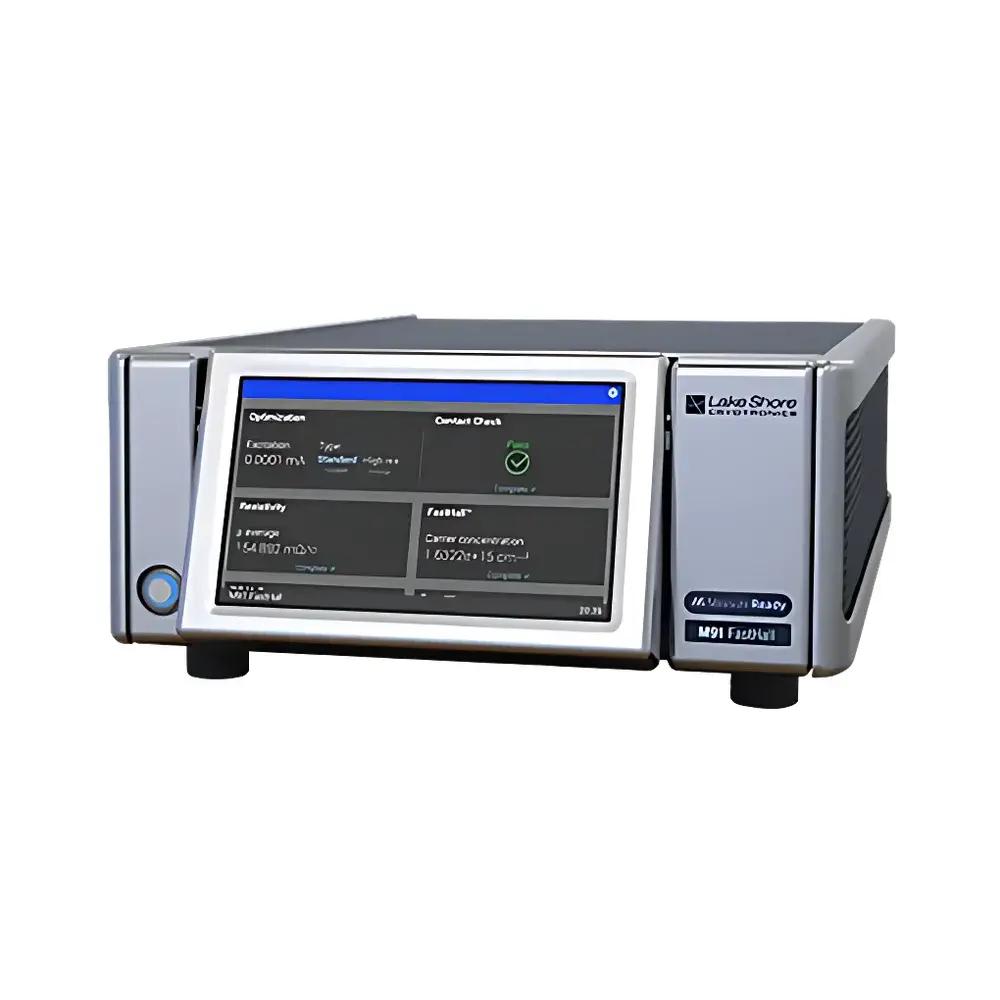
Lake Shore M91 FastHall Hall Effect Analyzer
| Brand | Lake Shore |
|---|---|
| Origin | USA |
| Model | M91 |
| Measurement Principle | FastHall™ (patented single-direction magnetic field Hall effect analysis) |
| Compliance | ASTM F76, ISO/IEC 17025-compatible operation |
| Software Interface | LakeSHORE HallScan™ v3.2 with 21 CFR Part 11 audit trail support |
| Standard Resistance Range | 10 mΩ to 10 MΩ |
| Extended Range (with M9-ADD-HR option) | 10 mΩ to 200 GΩ |
| Carrier Mobility Range | 0.001–1×10⁶ cm²/(V·s) |
| Sample Configurations | Van der Pauw, Hall bar, cloverleaf |
| Magnetic Field Compatibility | DC fields up to ±16 T (superconducting magnet-ready) |
| Thermal Drift Mitigation | Sub-50 ms measurement window, active thermal compensation algorithm |
| Data Output Format | CSV, HDF5, XML |
Overview
The Lake Shore M91 FastHall Hall Effect Analyzer is a fully integrated, benchtop semiconductor characterization instrument engineered for precision DC Hall effect and resistivity measurements under static magnetic fields. Unlike conventional Hall systems that rely on magnetic field reversal or AC excitation—introducing thermal drift, alignment sensitivity, and extended acquisition times—the M91 implements Lake Shore’s patented FastHall™ technology (U.S. Patents 9,797,965 and 10,073,151). This method enables accurate, single-polarity magnetic field operation by decoupling Hall voltage extraction from field polarity switching, thereby eliminating systematic errors caused by magnet alignment uncertainty, hysteresis in superconducting coils, and thermoelectric drift during long dwell periods. The M91 is optimized for use with high-field cryogenic platforms—including Quantum Design PPMS® and DynaCool® systems—and supports seamless integration via IEEE-488 (GPIB), USB 2.0, and Ethernet interfaces. Its sub-50 millisecond measurement window significantly suppresses thermal drift artifacts, making it uniquely suited for low-mobility materials such as organic semiconductors, thermoelectrics, perovskites, and amorphous oxides where traditional Hall methods fail or yield non-reproducible results.
Key Features
- Patented FastHall™ measurement architecture—no magnetic field reversal required, enabling stable operation with superconducting magnets and minimizing mechanical stress on sample stages
- Integrated hardware-software co-design: excitation current sourcing, low-noise voltage measurement, auto-ranging resistance detection, and real-time Hall coefficient calculation all housed within a single 19-inch rack-mountable chassis
- Extended resistivity coverage: standard 10 mΩ to 10 MΩ range; expandable to 200 GΩ using the optional M9-ADD-HR high-resistance module with guarded triaxial input topology
- Carrier mobility measurement capability down to 0.001 cm²/(V·s), validated against NIST-traceable reference standards across temperature ranges from 1.8 K to 450 K
- Automated Van der Pauw and Hall bar configuration recognition with configurable contact sequencing and polarity verification
- Real-time thermal drift correction via internal reference junction monitoring and adaptive baseline subtraction
Sample Compatibility & Compliance
The M91 supports standard semiconductor metrology geometries including Van der Pauw squares, Hall bars, and cloverleaf patterns on substrates ranging from silicon wafers to flexible polymer films. It complies with ASTM F76–22 (“Standard Test Methods for Measuring Resistivity and Hall Coefficient of Semiconductor Materials”) and aligns with ISO/IEC 17025 requirements for test method validation. When operated in GLP/GMP environments, HallScan™ software provides full 21 CFR Part 11 compliance—including electronic signatures, role-based access control, and immutable audit trails for all measurement parameters, calibration events, and data exports. All firmware and driver packages undergo annual cybersecurity review per IEC 62443-4-2 guidelines.
Software & Data Management
HallScan™ v3.2 is the native control and analysis suite for the M91, offering scriptable measurement sequences, multi-parameter fitting (e.g., two-carrier models), and batch processing for temperature- or field-swept datasets. Raw data are stored in HDF5 format with embedded metadata (sample ID, operator, timestamp, magnetic field value, temperature, excitation settings), ensuring FAIR (Findable, Accessible, Interoperable, Reusable) data principles. Export options include CSV (for Excel and Python pandas ingestion), XML (for LIMS integration), and direct MATLAB® .mat file generation. Remote operation is supported via secure SSH tunneling and RESTful API endpoints for lab automation frameworks.
Applications
- Characterization of emerging photovoltaic absorbers (e.g., CIGS, perovskites) where carrier lifetimes and defect densities necessitate rapid, low-drift Hall assessment
- Thermoelectric material development requiring precise n/p-type identification and mobility quantification at elevated temperatures
- Quality control of doped silicon carbide (SiC) and gallium nitride (GaN) power devices under high-field conditions
- Organic thin-film transistor (OTFT) research, particularly for solution-processed polymers exhibiting mobilities below 0.1 cm²/(V·s)
- In situ studies inside variable-temperature insert (VTI) and dilution refrigerator platforms where field reversal is mechanically constrained
FAQ
Does the M91 require magnetic field reversal to compute Hall coefficient?
No. FastHall™ uses a proprietary multi-current pulse sequence combined with phase-sensitive demodulation to extract Hall voltage polarity without field inversion.
Can the M91 be used with non-Lake Shore cryostats or magnet systems?
Yes. It interfaces with any DC magnet system via analog field input (0–10 V) and supports external temperature sensor inputs (PT100, diode, Cernox™) for synchronized parameter logging.
Is calibration traceable to national standards?
Yes. Factory calibration includes NIST-traceable resistance standards and certified Hall reference samples; user-accessible calibration routines support periodic verification.
What level of technical support is provided for integration into existing PPMS workflows?
Lake Shore offers application engineering support packages—including custom LabVIEW™ drivers, Python SDK documentation, and on-site system commissioning—for PPMS-integrated deployments.
How does FastHall™ mitigate thermoelectric offset errors?
By limiting total measurement time per data point to <50 ms and employing differential voltage sensing with matched thermal paths, the M91 reduces Seebeck-induced offsets to <10 nV—well below typical Hall signal magnitudes in low-mobility regimes.





