
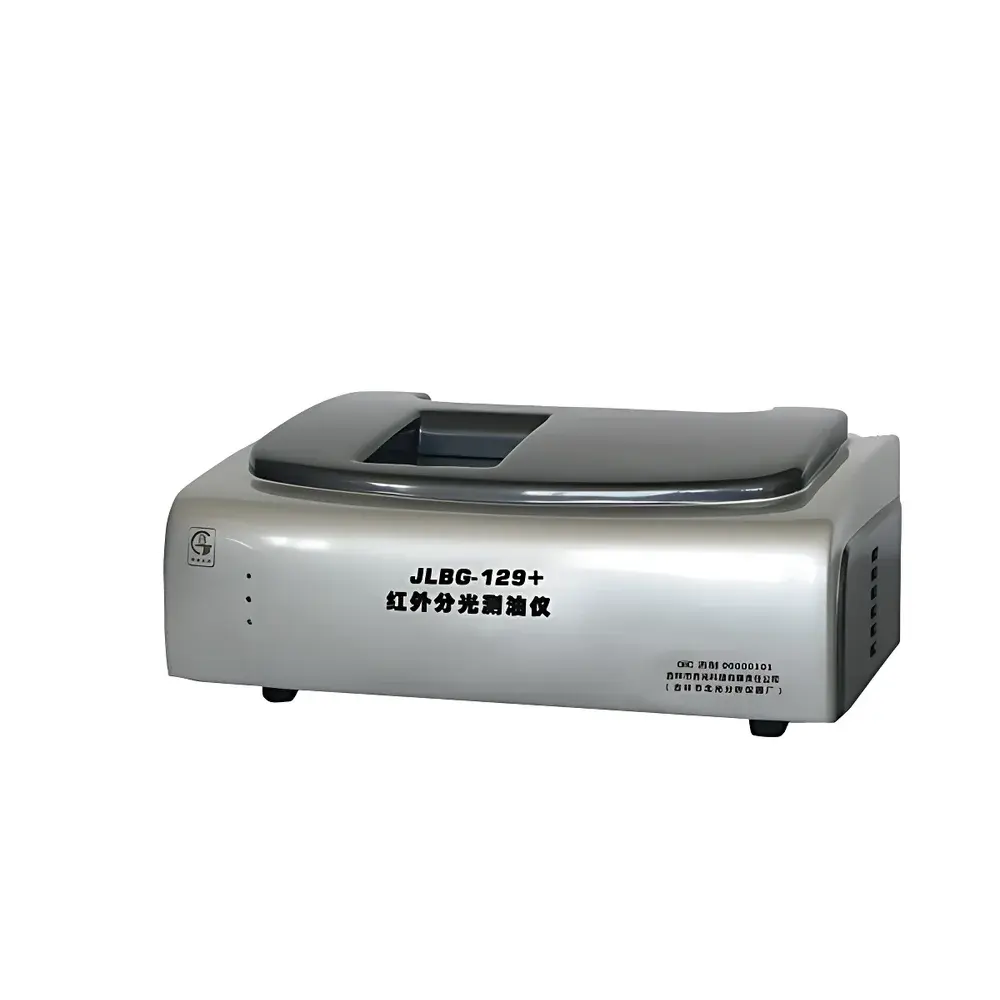
Beiguang JLBG-129+ Infrared Spectrophotometric Oil Content Analyzer
| Brand | Beiguang |
|---|---|
| Origin | Jilin, China |
| Model | JLBG-129+ |
| Instrument Type | Laboratory |
| Measurement Principle | Infrared Spectrophotometry |
| Measurement Range | 0 mg/L – 100% oil (w/w or v/v, matrix-dependent) |
| Detection Limit | 0.1 mg/L (as petroleum hydrocarbons in water) |
| Accuracy | ±10% (relative error vs. certified reference materials) |
| Resolution | 0.1 ppm (absorbance-based quantification) |
| Measurement Cycle Time | 75 seconds per sample |
| Solvent Compatibility | Tetrachloroethylene (TCE) or Carbon Tetrachloride (CTC) — CTC use discouraged per Montreal Protocol and updated Chinese environmental standards (e.g., HJ 637–2012 revision) |
Overview
The Beiguang JLBG-129+ Infrared Spectrophotometric Oil Content Analyzer is a laboratory-grade instrument engineered for precise, regulatory-compliant quantification of total petroleum hydrocarbons (TPH) and selected aromatic compounds in aqueous environmental matrices. It operates on the fundamental principle of mid-infrared (MIR) absorption spectroscopy, specifically targeting the C–H stretching vibrational bands at wavenumbers 2930 cm⁻¹ (aliphatic CH₂), 2960 cm⁻¹ (aliphatic CH₃), and 3030 cm⁻¹ (aromatic C–H), as defined in the Chinese national standard HJ 637–2012. Unlike non-dispersive infrared (NDIR) instruments—which measure only discrete fixed wavelengths—the JLBG-129+ performs full-spectrum scanning across 4000–400 cm⁻¹, enabling spectral verification of analyte identity, interference assessment, and method transparency. This capability is critical for distinguishing true petroleum hydrocarbons from confounding organic interferences (e.g., alcohols, ketones, amines) that absorb near 3030 cm⁻¹ but lack the characteristic aliphatic triplet pattern.
Key Features
- Regulatory-Aligned Dual-Solvent Operation: Supports both tetrachloroethylene (TCE) and carbon tetrachloride (CTC) as extraction solvents—though TCE is strongly recommended to comply with the Montreal Protocol and revised HJ 637 implementation guidelines issued by the Ministry of Ecology and Environment (MEE).
- Standard-Compliant Quantitative Algorithm: Implements the exact calculation formula mandated by HJ 637–2012 Section 9.1: ρ = X·A2930 + Y·A2960 + Z·(A3030 − A3030/F), eliminating reliance on empirical calibration curves—a scientifically unsound approach for heterogeneous petroleum mixtures.
- True Full-Spectrum IR Acquisition: Equipped with a high-stability Czerny–Turner monochromator featuring precision worm-gear drive mechanics, ensuring wavelength reproducibility <±0.2 cm⁻¹ and long-term photometric stability (<0.5% drift over 8 h).
- Verified Instrument Detection Limit: Demonstrates practical detection of 0.4 mg/L petroleum hydrocarbon standard solution under standard extraction conditions (1000 mL sample, 25 mL TCE, 10-mm pathlength cell), satisfying the derived instrument-level sensitivity requirement of HJ 637–2012.
- Aromatic-Specific Validation Capability: Accurately resolves and quantifies aromatic components—including benzene and toluene—at 3030 cm⁻¹, supporting compliance with toxicity-weighted monitoring requirements in petrochemical, steelmaking, and refinery effluent discharge assessments.
Sample Compatibility & Compliance
The JLBG-129+ is validated for use with liquid-phase environmental samples including surface water, groundwater, wastewater, leachate, and industrial process water. It supports solid-phase extraction (SPE) eluates and solvent extracts prepared per HJ 637–2012 protocols. Instrument output meets data integrity expectations for GLP-aligned environmental testing laboratories. While not inherently 21 CFR Part 11 compliant (no embedded electronic signature or audit trail), raw spectral data files (ASCII .csv or proprietary .jlb format) are exportable for integration into validated LIMS environments. The methodology aligns with ISO 9377-2:2000 (petroleum hydrocarbons in water) and serves as a technically equivalent alternative to ASTM D7066–04 where regional regulatory frameworks accept HJ 637–2012–based procedures.
Software & Data Management
The embedded control software provides real-time spectral visualization, peak annotation, baseline correction, and automatic application of the HJ 637–2012 calculation algorithm. All spectra and quantitative results are timestamped and stored with user ID metadata. Raw interferograms and processed absorbance spectra are retained in open-format exports for third-party validation. Software supports batch processing of up to 24 samples with auto-zero referencing between runs. Calibration coefficient sets (X, Y, Z, F) are user-editable but logged with change history; factory-default coefficients are traceable to NIM-certified reference standards.
Applications
- Regulatory compliance monitoring of petroleum hydrocarbons in municipal and industrial wastewater discharges
- Groundwater plume characterization at legacy UST (underground storage tank) sites
- Process water quality control in refineries, petrochemical plants, and metalworking facilities
- Method validation and interlaboratory comparison studies under CNAS accreditation scopes
- Extended analysis of aromatic VOCs (benzene, toluene, xylene, phenol, aniline) using library-matched spectral deconvolution
FAQ
Why does the JLBG-129+ avoid standard curve calibration?
Because petroleum is a chemically heterogeneous mixture; a single calibration curve built from one surrogate standard (e.g., hexadecane/isooctane/benzene) cannot represent variable compositional profiles in real-world samples. HJ 637–2012 explicitly prohibits curve-based correction.
Is carbon tetrachloride still acceptable for routine use?
No—CTC is listed as a Class II controlled substance under the Montreal Protocol. Its phase-out is legally binding in China; TCE is the designated replacement solvent in all updated MEE technical guidance documents.
How is the 0.1 mg/L method detection limit (MDL) related to instrument performance?
The MDL is a sample-level value derived from analytical conditions. Per HJ 637–2012, the required instrument detection limit is calculated as (sample volume / extract volume) × MDL = (1000 mL / 25 mL) × 0.01 mg/L = 0.4 mg/L. The JLBG-129+ is verified to detect this concentration reliably.
Can the instrument distinguish between aliphatic and aromatic hydrocarbons?
Yes—by resolving absorbance contributions at 2930 cm⁻¹ (CH₂), 2960 cm⁻¹ (CH₃), and 3030 cm⁻¹ (aromatic C–H), and applying the standardized weighting factors (X, Y, Z, F), it delivers compositionally informed quantitation aligned with toxicological relevance.
What maintenance is required for long-term spectral accuracy?
Annual verification using NIST-traceable polystyrene film and certified petroleum hydrocarbon standards is recommended. Optical alignment checks and desiccant replacement in the sample compartment should be performed quarterly.
Related Products







