
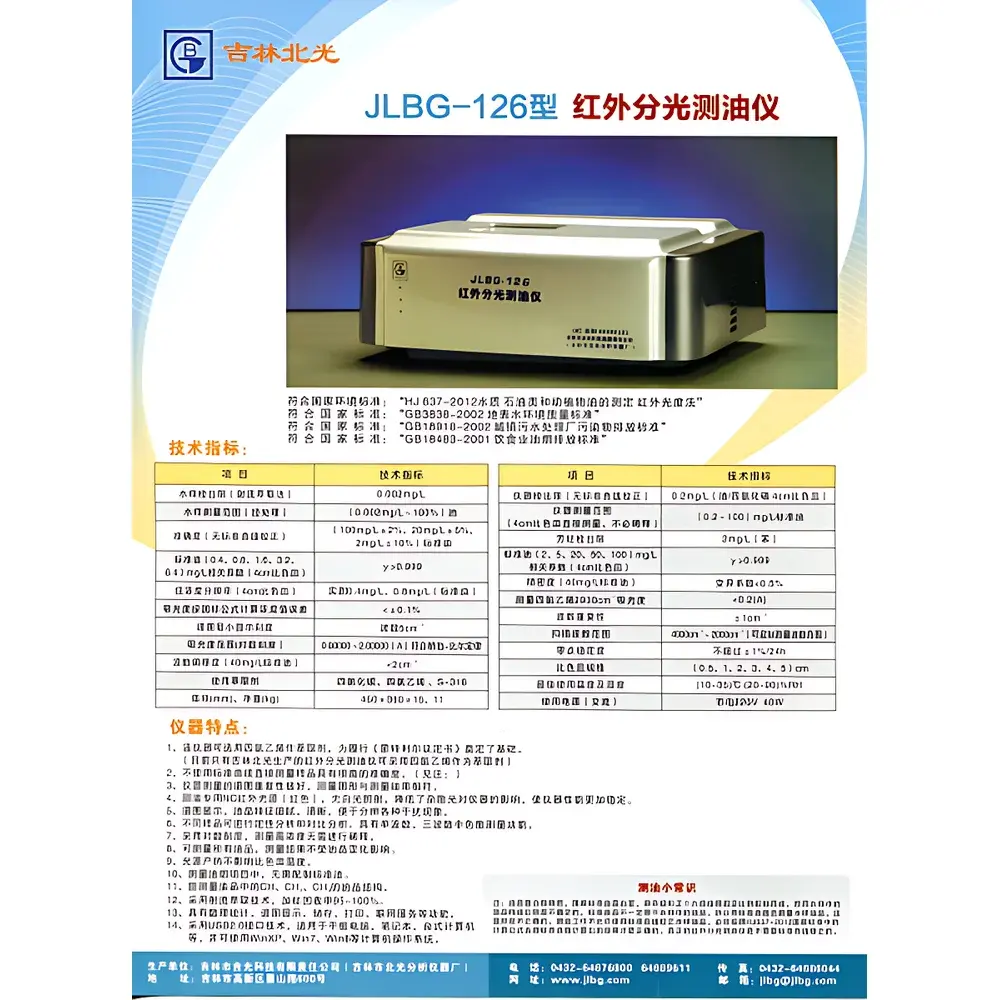
Beiguang JLBG-126 Infrared Oil Content Analyzer
| Brand | Beiguang |
|---|---|
| Origin | Jilin, China |
| Instrument Type | Laboratory Analyzer |
| Measurement Principle | Infrared Spectrophotometry (Dual-Wavelength & Triple-Wavelength Non-Dispersive Modes) |
| Measurement Range | 0.002 mg/L – 100% oil (post-extraction) |
| Detection Limit | 0.002 mg/L (by jet extraction) |
| Accuracy | ±2% at 100 mg/L |
| Resolution | 0.1 ppm (as oil in solvent) |
| Measurement Frequency | 2 measurements/minute |
| Wavenumber Range | 4000–2000 cm⁻¹ (customizable) |
| Wavenumber Repeatability | ±1 cm⁻¹ |
| Absorbance Range (log scale) | 0.00000–2.00000 A |
| Compliance | HJ 637–2012, GB 3838–2002, GB 18918–2002, GB 18483–2001 |
Overview
The Beiguang JLBG-126 Infrared Oil Content Analyzer is a laboratory-grade spectrophotometric instrument engineered for quantitative determination of petroleum hydrocarbons and animal/vegetable oils in aqueous matrices. It operates on the principle of infrared absorption spectroscopy—specifically targeting the asymmetric C–H stretching vibrations near 2930 cm⁻¹, symmetric C–H stretching near 2960 cm⁻¹, and C–H bending near 2870 cm⁻¹—enabling selective quantification per the Chinese national standard HJ 637–2012. Unlike dispersive IR systems relying on grating monochromators, the JLBG-126 employs a proprietary pulsed NC (Near-Infrared Carbon) infrared source coupled with non-dispersive dual- and triple-wavelength detection modes. This architecture eliminates moving optical components, minimizes stray light interference, and ensures long-term photometric stability without thermal drift affecting cuvette temperature. The instrument is calibrated to comply with the Lambert–Beer law across its full absorbance range (0.00000–2.00000 A), supporting direct high-concentration measurement up to 100 mg/L without dilution or range switching.
Key Features
- Proprietary pulsed NC infrared source emitting exclusively in the 2800–3000 cm⁻¹ band—no visible emission, eliminating white-light contamination and enhancing signal-to-noise ratio.
- Non-dispersive measurement capability at single, dual, and triple wavenumbers (e.g., 2930, 2960, 2870 cm⁻¹), enabling matrix-specific correction for interferences from alcohols, ketones, or chlorinated solvents.
- Jet extraction-compatible design validated for >95% spike recovery across diverse water types (surface water, wastewater, leachate, cooking fume condensate).
- Support for environmentally compliant extraction solvents: tetrachloroethylene (C₂Cl₄), carbon tetrachloride (CCl₄), and S-316—fully aligned with Montreal Protocol phase-out requirements for ozone-depleting substances.
- Logarithmic absorbance display with 5 cm⁻¹ spectral resolution, enabling visual discrimination of overlapping peaks and qualitative oil-type comparison (e.g., mineral vs. vegetable oil signatures).
- Thermally isolated optical path: source heat dissipation does not influence cuvette temperature, ensuring reproducible pathlength and refractive index stability during sequential measurements.
- USB 2.0 interface compatible with Windows XP through Windows 10 operating systems; no proprietary drivers required.
Sample Compatibility & Compliance
The JLBG-126 is validated for analysis of total petroleum hydrocarbons (TPH), diesel-range organics (DRO), and edible oil residues in environmental and industrial samples—including municipal wastewater effluent, river and lake water, landfill leachate, and kitchen exhaust condensates. Its performance meets the method validation criteria specified in HJ 637–2012 for precision (CV 0.999 over five-point calibration curves), and wavenumber accuracy (±1 cm⁻¹ repeatability). The instrument supports compliance workflows under GLP and ISO/IEC 17025 frameworks: all absorbance spectra, calculation logs, and user actions are timestamped and stored with immutable metadata. While not FDA 21 CFR Part 11–certified out-of-the-box, audit trails and electronic signature support can be implemented via optional software modules adhering to GMP-aligned data integrity principles.
Software & Data Management
Embedded firmware provides real-time spectrum acquisition, peak identification, and concentration calculation using HJ 637–2012’s standardized absorbance summation algorithm. Data output includes raw interferograms (if equipped with FT option), processed spectra, numerical results (mg/L oil), and statistical summaries (mean, SD, CV%). Spectra and reports are exportable in CSV, BMP, and PDF formats. Local storage retains ≥10,000 measurement records with automatic date/time stamping and operator ID tagging. Network connectivity (via optional Ethernet module) enables centralized data aggregation into LIMS environments. All spectral files contain embedded calibration parameters, solvent ID, cuvette pathlength, and measurement date—ensuring full traceability per ISO 17025 clause 7.7.
Applications
- Regulatory monitoring of petroleum hydrocarbon discharge limits per GB 18918–2002 in municipal wastewater treatment plants.
- Source identification and load assessment in surface water bodies under GB 3838–2002 Class III–V criteria.
- Compliance verification for cooking oil emissions from food service establishments per GB 18483–2001.
- Leachate characterization in landfill environmental impact assessments.
- Method development and inter-laboratory comparison studies requiring high spectral fidelity and low instrumental drift.
FAQ
Does the JLBG-126 require daily recalibration with standard oil solutions?
No—its pulsed NC source and fixed optical geometry enable stable baseline operation for ≥24 hours (zero drift ≤ ±1%/24 h). Full calibration is recommended before each analytical batch or after solvent change.
Can the instrument quantify oil type (e.g., diesel vs. lubricating oil) based on spectral shape?
Yes—the high-fidelity 5 cm⁻¹ resolution and log-scale absorbance display allow visual and comparative spectral analysis. Quantitative differentiation requires reference libraries and multivariate regression, supported via optional chemometric software add-ons.
Is tetrachloroethylene (C₂Cl₄) validated as an extraction solvent for regulatory reporting?
Yes—method validation data per HJ 637–2012 confirm equivalent recovery and precision using C₂Cl₄ versus CCl₄, with documented compliance for Montreal Protocol adherence in official environmental monitoring programs.
What is the minimum detectable concentration when using jet extraction?
0.002 mg/L oil in water—verified using certified reference materials and spike-recovery experiments across three independent laboratories.
How does the instrument handle high-absorbance samples without dilution?
The logarithmic absorbance scale (0.00000–2.00000 A) and optimized detector dynamic range eliminate saturation artifacts, permitting direct measurement of undiluted extracts up to 100 mg/L oil concentration.
Related Products







